 뒤로
Exam III Study Guide: Chemical Composition, Reactions, and Stoichiometry
스터디 가이드 - 스마트 노트
 자료에 맞춘 맞춤형 노트, 핵심 정의, 예시, 맥락을 확장해 제공합니다.
Chemical Composition and Calculations
Mass, Moles, and Particles
Understanding the relationships between mass, moles, and particles is fundamental in chemistry. The mole is a counting unit that allows chemists to relate the mass of a substance to the number of particles it contains.
Mole: One mole contains particles (atoms, molecules, ions, or formula units).
Molar Mass: The mass of one mole of a substance, expressed in grams per mole (g/mol).
Conversions: Use the following relationships:
Mass (g) → Moles:
Moles → Particles:
Percent Composition: The mass percent of each element in a compound is calculated as:
Empirical and Molecular Formulas
The empirical formula represents the simplest whole-number ratio of elements in a compound, while the molecular formula gives the actual number of atoms of each element in a molecule.
Empirical Formula: Determined from percent composition or mass data.
Molecular Formula: Calculated using the empirical formula and molar mass: , where
Example: If a compound has an empirical formula CH and a molar mass of 78 g/mol, then , so the molecular formula is C6H6.
Unit Conversions
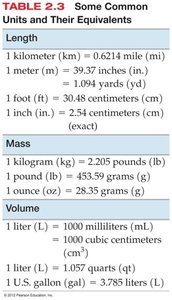
Unit conversions are essential for quantitative chemistry. Common conversions include length, mass, and volume.
Length: 1 meter (m) = 39.37 inches (in), 1 kilometer (km) = 0.6214 mile (mi)
Mass: 1 kilogram (kg) = 2.205 pounds (lb), 1 pound (lb) = 453.59 grams (g)
Volume: 1 liter (L) = 1000 milliliters (mL), 1 U.S. gallon = 3.785 liters (L)
Chemical Reactions and Equations
Balancing Chemical Equations
Balancing chemical equations ensures the conservation of mass and atoms. Each side of the equation must have the same number of atoms for each element.
Steps:
Write the unbalanced equation.
Count atoms of each element on both sides.
Add coefficients to balance atoms.
Check your work.
Example:
Types of Chemical Reactions
Chemical reactions are classified based on the rearrangement of atoms and molecules.
Combination (Synthesis): Two or more substances combine to form one product.
Decomposition: One substance breaks down into two or more products.
Single Replacement: One element replaces another in a compound.
Double Replacement: Two compounds exchange ions to form new compounds.
Combustion: A hydrocarbon reacts with oxygen to produce CO2 and H2O.
Solubility Rules
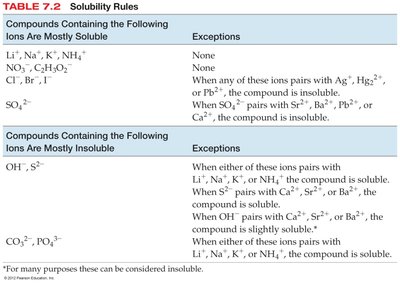
Solubility rules help predict whether an ionic compound will dissolve in water. These rules are essential for identifying precipitation reactions.
Mostly Soluble Ions: Li+, Na+, K+, NH4+, NO3-, C2H3O2-, Cl-, Br-, I-, SO42-
Exceptions: Ag+, Hg22+, Pb2+ (for Cl-, Br-, I-); Sr2+, Ba2+, Pb2+, Ca2+ (for SO42-)
Mostly Insoluble Ions: OH-, S2-, CO32-, PO43-
Exceptions: Li+, Na+, K+, NH4+ (for all); Ca2+, Sr2+, Ba2+ (for S2- and OH-)
Electrolytes and Non-Electrolytes
When substances dissolve in water, they may form ions (electrolytes) or remain as molecules (non-electrolytes).
Electrolytes: Substances that dissociate into ions in water, conducting electricity (e.g., NaCl).
Non-Electrolytes: Substances that dissolve without forming ions (e.g., sugar).
Writing Ionic and Net Ionic Equations
For precipitation and acid/base reactions, it is important to write the complete balanced equation, the complete ionic equation, and the net ionic equation.
Complete Balanced Equation: Shows all reactants and products.
Complete Ionic Equation: Shows all strong electrolytes as ions.
Net Ionic Equation: Shows only the species that change during the reaction.
Strong Acids
There are six strong acids to remember:
HCl, HBr, HI, HNO3, HClO4, H2SO4
Stoichiometry and Reaction Quantities
Stoichiometry Calculations
Stoichiometry involves calculating the quantities of reactants and products in a chemical reaction using balanced equations.
Mass-Mole Relationships: Use the balanced equation to relate moles of reactants and products.
Limiting Reactant: The reactant that is completely consumed first, limiting the amount of product formed.
Theoretical Yield: The maximum amount of product that can be formed from the limiting reactant.
Percent Yield:
Enthalpy Calculations: Use enthalpy values to determine the heat absorbed or released in a reaction.
Periodic Table Reference
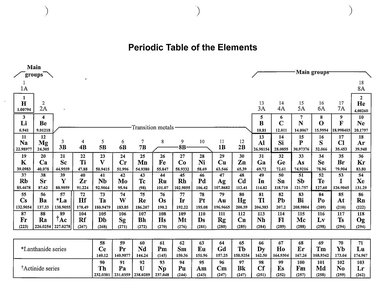
The periodic table is a fundamental tool for identifying elements, their atomic masses, and their properties. It is used for calculating molar masses and understanding chemical behavior.
Solubility Table Reference
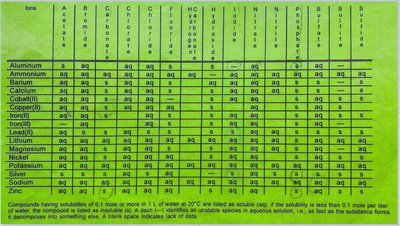
Solubility tables provide detailed information about the solubility of various ionic compounds in water, which is essential for predicting precipitation reactions.
Summary Table: Common Units and Their Equivalents
Quantity | Unit | Equivalent |
|---|---|---|
Length | 1 kilometer (km) | 0.6214 mile (mi) |
Length | 1 meter (m) | 39.37 inches (in) |
Length | 1 foot (ft) | 30.48 centimeters (cm) |
Length | 1 inch (in) | 2.54 centimeters (cm) |
Mass | 1 kilogram (kg) | 2.205 pounds (lb) |
Mass | 1 pound (lb) | 453.59 grams (g) |
Mass | 1 ounce (oz) | 28.35 grams (g) |
Volume | 1 liter (L) | 1000 milliliters (mL) |
Volume | 1 liter (L) | 1000 cubic centimeters (cm3) |
Volume | 1 liter (L) | 1.057 quarts (qt) |
Volume | 1 U.S. gallon | 3.785 liters (L) |
Summary Table: Solubility Rules
Ion | Solubility | Exceptions |
|---|---|---|
Li+, Na+, K+, NH4+ | Mostly Soluble | None |
NO3-, C2H3O2- | Mostly Soluble | None |
Cl-, Br-, I- | Mostly Soluble | Ag+, Hg22+, Pb2+ |
SO42- | Mostly Soluble | Sr2+, Ba2+, Pb2+, Ca2+ |
OH-, S2- | Mostly Insoluble | Li+, Na+, K+, NH4+, Ca2+, Sr2+, Ba2+ |
CO32-, PO43- | Mostly Insoluble | Li+, Na+, K+, NH4+ |
Summary Table: Strong Acids
Acid | Formula |
|---|---|
Hydrochloric acid | HCl |
Hydrobromic acid | HBr |
Hydroiodic acid | HI |
Nitric acid | HNO3 |
Perchloric acid | HClO4 |
Sulfuric acid | H2SO4 |
Additional info: Academic context and examples were added to ensure completeness and clarity for exam preparation.
