 뒤로
The Quantum-Mechanical Model of the Atom: Structure, Light, and Atomic Spectra
스터디 가이드 - 스마트 노트
 자료에 맞춘 맞춤형 노트, 핵심 정의, 예시, 맥락을 확장해 제공합니다.
The Quantum-Mechanical Model of the Atom
Introduction to Quantum Mechanics
The quantum-mechanical model explains the behavior of electrons in atoms, which is fundamentally different from the behavior of macroscopic objects. This model is essential for understanding atomic structure, chemical bonding, and the periodic trends of elements.
Key Scientists: Albert Einstein, Niels Bohr, Louis de Broglie, Max Planck, Werner Heisenberg, P. A. M. Dirac, Erwin Schrödinger.
Subatomic Particles: Electrons, protons, and neutrons are the fundamental particles of atoms.
Wave–Particle Duality: Electrons and light exhibit both wave-like and particle-like properties depending on experimental conditions.
The Nature of Light
Wave Properties of Light
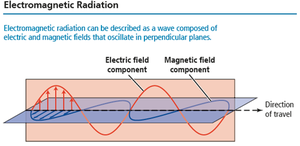
Light is a form of electromagnetic radiation, consisting of oscillating electric and magnetic fields that propagate through space at the speed of light.
Electric Field: Region where an electrically charged particle experiences a force.
Magnetic Field: Region where a magnetized particle experiences a force.
Speed of Light (c): m/s in a vacuum.
Characteristics of Energy Waves
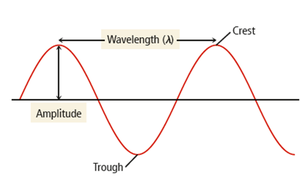
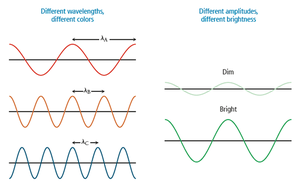
Amplitude: The height of the wave, related to the intensity (brightness) of light.
Wavelength (\(\lambda\)): The distance between successive crests or troughs, determines the color of light.
Frequency (\(\nu\)): The number of wave cycles passing a point per second, measured in hertz (Hz).
Wavelength and amplitude are independent properties. Wavelength determines color, while amplitude determines brightness.
Color and the Electromagnetic Spectrum
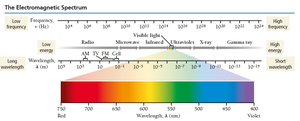
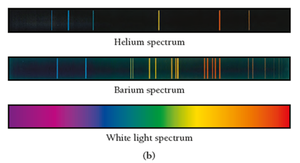
The color of visible light is determined by its wavelength or frequency. White light contains all visible wavelengths, which can be separated into a spectrum using a prism.

Visible Spectrum: Ranges from approximately 400 nm (violet) to 700 nm (red).
Electromagnetic Spectrum: Includes radio waves, microwaves, infrared, visible light, ultraviolet, X-rays, and gamma rays.
Energy Relationship: Shorter wavelength (higher frequency) light has higher energy.
Wave Behavior: Interference and Diffraction
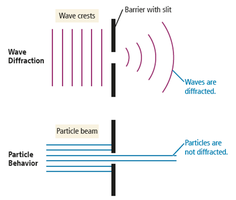
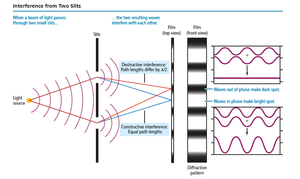
Waves can interact through interference and can bend around obstacles through diffraction. These properties are key to understanding the behavior of light and electrons.
Constructive Interference: Waves in phase add to make a larger wave.
Destructive Interference: Waves out of phase cancel each other.
Diffraction: Bending of waves around obstacles or slits, producing characteristic patterns.
Quantization of Energy and the Photoelectric Effect
Quantum Theory and Photons
Energy is quantized, meaning it can only exist in discrete amounts called quanta. A photon is a quantum of electromagnetic radiation.
Planck's Constant (h): J·s
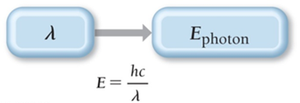
Photon Energy Equations:
The Photoelectric Effect
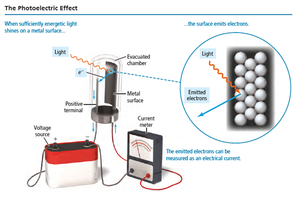
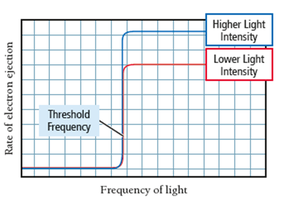
When light of sufficient frequency strikes a metal surface, electrons are emitted. This phenomenon, explained by Einstein, demonstrates the particle nature of light.
Threshold Frequency: Minimum frequency required to eject electrons from a metal surface.
Photon Energy: If the photon energy exceeds the binding energy, electrons are emitted with kinetic energy equal to the excess energy.
Atomic Spectra and the Bohr Model
Atomic Emission and Absorption Spectra
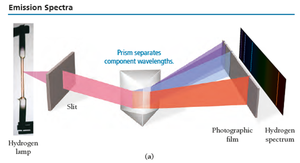
Atoms emit or absorb light at specific wavelengths, producing line spectra unique to each element. These spectra arise from electron transitions between quantized energy levels.
Emission Spectrum: Light emitted from excited atoms, seen as bright lines.
Absorption Spectrum: Dark lines where specific wavelengths are absorbed by atoms.




The Bohr Model of the Atom
The Bohr model describes electrons as moving in fixed orbits around the nucleus, with quantized energies. Electron transitions between orbits explain the observed line spectra.
Quantized Orbits: Electrons can only occupy certain energy levels.
Photon Emission: When an electron falls to a lower energy level, a photon is emitted with energy equal to the difference between the levels.
Wave-Particle Duality and Quantum Numbers
Wave Properties of Electrons
Electrons exhibit both wave and particle properties. The de Broglie hypothesis states that all matter has a wavelength inversely proportional to its mass and velocity.
Heisenberg's Uncertainty Principle
It is impossible to simultaneously know both the exact position and momentum (velocity) of an electron. This principle limits our ability to predict electron paths and leads to the concept of probability distributions for electron locations.
Quantum Mechanical Model and Quantum Numbers
The quantum mechanical model uses wave functions (\(\psi\)) to describe the probability of finding an electron in a given region. Each electron in an atom is described by a unique set of quantum numbers:
Principal Quantum Number (n): Energy level (shell), n = 1, 2, 3, ...
Angular Momentum Quantum Number (l): Orbital shape (subshell), l = 0 to n-1
Magnetic Quantum Number (ml): Orbital orientation, ml = -l to +l
Spin Quantum Number (ms): Electron spin, ms = +1/2 or -1/2
Summary Table: Quantum Numbers and Their Meaning
Quantum Number | Symbol | Allowed Values | Physical Meaning |
|---|---|---|---|
Principal | n | 1, 2, 3, ... | Energy level (shell) |
Angular Momentum | l | 0 to n-1 | Orbital shape (subshell) |
Magnetic | ml | -l to +l | Orbital orientation |
Spin | ms | +1/2, -1/2 | Electron spin direction |
Conclusion
The quantum-mechanical model provides a comprehensive framework for understanding atomic structure, electron behavior, and the origins of atomic spectra. This model is foundational for all further study in chemistry and explains many periodic trends and chemical properties.
