 뒤로
뒤로Aggregate Expenditure and Equilibrium Output: Core Concepts in Macroeconomic Theory
스터디 가이드 - 스마트 노트
 자료에 맞춘 맞춤형 노트, 핵심 정의, 예시, 맥락을 확장해 제공합니다.
Aggregate Expenditure and Equilibrium Output
Introduction to the Core of Macroeconomic Theory
The core of macroeconomic theory examines how the level of GDP, the overall price level, and the level of employment are determined by the interaction of three key markets: the goods-and-services market, the financial (money) market, and the labor market. This section focuses on the goods-and-services market, specifically the determination of aggregate expenditure and equilibrium output.
The Keynesian Theory of Consumption
Consumption Function and Its Determinants
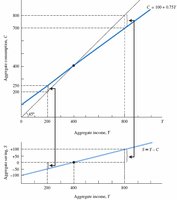
The Keynesian theory of consumption posits that current income is the primary determinant of consumption levels in the economy. The consumption function describes the relationship between consumption and income, typically represented as a straight line for simplicity:
Marginal Propensity to Consume (MPC): The fraction of a change in income that is consumed or spent.
Marginal Propensity to Save (MPS): The fraction of a change in income that is saved.
Aggregate Saving (S): The part of aggregate income that is not consumed.
Identity: An equation that is always true by definition, such as the equality between aggregate output and aggregate income.
The consumption function can be written as:
where is consumption, is autonomous consumption, is the MPC, and is income.
Example: If , then for every 100 increase in income, consumption rises by 75. The slope of the line (0.75) is the MPC.
Other Determinants of Consumption
Besides current income, household consumption decisions are influenced by:
Wealth: Higher wealth generally increases consumption.
Interest Rate: Higher interest rates may encourage saving and reduce consumption.
Expectations of the Future: Optimism or pessimism about future income can affect current consumption.
Behavioral economics highlights psychological biases in saving behavior, such as the impact of default options in retirement plans.

Planned Investment versus Actual Investment
Definitions and Distinctions
Inventory: The stock of goods a firm has awaiting sale.
Planned Investment (I): Additions to capital stock and inventory that are planned by firms.
Actual Investment: The actual amount of investment, including unplanned changes in inventories.
If a firm overestimates sales, it ends up with more inventory than planned, resulting in actual investment exceeding planned investment.
Planned Investment and the Interest Rate
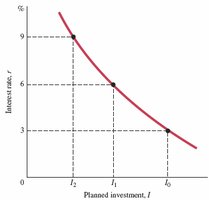
Planned investment is negatively related to the interest rate. As the interest rate rises, the cost of borrowing increases, reducing planned investment. Conversely, lower interest rates encourage more investment projects.
Other Determinants of Planned Investment
Expectations about future sales and the overall economic outlook ("animal spirits") also play a significant role in investment decisions.
The Determination of Equilibrium Output (Income)
Equilibrium in the Goods Market
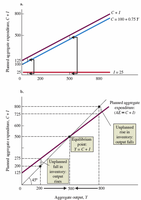
Equilibrium occurs when there is no tendency for change. In the macroeconomic goods market, equilibrium is achieved when planned aggregate expenditure (AE) equals aggregate output (Y):
At equilibrium:
If aggregate output exceeds planned expenditure, inventories rise and firms reduce output. If planned expenditure exceeds output, inventories fall and firms increase output.
The Saving/Investment Approach to Equilibrium
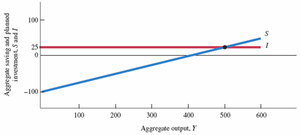
Equilibrium can also be analyzed by equating saving and planned investment:
This approach emphasizes that equilibrium output is achieved only when planned investment equals saving.
Adjustment to Equilibrium
If planned spending is greater than output, firms increase production, raising output toward equilibrium. If planned spending is less than output, firms cut production, lowering output toward equilibrium.
The Multiplier
Definition and Process
The multiplier is the ratio of the change in equilibrium output to a change in an exogenous variable (such as investment):
The multiplier process means that an initial change in spending leads to a larger change in equilibrium output due to induced increases in consumption.
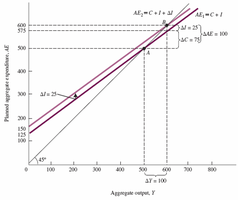
The Multiplier Equation
Algebraically, the multiplier can be derived as follows:
where is the change in equilibrium output and is the change in investment.
The Paradox of Thrift
The paradox of thrift describes a situation where increased saving by households leads to a decrease in equilibrium output and income, with no overall change in saving in the aggregate. This occurs because reduced consumption lowers income, which in turn reduces saving back to its original level.
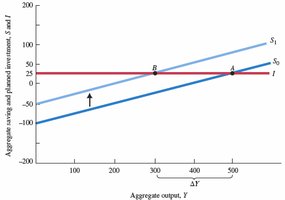
The Size of the Multiplier in the Real World
In practice, the multiplier is smaller than the simple model predicts due to factors such as:
Income-dependent taxes
Monetary policy responses
Price level changes
Imports
Empirical estimates suggest the multiplier is about 2 in real economies.
Key Terms and Equations
Actual investment
Aggregate income
Aggregate output
Aggregate saving (S)
Consumption function
Equilibrium
Exogenous variable
Identity
Marginal propensity to consume (MPC)
Marginal propensity to save (MPS)
Multiplier
Planned aggregate expenditure (AE)
Planned investment (I)
Key Equations:
(at equilibrium)
