 뒤로
뒤로Chapter 24: The Government and Fiscal Policy – Macroeconomics Study Notes
스터디 가이드 - 스마트 노트
 자료에 맞춘 맞춤형 노트, 핵심 정의, 예시, 맥락을 확장해 제공합니다.
The Government and Fiscal Policy
Introduction to Fiscal Policy
Fiscal policy refers to the government's use of spending and taxation to influence the overall economy. Alongside monetary policy, it is a primary tool for macroeconomic management. Fiscal policy can be used to stabilize economic fluctuations, promote growth, and achieve other macroeconomic objectives.
Fiscal policy: The government’s spending and taxing policies.
Monetary policy: The behavior of the Federal Reserve concerning the nation’s money supply.
Government in the Economy
Discretionary and Automatic Fiscal Policy
Government spending and taxation can change in response to economic conditions. These changes can be either discretionary or automatic:
Discretionary fiscal policy: Deliberate changes in government spending or taxes to influence the economy.
Automatic stabilizers: Revenue and expenditure items that automatically change with the state of the economy to stabilize GDP.
Automatic destabilizers: Items that automatically change in a way that destabilizes GDP.
Government Purchases, Net Taxes, and Disposable Income
Key Definitions and Circular Flow
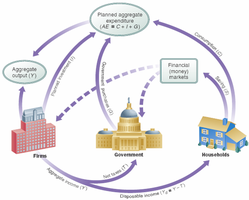
Government activity affects the circular flow of income through purchases, taxes, and transfers. Understanding these flows is essential for analyzing fiscal policy impacts.
Net taxes (T): Taxes paid by firms and households minus transfer payments to households.
Disposable income (Yd): Total income minus net taxes: .
Budget deficit: The difference between government spending and tax collections: .
Adding Taxes to the Consumption Function
Consumption depends on disposable income rather than total income. The aggregate consumption function is modified to reflect this:
Original:
With taxes:
Where a is autonomous consumption and b is the marginal propensity to consume (MPC).
Government Influence on Investment
The government can affect investment through tax policies, such as depreciation allowances and investment tax credits. Planned investment also depends on the interest rate.
The Determination of Equilibrium Output (Income)
Aggregate Expenditure and Equilibrium
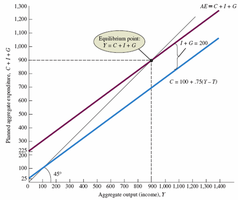
Equilibrium output occurs where total spending equals total output. With government, the aggregate expenditure (AE) function includes government purchases:
Equilibrium:
Saving/Investment Approach
In equilibrium, planned saving equals planned investment plus the government budget balance.
Fiscal Policy at Work: Multiplier Effects
Fiscal Multipliers
Fiscal multipliers measure the effect of changes in government spending or taxes on equilibrium output. The three main multipliers are:
Government spending multiplier: The ratio of change in output to a change in government spending.
Tax multiplier: The ratio of change in output to a change in taxes.
Balanced-budget multiplier: The effect on output when government spending and taxes change by the same amount.
The Government Spending Multiplier
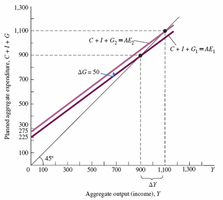
An increase in government spending shifts the AE function upward, leading to a multiplied increase in equilibrium output.
Formula:
The Tax Multiplier
Formula:
The tax multiplier is negative because an increase in taxes reduces disposable income and thus consumption.
The Balanced-Budget Multiplier
The balanced-budget multiplier shows that increasing government spending and taxes by the same amount increases output by that amount.
Formula:
Additional info: This result holds because the government spending multiplier is always one greater in absolute value than the tax multiplier.
The Federal Budget
Federal Budget Structure and Trends
The federal budget is a statement of the government’s receipts and expenditures. Fiscal policy operates through changes in the budget.
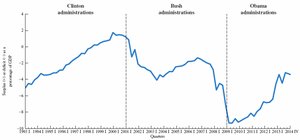
Federal surplus (+) or deficit (−): Receipts minus expenditures.
In 2014, receipts were $3,300.8 billion and expenditures were $3,883.1 billion.
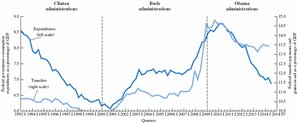
Trends in Federal Budget Components
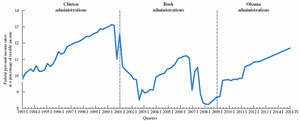
Federal budget components and their shares of GDP have changed over time, reflecting policy and economic conditions.
Federal Debt
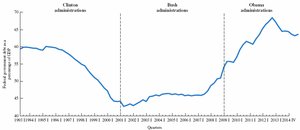
The federal debt is the total amount owed by the government. It can be measured as a percentage of GDP and separated into privately held and government-held portions.
Federal debt: Total amount owed by the federal government.
Privately held federal debt: Debt held by non-government entities.
The Economy’s Influence on the Government Budget
Automatic Stabilizers and Destabilizers
Some budget items automatically change with the economy, helping to stabilize or destabilize GDP.
Automatic stabilizers: Items like unemployment insurance and progressive taxes that dampen economic fluctuations.
Automatic destabilizers: Items that amplify economic fluctuations.
Fiscal drag: The negative effect when average tax rates rise as incomes increase during expansions.
Full-Employment Budget, Structural and Cyclical Deficits
The full-employment budget estimates what the budget would be if the economy were at full employment. Deficits can be structural (existing even at full employment) or cyclical (resulting from economic downturns).
Full-employment budget: The hypothetical budget at full employment.
Structural deficit: The deficit at full employment.
Cyclical deficit: The deficit due to the business cycle.
Appendix A: Deriving the Fiscal Policy Multipliers
Government Spending and Tax Multipliers (Algebraic Derivation)
Using the consumption function and the equilibrium condition , we can derive the multipliers:
Government spending multiplier:
Tax multiplier:
For a balanced-budget change (), the multiplier is 1.
Appendix B: Taxes That Depend on Income
Income-Dependent Taxes and the Multiplier
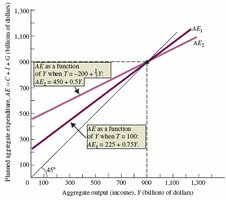
When taxes depend on income, the multiplier effect is reduced. The tax function can be written as:
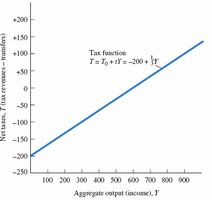
With income-dependent taxes, the aggregate expenditure function is flatter, and the multiplier is smaller than with lump-sum taxes.
Key Terms and Concepts
Automatic stabilizers
Automatic destabilizers
Balanced-budget multiplier
Budget deficit
Cyclical deficit
Discretionary fiscal policy
Disposable income (Yd)
Federal budget
Federal debt
Federal surplus/deficit
Fiscal drag
Fiscal policy
Full-employment budget
Government spending multiplier
Monetary policy
Net taxes (T)
Privately held federal debt
Structural deficit
Tax multiplier
