 뒤로
뒤로Economic Growth and the Business Cycle: Concepts, Measures, and Applications
스터디 가이드 - 스마트 노트
 자료에 맞춘 맞춤형 노트, 핵심 정의, 예시, 맥락을 확장해 제공합니다.
Growth and Business Cycle
Introduction to Economic Growth
Economic growth is a central concept in macroeconomics, referring to the increase in the amount of goods and services produced by an economy over time. It is a long-run process that reflects an economy’s rising ability to produce output, thereby improving living standards.
Economic growth: The sustained increase in real output (goods and services) produced by an economy.
Measured by changes in real GDP (Gross Domestic Product) and real GDP per capita.
Growth is essential for improving living standards and reducing poverty.
Real GDP per Capita
Real GDP per capita is a key indicator of average economic well-being, calculated by dividing real GDP by the population. It allows for comparisons of living standards across countries and over time.
Formula:
Adjusts for inflation and population size, providing a more accurate measure of economic prosperity.
Calculating Growth Rates
The growth rate of real GDP per capita measures how quickly average income is rising. It is calculated as the percentage change from one period to the next.
Formula:
Example: If real GDP per capita increases from \frac{66,814 - 65,478}{65,478} \times 100\% = 2.04\%$.
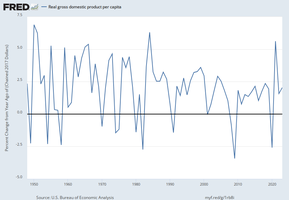
U.S. Real GDP per Capita: Annual Growth Rate
The annual growth rate of U.S. real GDP per capita fluctuates due to various economic factors, including recessions and expansions. The graph below illustrates these fluctuations over time, highlighting periods of rapid growth and contraction.
Importance of Economic Growth
Economic growth is crucial for raising living standards, reducing poverty, and providing resources for public goods and services. Sustained growth enables economies to invest in education, healthcare, and infrastructure.
Higher growth rates lead to faster improvements in average income and quality of life.
Growth is necessary for long-term economic development and stability.
Determinants of Economic Growth
Several factors contribute to economic growth, with labor productivity being the most important. The main sources of growth include:
Investment in physical capital and human capital: Physical capital refers to machinery, infrastructure, and technology; human capital refers to the skills and knowledge of workers.
Technological progress: Innovations and improvements in production methods increase productivity.
Institutions: Effective rules, policies, and customs (such as property rights, political stability, and competitive markets) facilitate growth.
Technological Progress
Technological progress drives economic growth by enabling the production of new goods and services and improving the quality of existing ones. It increases labor productivity and underpins long-term improvements in living standards.
Examples: The development of generative artificial intelligence (e.g., ChatGPT) and advancements in mobile phone technology.
Rule of 70
The Rule of 70 is a simple way to estimate how long it takes for a variable (such as real GDP per capita) to double, given a constant annual growth rate.
Formula:
Example: At a 2% growth rate, output per capita doubles in years.
Business Cycle Concepts
The business cycle refers to periodic fluctuations in economic activity, as measured by changes in real GDP and employment. Key phases include expansions, peaks, recessions (contractions), troughs, and recoveries.
Recession: A significant decline in economic activity lasting more than a few months, spread across the economy.
Depression: A prolonged and severe recession (e.g., the Great Depression).
Expansion: A period of increasing economic activity and rising output.
Actual versus Potential Output
Potential output is the maximum sustainable output an economy can produce when all resources are fully employed. Actual output may fall below potential during recessions or exceed it during booms.
Potential output highlights the long-term trend in economic growth.
Full employment does not mean zero unemployment, but rather the lowest sustainable rate of unemployment.
Growth and the Production Possibilities Frontier (PPF)
The Production Possibilities Frontier (PPF) illustrates the maximum combinations of goods and services an economy can produce. Economic growth shifts the PPF outward, indicating an increase in productive capacity.
Growth allows for more production of both consumer and investment goods.
Operating on the PPF means the economy is using resources efficiently.
Institutions and Growth
Strong institutions are essential for sustained economic growth. They provide the framework for economic activity and investment.
Protected property rights, political stability, competitive markets, price stability, free trade, open capital markets, and low tax rates all contribute to growth.
"Recession" versus "Slump"
It is important to distinguish between a recession and a slump. A recession is a period of declining economic activity, while a slump refers to an extended period of low resource utilization, often following a recession.
A slump lasts from when employment falls below normal during a contraction to when it returns to normal during an expansion.
Non-economists often use "recession" when they mean "slump."
