 뒤로
뒤로Economic Growth: Concepts, Measurement, and Sources
스터디 가이드 - 스마트 노트
 자료에 맞춘 맞춤형 노트, 핵심 정의, 예시, 맥락을 확장해 제공합니다.
Economic Growth
Introduction to Economic Growth
Economic growth refers to the sustained increase in a country’s output of goods and services, typically measured as the growth rate of real Gross Domestic Product (GDP) or real GDP per capita. Understanding economic growth is crucial for analyzing improvements in living standards and the expansion of production possibilities over time.
Measuring Economic Growth
Growth Rate of Real GDP: The percentage change in real GDP from one period to another, reflecting the economy’s overall expansion.
Potential GDP: The level of GDP attained when all resources are fully employed; its growth rate smooths out short-term business cycle fluctuations.
Rule of 70: An approximation for the number of years it takes for a variable to double, calculated as 70 divided by the annual growth rate (in percent).
Long-Term Trends: Even moderate growth rates, when sustained, can dramatically increase income over time. For example, a 2% annual growth rate increases income more than sevenfold over a century.
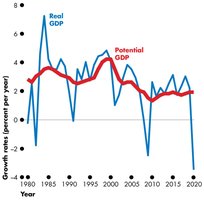
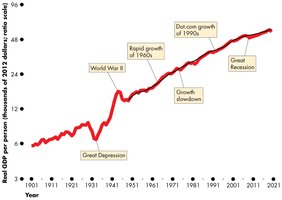
Comparing Growth: US and International Perspectives
Growth rates and income levels vary significantly across countries. Advanced economies like the US, Canada, Japan, and major European countries have experienced steady growth, while emerging markets show more variability.
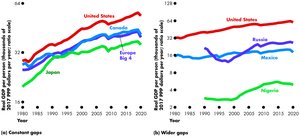
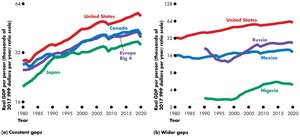
Theories and Models of Economic Growth
The Cobb-Douglas Production Function
The Cobb-Douglas production function models how output (Y) is produced using capital (K) and labor (N):
A: Total Factor Productivity (TFP), capturing technology and efficiency.
\alpha: Capital share parameter (0 < \alpha < 1).
Constant Returns to Scale: If both K and N increase by x%, Y increases by x%.
Diminishing Marginal Returns: Increasing one input while holding the other constant yields smaller and smaller output gains.
Diminishing Marginal Returns
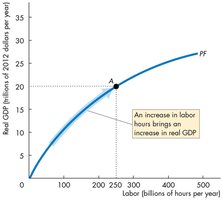
As more labor is added (holding capital constant), each additional worker contributes less to output than the previous one. This is illustrated by the concave shape of the production function.
The Labor Market and Economic Growth
Labor Market Equilibrium
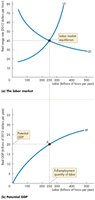
The amount of labor used in production is determined where labor demand equals labor supply:
Labor Demand: Downward sloping due to diminishing marginal returns.
Labor Supply: Upward sloping as higher real wages encourage more work.
Sources of Economic Growth
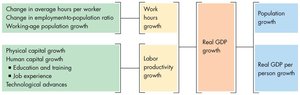
Growth in the Supply of Labor
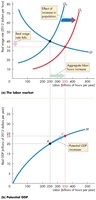
More people working (population growth, higher employment/population ratio).
Individuals working longer hours.
Limits: Time constraints (sleep, leisure), and the employment/population ratio cannot rise indefinitely.
Population growth increases total GDP but not necessarily GDP per capita.
Growth in Labor Productivity
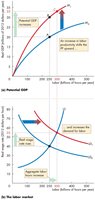
Labor productivity increases when output per worker rises.
Sources: Investment in physical capital, investment in human capital (education, training, experience), and technological innovation.
Higher productivity shifts labor demand rightward, raising real wages and potential GDP.
Investment in Physical Capital
Physical capital (machines, buildings) boosts labor productivity.
When gross investment exceeds depreciation, the capital stock grows, increasing output.
However, diminishing returns mean that capital accumulation alone cannot sustain long-term growth without technological progress.
Investment in Human Capital
Education, training, and experience enhance workers’ skills and knowledge.
Human capital investment raises productivity but also faces diminishing returns.
Technological Change
Technological innovation is a primary driver of long-run growth in GDP per capita.
It raises Total Factor Productivity (TFP), allowing more output from the same inputs.
Since the Industrial Revolution, technological progress has accelerated, fueling sustained economic growth.
The Process of Growth: Summary Diagram
Theories of Economic Growth
Malthusian Theory (Pre-Industrial Revolution)
Thomas Malthus argued that increases in living standards led to population growth, which then reduced per capita income back to subsistence levels—a "poverty trap."
Population growth absorbed economic gains, preventing sustained increases in income per person.
Post-Industrial Revolution: Neoclassical Growth Theory
After the Industrial Revolution, population growth slowed, allowing for sustained increases in income per capita.
Capital accumulation alone cannot drive long-term growth due to diminishing returns (as shown by Solow).
Total Factor Productivity (TFP) is the key to sustained growth.
Capital, Convergence, and TFP
Poor countries should, in theory, grow faster than rich countries due to higher marginal returns to capital (convergence hypothesis).
However, not all poor countries catch up—TFP differences explain much of the variation in growth rates.
Total Factor Productivity (TFP): Determinants and Importance
TFP encompasses technology, efficiency, institutions, and other factors that affect how inputs are transformed into output.
Key determinants include:
Peace and security (war and violence hinder growth)
Good institutions (accountability, transparency, predictable regulation)
Economic freedoms and market incentives
Provision of public goods (infrastructure, education, health, research)
Natural resources (can be a mixed blessing)
TFP is multidimensional and difficult to measure precisely.
Summary Table: Sources of Economic Growth
Source | Effect on Growth |
|---|---|
Population Growth | Increases total GDP, but not necessarily GDP per capita |
Physical Capital Accumulation | Raises productivity, but with diminishing returns |
Human Capital Accumulation | Raises productivity, but also faces diminishing returns |
Technological Change (TFP) | Main driver of long-run growth in GDP per capita |
Institutions & Public Goods | Support innovation, investment, and efficient markets |
