 뒤로
뒤로Economic Growth, the Financial System, and Business Cycles – Study Notes
스터디 가이드 - 스마트 노트
 자료에 맞춘 맞춤형 노트, 핵심 정의, 예시, 맥락을 확장해 제공합니다.
Economic Growth, the Financial System, and Business Cycles
Introduction
This chapter explores the foundations of long-run economic growth, the role of the financial system, and the nature of business cycles. Understanding these concepts is essential for analyzing how economies expand, why recessions occur, and how financial markets facilitate investment and growth.
Long-Run Economic Growth
Definition and Importance
Long-run economic growth refers to the sustained increase in real GDP per capita over time, which raises the average standard of living.
This is distinct from the business cycle, which describes short-term fluctuations between economic expansion and recession.
The most common measure of living standards is real GDP per capita: total production per person, adjusted for changes in the price level.
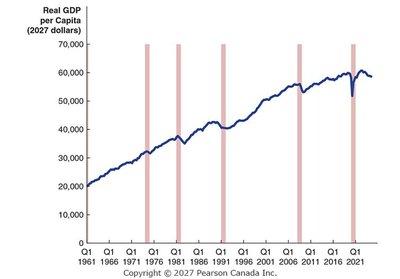
Example: In Canada, real GDP per capita rose from about $20,000 in 1961 to $58,600 in 2024, meaning the average Canadian can now buy nearly three times as many goods and services as in 1961.
Calculating Growth Rates and the Rule of 70
The growth rate of an economic variable (e.g., real GDP) is the percentage change from the previous year.
Formula for annual growth rate:
For longer periods, solve for the average annual growth rate g:
The Rule of 70 estimates the number of years for a variable to double:
Example: At a 5% growth rate, it takes about 14 years for GDP to double.
Determinants of Long-Run Growth
Growth in labour productivity—the quantity of goods and services produced per worker or per hour—is the key driver of rising living standards.
Factors influencing productivity growth:
Increases in capital per hour worked: More physical and human capital (knowledge and skills) make workers more productive.
Technological change: Innovations and improved methods allow more output from the same inputs.
Entrepreneurship: Entrepreneurs pioneer new ways to combine resources, driving productivity and growth.
Property Rights and Economic Growth
Secure private property rights are essential for investment, innovation, and long-term planning.
An independent court system enforces contracts and resolves disputes.
Governments support growth by providing efficient financial, education, transportation, and communication systems.
Potential GDP and the Output Gap
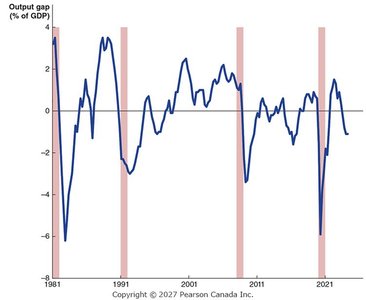
Potential GDP is the level of real GDP when firms operate at normal capacity with a normal workforce.
The output gap measures the percentage difference between actual GDP and potential GDP.
A negative output gap indicates underused resources (recession), while a positive gap signals overheating and inflation risk.
The Financial System and Economic Growth
Saving, Investment, and the Financial System
Economic growth depends on firms’ ability to finance expansion, often requiring funds beyond retained earnings.
The financial system channels funds from savers (households) to borrowers (firms), either directly or through intermediaries.
Components of the Financial System
Financial markets: Where securities like stocks (ownership) and bonds (loans) are bought and sold.
Financial intermediaries: Institutions (banks, mutual funds, pension funds, insurance companies) that collect funds from savers and lend to borrowers.
Key Services of the Financial System
Risk-sharing: Diversification reduces risk for investors.
Liquidity: Savers can quickly convert investments to cash.
Information: Security prices reflect collective beliefs about future returns.
Macroeconomics of Saving and Investment
GDP identity for a closed economy (no trade):
Solving for investment:
Private saving (SPrivate):
Public saving (SPublic):
Total saving (S):
Thus, in a closed economy, saving equals investment ().
Government budget deficits reduce public saving, decreasing funds available for investment (crowding out).
The Market for Loanable Funds
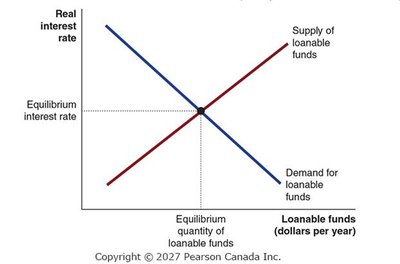
The market for loanable funds aggregates all borrowing and lending in the economy, determining the equilibrium real interest rate and quantity of funds loaned.
Households supply funds (savings); firms demand funds (for investment).
Shifts in the Loanable Funds Market
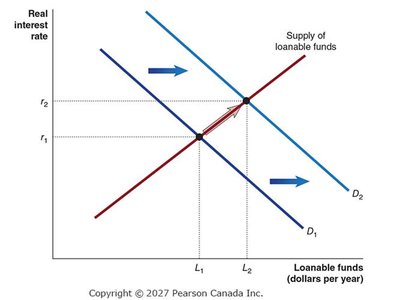
Increase in demand: Technological change makes investment more profitable, shifting demand right, raising interest rates and quantity loaned.
Increase in supply: Households save more, shifting supply right, lowering interest rates and increasing funds loaned.
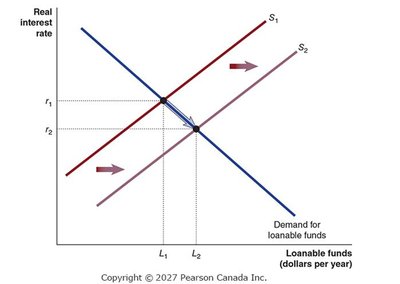
Budget deficit: Government borrows, reducing supply to firms, raising interest rates, and decreasing funds loaned (crowding out).
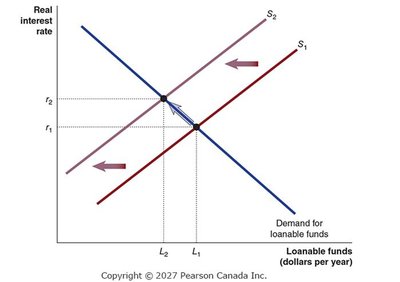
In practice, the effect of government deficits on interest rates is usually small due to global capital flows, but future debt repayment may require higher taxes, potentially slowing growth.
The Business Cycle
Definition and Phases
The business cycle refers to short-run fluctuations in real GDP around its long-run trend.
Phases include expansion (rising GDP), peak (highest point), recession (falling GDP), and trough (lowest point).
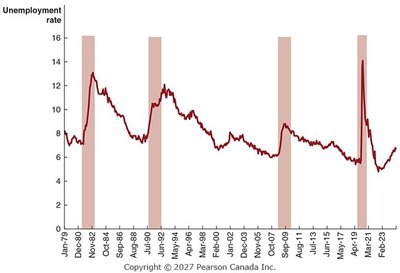
Major Canadian recessions: early 1980s, early 1990s, 2008–09, 2020–21, 2023–24.
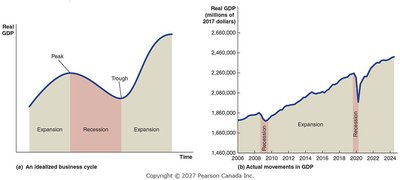
Economists define a recession as two consecutive quarters of negative real GDP growth.
Business Cycle Effects on Inflation and Unemployment
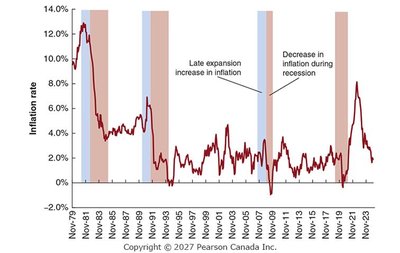
Inflation rate: Percentage increase in the price level year-over-year.
During expansions, inflation tends to rise; during recessions, inflation slows or may turn to deflation.
Unemployment rate: Rises sharply during recessions, falls during expansions, but may lag behind GDP recovery.
Unemployment often continues to rise after a recession ends due to slow employment growth and returning job seekers.
Summary Table: Key Concepts
Concept | Definition | Key Formula |
|---|---|---|
Real GDP per capita | Total output per person, adjusted for inflation | |
Growth Rate | Annual percentage change in a variable | |
Rule of 70 | Years to double at constant growth rate | |
Potential GDP | GDP at normal capacity and workforce | |
Output Gap | Actual GDP minus potential GDP (as % of potential) | |
Saving (S) | Sum of private and public saving | |
Investment (I) | Spending on capital goods | |
Business Cycle | Short-run fluctuations in GDP |
