 뒤로
뒤로Long-Run Economic Growth: Sources, Policies, and Global Comparisons
스터디 가이드 - 스마트 노트
 자료에 맞춘 맞춤형 노트, 핵심 정의, 예시, 맥락을 확장해 제공합니다.
Long-Run Economic Growth
Introduction
Economic growth is a fundamental driver of improvements in health, wealth, and overall living standards. For example, in 2024, there were 282 million cases of malaria worldwide, with most deaths occurring in poorer countries. Economic growth is essential for providing the resources needed to prevent such tragedies. Higher GDP per capita is strongly associated with higher survival rates for newborns, illustrating the close relationship between health and wealth.
Incomes and Growth Around the World
Fact 1: There are vast differences in living standards across countries, as measured by income per capita.
Fact 2: There is also significant variation in growth rates among countries, leading to persistent differences in prosperity.
Key questions in macroeconomics include: Why are some countries richer than others? Why do some countries grow quickly while others remain poor? What policies can help raise growth rates and long-run living standards?
Productivity and Its Determinants
Definition of Productivity
Productivity is the average quantity of goods and services produced per unit of labor input. It is a central determinant of a country's standard of living.
Formula: , where is real GDP (output) and is the quantity of labor.
When productivity is high, real GDP and incomes are also high. Rapid productivity growth leads to rising living standards over time.
Physical Capital Per Worker
Physical capital refers to the stock of equipment and structures used to produce goods and services, denoted as .
Capital per worker:
Productivity increases when workers have more capital (e.g., machines, tools).
Relationship: An increase in leads to an increase in .
Human Capital Per Worker
Human capital () is the knowledge and skills that workers acquire through education, training, and experience.
Human capital per worker:
Higher human capital leads to higher productivity.
Each additional year of schooling can significantly increase a worker's wage (e.g., by 10% in the U.S.).
Technological Knowledge
Technological knowledge is society’s understanding of the best ways to produce goods and services. It encompasses not only new inventions but also improvements in processes and organization. Advances in technology allow societies to produce more output from the same resources.
Examples: AI in agriculture, innovations in manufacturing.
Economic Growth and Public Policy
Saving and Investment
Increasing the stock of physical capital () requires investment, which in turn requires saving. Because resources are scarce, producing more capital goods means producing fewer consumption goods in the present—a tradeoff between current and future consumption.
Higher saving leads to more investment and higher future productivity.
Investment from Abroad
Foreign investment can boost a country’s capital stock and productivity.
Foreign direct investment (FDI): Capital investment owned and operated by a foreign entity.
Foreign portfolio investment: Capital investment financed with foreign money but operated by domestic residents.
International organizations like the World Bank and IMF help channel investment to developing countries.
Education
Government policies that promote education increase human capital and productivity. Examples include public schools and subsidized loans for college. However, investing in education involves a tradeoff: time spent in school is time not spent earning wages.
Incentives and Institutions
Institutions are the formal and informal “rules of the game” that structure economic incentives. Good institutions are essential for economic growth.
Key institutions: Property rights, honest government, political stability, and a dependable legal system.
Honest Government: The Good and the Bad
Corruption undermines economic growth by distorting incentives and reducing trust in institutions. Countries with honest governments tend to have higher growth rates.
Proof That Institutions Matter
The impact of institutions can be seen in stark contrasts between countries with similar geography but different economic systems.
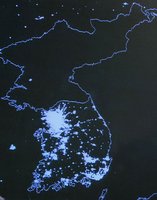
Additional info: The image above shows a satellite view of the Korean peninsula at night, highlighting the dramatic difference in economic development between North Korea (dark) and South Korea (brightly lit), illustrating the importance of institutions.
Free Trade
Trade policies significantly affect economic growth. Inward-oriented policies (e.g., tariffs, restrictions on foreign investment) aim to protect domestic industries but often fail to promote growth. Outward-oriented policies (e.g., free trade, openness to foreign investment) encourage integration with the world economy and have been associated with rapid growth in countries like South Korea, Singapore, and Taiwan.
Trade increases productivity and living standards, similar to technological progress.
Research and Development (R&D)
Technological progress is the main driver of rising living standards in the long run. Because knowledge is a public good, policies that promote R&D can have widespread benefits.
Examples of policies: Patent laws, tax incentives for private R&D, grants for university research.
Active Learning: Policy Discussion
Consider which policies might be most effective at boosting growth and living standards in a poor country over the long run:
Tax incentives for investment by local or foreign firms
Cash payments for good school attendance
Cracking down on government corruption
Restricting imports to protect domestic industries
Allowing free trade
Public health interventions
Policies that promote investment, education, honest government, and free trade are generally most effective at fostering long-run economic growth.
