 뒤로
Monetary Policy: Tools, Goals, and Economic Impact
스터디 가이드 - 스마트 노트
 자료에 맞춘 맞춤형 노트, 핵심 정의, 예시, 맥락을 확장해 제공합니다.
Monetary Policy
Introduction to Monetary Policy
Monetary policy is a central topic in macroeconomics, focusing on how the Federal Reserve (the Fed) manages the money supply and interest rates to achieve key macroeconomic objectives. The Fed's actions are crucial for stabilizing the economy, especially during crises such as the 2007–2009 financial crisis and the Covid-19 recession.
Monetary policy: Actions by the Federal Reserve to manage the money supply and interest rates.
Key goals: Price stability, high employment, stability of financial markets and institutions, and economic growth.

The Goals of Monetary Policy
The Federal Reserve pursues four main goals:
Price Stability: Prevents inflation from eroding the purchasing power of money. High inflation periods, such as the 1970s and the Covid-19 pandemic, highlight the importance of this goal.
High Employment: Ensures maximum employment, production, and purchasing power. This is part of the Fed's dual mandate.
Stability of Financial Markets and Institutions: Maintains confidence in banks and financial markets, especially during crises.
Economic Growth: Encourages stable long-run investment and growth.
Price Stability Example
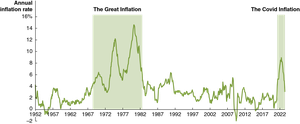
Periods of high inflation (e.g., the 1970s and 2021) demonstrate the need for effective monetary policy.
The Federal Funds Rate and How the Fed Conducts Monetary Policy
Interest Rates and Aggregate Demand
The Fed influences aggregate demand primarily through interest rates, especially the federal funds rate.
Federal funds rate: The interest rate banks charge each other for overnight loans.
The Fed sets targets for the federal funds rate and uses various tools to achieve these targets.
Equilibrium in the Federal Funds Market
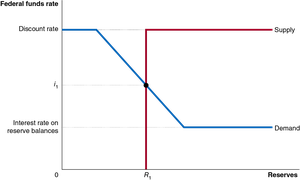
The demand for reserves is downward sloping; the supply is vertical or horizontal depending on the regime.
Equilibrium occurs where demand equals supply.
Ample-Reserves Regime
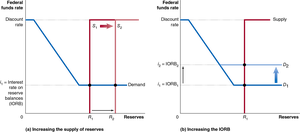
When banks hold excess reserves, the Fed can control the federal funds rate by adjusting the interest on reserve balances (IORB).
Federal Funds Rate and IORB
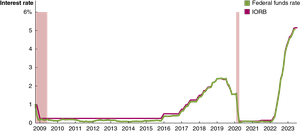
Administered rates (IORB and ONRRP) allow the Fed to tightly control the federal funds rate.
Monetary Policy Tools
The Fed uses several tools to manage monetary policy:
Interest on reserve balances (IORB): Sets a floor for the federal funds rate.
Interest rate on overnight reverse repurchase agreements (ONRRP): Provides a lower bound for the federal funds rate.
Quantitative easing: Buying long-term securities to lower long-term interest rates when the federal funds rate is at the zero lower bound.
Forward guidance: Communicating future policy intentions to influence expectations.
Open market operations: Buying and selling Treasury securities to adjust reserves.
Discount rate: The rate charged for loans to banks, acting as a ceiling.
Reserve requirements: Minimum reserves banks must hold (not actively used since 2020).
Quantitative Easing and Bank Reserves
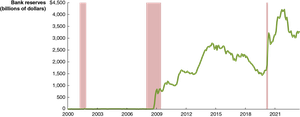
Quantitative easing increases bank reserves and lowers long-term interest rates.
Monetary Policy and Economic Activity
Effects on Real GDP and Price Level
The Fed uses aggregate demand and supply models to analyze the effects of monetary policy.
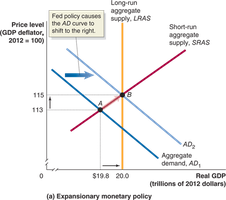
Lower interest rates increase consumption, investment, and net exports, raising real GDP.
Expansionary monetary policy is used when real GDP is below potential GDP.
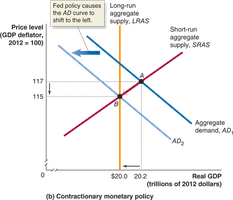
Contractionary monetary policy is used to reduce inflation when the economy is above potential GDP.
Expansionary Monetary Policy Example
Contractionary Monetary Policy Example
Challenges in Monetary Policy
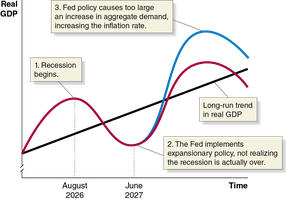
Lag in recognizing economic conditions makes timely policy difficult.
Poorly timed policy can lead to excessive inflation or severe recessions.
Poorly Timed Monetary Policy
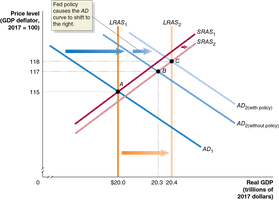
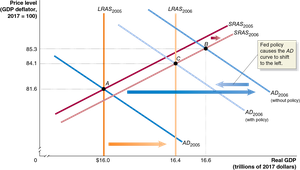
Monetary Policy in the Dynamic Aggregate Demand and Aggregate Supply Model
Dynamic AD-AS Model
Accounts for annual increases in potential GDP, aggregate demand, and price level.
Fed uses expansionary or contractionary policy to keep real GDP at potential and manage inflation.
Expansionary Policy in Dynamic Model
Contractionary Policy in Dynamic Model
The Fed’s Setting of Monetary Policy Targets
Targeting the Federal Funds Rate vs. Money Supply
Monetarists advocated targeting the money supply, but the relationship between money supply and real GDP has weakened.
The Fed now targets the federal funds rate.
The Taylor Rule
The Taylor rule links the federal funds rate to economic variables: equilibrium real rate, inflation gap, and output gap.
Formula:
Inflation Targeting and Other Strategies
Inflation Targeting
Fed announced a 2% average inflation target in 2012.
Arguments for: clarity, accountability, improved planning.
Arguments against: reduced flexibility, reliance on accurate forecasts.
Average-Inflation Targeting
Fed aims for inflation to average 2% over time, allowing for temporary deviations.
Nominal GDP Targeting
Targets the sum of real GDP growth and inflation; not currently adopted by central banks.
Fed Policies During the 2007–2009 and 2020 Recessions
Financial Crises and Fed Responses
Bubbles in asset markets (e.g., housing) can lead to recessions.
Fed provided liquidity and credit facilities to stabilize financial markets.
Actions during Covid-19 included cutting rates to zero and lending to non-bank firms.
Online Appendix: The Money Market and the Fed
Money Market Model
Explains how the Fed can affect short-term interest rates by controlling the money supply.
Demand for money decreases as interest rates rise due to opportunity cost.
Fed uses open market operations to adjust the money supply.
Demand for Money
Effect of Increasing Money Supply
Effect of Decreasing Money Supply
Choosing a Monetary Policy Target
The Fed cannot target both the money supply and interest rate simultaneously due to their interdependence.
Fed Can't Target Both Money Supply and Interest Rate
Summary Table: Fed's Monetary Policy Tools
Tool | Purpose |
|---|---|
Interest on Reserve Balances (IORB) | Manage federal funds rate |
Overnight Reverse Repurchase Agreements (ONRRP) | Lower bound for federal funds rate |
Quantitative Easing | Increase aggregate demand at zero lower bound |
Forward Guidance | Signal future policy intentions |
Open Market Operations | Adjust reserves and federal funds rate |
Discount Rate | Lender of last resort, ceiling for funds rate |
Reserve Requirements | Minimum reserves (not actively used) |
Key Terms and Concepts
Federal funds rate: Short-term interest rate for interbank loans.
Quantitative easing: Buying long-term securities to lower interest rates.
Forward guidance: Fed's communication about future policy.
Inflation targeting: Central bank's explicit inflation goal.
Taylor rule: Formula linking policy rate to economic variables.
Expansionary policy: Lowering rates to boost GDP.
Contractionary policy: Raising rates to control inflation.
Additional info: Some explanations and context were expanded for clarity and completeness, especially regarding the Fed's tools, the Taylor rule, and the dynamic AD-AS model.
