 뒤로
Pearson Edexcel International Advanced Level Economics: Specification and Core Concepts
스터디 가이드 - 스마트 노트
 자료에 맞춘 맞춤형 노트, 핵심 정의, 예시, 맥락을 확장해 제공합니다.
Overview of the Pearson Edexcel International Advanced Level in Economics
Introduction
The Pearson Edexcel International Advanced Level in Economics is a modular qualification designed to provide students with a comprehensive understanding of economic principles, models, and real-world applications. The course is structured into four main units, each focusing on key areas of microeconomics and macroeconomics, business behaviour, and developments in the global economy. The qualification aims to develop analytical, quantitative, and evaluative skills essential for further study and professional careers in economics and related fields.
Unit Structure and Content Overview
Unit 1: Markets in Action
Introductory Concepts: Nature of economics as a social science, positive vs. normative statements, scarcity, production possibility frontiers, specialisation, and the role of money and financial markets.
Consumer Behaviour and Demand: Rational decision-making, demand curve, price, income, and cross-elasticities of demand.
Supply: The supply curve, factors affecting supply, and price elasticity of supply.
Price Determination: Market equilibrium, consumer and producer surplus, functions of the price mechanism, and the impact of indirect taxes and subsidies.
Market Failure: Sources of market failure, externalities, public goods, imperfect information, moral hazard, and market bubbles.
Government Intervention: Methods and purposes of intervention, including taxation, subsidies, price controls, regulation, and government failure.
Unit 2: Macroeconomic Performance and Policy
Measures of Economic Performance: GDP, GNI, inflation, unemployment, and balance of payments.
Aggregate Demand and Supply: Components and determinants of AD and AS, short-run and long-run AS, and the AD/AS model.
National Income: Circular flow of income, injections and withdrawals, equilibrium, and the multiplier effect.
Economic Growth: Causes, benefits, costs, and output gaps.
Macroeconomic Objectives and Policies: Objectives (growth, inflation, unemployment, balance of payments, government budget, income equality), conflicts between objectives, supply-side and demand-side policies, and the role of central banks.
Unit 3: Business Behaviour
Types and Sizes of Businesses: Private and public sector, for-profit and not-for-profit, business growth and constraints, mergers, and demergers.
Revenue, Costs, and Profits: Calculation and relationships between revenue, costs, and profit; economies and diseconomies of scale.
Market Structures and Contestability: Perfect competition, monopolistic competition, oligopoly, monopoly, monopsony, and contestable markets.
Labour Markets: Demand and supply of labour, wage determination, and market failure in labour markets.
Government Intervention: Regulation of product and labour markets, promotion of competition, and limits to intervention.
Unit 4: Developments in the Global Economy
Globalisation: Characteristics, causes, and effects of globalisation, including the role of transnational companies and FDI.
Trade and the Global Economy: Specialisation, comparative advantage, patterns of world trade, terms of trade, trading blocs, and protectionism.
Balance of Payments, Exchange Rates, and Competitiveness: Components of the balance of payments, exchange rate systems, and international competitiveness.
Poverty and Inequality: Measures and causes of poverty and inequality, and their economic impacts.
The Role of the State: Public expenditure, taxation, public sector borrowing, and macroeconomic policies.
Growth and Development: Measures of development, constraints on growth, and strategies for promoting development in different economies.
Assessment Structure
Each unit is externally assessed through written examinations, including multiple-choice, short-answer, data response, and essay questions.
Quantitative skills are integrated throughout the assessments, requiring calculations, data interpretation, and diagrammatic analysis.
Assessment objectives include knowledge, application, analysis, and evaluation of economic concepts and evidence.
Key Skills Developed
Critical thinking and problem-solving
Quantitative analysis and interpretation of economic data
Effective written communication and argumentation
Application of economic theory to real-world contexts
Evaluation of policy measures and economic outcomes
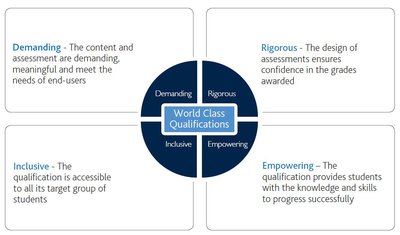
World Class Qualification Principles
Demanding: Content and assessment are rigorous and meaningful, meeting the needs of end-users.
Rigorous: Assessment design ensures confidence in the grades awarded.
Inclusive: The qualification is accessible to all its target group of students.
Empowering: Students gain the knowledge and skills needed for progression.
Transferable Skills Framework
Cognitive Skills: Critical thinking, analysis, reasoning, and decision-making.
Intrapersonal Skills: Adaptability, self-direction, perseverance, and ethical responsibility.
Interpersonal Skills: Communication, teamwork, collaboration, and leadership.

Assessment Objectives and Weightings
AO1: Demonstrate knowledge and understanding of economic terms, concepts, theories, and models.
AO2: Apply knowledge and understanding to various economic contexts.
AO3: Analyse issues and evidence, showing understanding of their impact on economic agents.
AO4: Evaluate economic arguments and use evidence to support informed judgements.
Quantitative Skills Required
Calculation and interpretation of ratios, percentages, index numbers, elasticity, and revenue/cost/profit measures.
Construction and interpretation of diagrams and graphical data.
Analysis of written, graphical, tabular, and numerical information.
Progression and Further Study
Successful completion enables progression to higher education in economics, business, finance, and related fields.
Develops skills relevant for careers in finance, banking, management, consultancy, and professional economics.
