뒤로
Principles of Macroeconomics: Foundations, Trade-offs, and the Market System (Chapters 1 & 2)
스터디 가이드 - 스마트 노트
 자료에 맞춘 맞춤형 노트, 핵심 정의, 예시, 맥락을 확장해 제공합니다.
Economics: Foundations and Models
Introduction to Economics
Economics is the study of how individuals and societies allocate scarce resources to satisfy unlimited wants. The discipline uses models to analyze real-world situations and answer questions about prices, production, and policy.
Scarcity: A situation in which unlimited wants exceed the limited resources available to fulfill those wants.
Economic models: Simplified representations of reality used to analyze economic problems and predict outcomes.
Market: A group of buyers and sellers of a good or service and the institution or arrangement by which they come together to trade.
Three Key Economic Ideas
People are rational: Individuals use all available information to achieve their goals, weighing costs and benefits to make optimal decisions.
People respond to incentives: Changes in incentives lead to changes in behavior.
Optimal decisions are made at the margin: Most choices involve doing a little more or less of something, analyzed through marginal benefit (MB) and marginal cost (MC).
Marginal analysis: Comparing MB and MC to make decisions.
The Economic Problem Every Society Must Solve
Scarcity forces societies to make choices about what, how, and for whom to produce.
Trade-off: Producing more of one good means producing less of another due to limited resources.
Opportunity cost: The highest-valued alternative that must be given up to engage in an activity.
Three Fundamental Economic Questions
What goods and services will be produced? Determined by choices of individuals, firms, and governments.
How will goods and services be produced? Firms choose production methods based on costs and available technology.
Who will receive the goods and services? Distribution depends on income, government policies, and market outcomes.
Positive vs. Normative Analysis
Positive analysis: Concerned with what is (objective, fact-based).
Normative analysis: Concerned with what ought to be (subjective, value-based).
Economics as a Social Science
Economics studies individual and group behavior, emphasizing the effects of decisions on outcomes like prices and resource allocation. It is closely related to other social sciences but focuses more on market interactions and policy impacts.
Economic Skills and Careers
Economics majors often earn higher salaries, but causation versus correlation should be considered. Skills in analysis, critical thinking, and quantitative reasoning are highly valued in the job market.
Median Wage, Early Career (22-27) | Median Wage, Midcareer (35-45) | |
|---|---|---|
Economics majors | $60,000 | $91,000 |
All majors | $45,000 | $72,000 |
Production Possibilities Frontiers and Opportunity Costs
Production Possibilities Frontier (PPF)
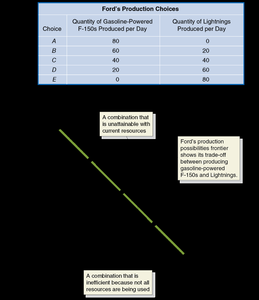
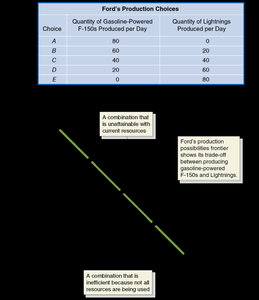
The PPF is a curve showing the maximum attainable combinations of two goods that can be produced with available resources and technology. It illustrates concepts of efficiency, trade-offs, and opportunity cost.
Points on the PPF: Efficient and attainable.
Points inside the PPF: Inefficient (resources underutilized).
Points outside the PPF: Unattainable with current resources.
Opportunity Cost and the PPF
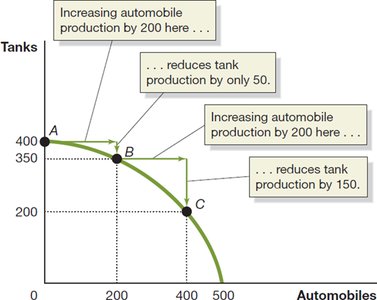
Moving along the PPF involves shifting resources from one good to another, incurring opportunity costs. The opportunity cost is the amount of one good foregone to produce more of the other.
Opportunity costs are often increasing because resources are not equally suited to all tasks.
Economic Growth and Shifts in the PPF
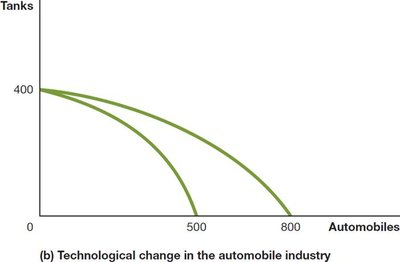
Economic growth occurs when an economy's capacity to produce goods and services increases, shifting the PPF outward. This can result from more resources or technological improvements.
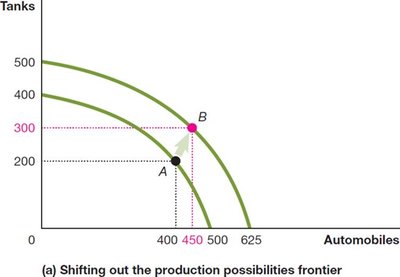
General growth: Outward shift in the PPF for all goods.
Technological improvement in one sector: Outward shift in the PPF for that good only.
Comparative Advantage and Trade
Production Possibilities and Specialization
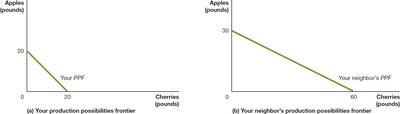
Individuals or countries can benefit from trade by specializing in the production of goods for which they have a comparative advantage (lower opportunity cost) and trading for others.
Absolute vs. Comparative Advantage
Absolute advantage: Ability to produce more of a good with the same resources.
Comparative advantage: Ability to produce a good at a lower opportunity cost.
Trade is based on comparative, not absolute, advantage.
Gains from Trade
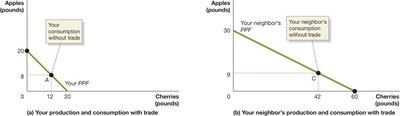
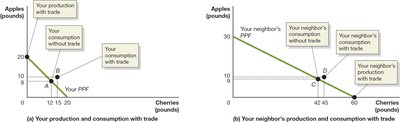
Specialization and trade allow both parties to consume beyond their individual PPFs, increasing overall welfare.
You: Apples (lbs) | You: Cherries (lbs) | Neighbor: Apples (lbs) | Neighbor: Cherries (lbs) | |
|---|---|---|---|---|
Production and consumption without trade | 8 | 12 | 9 | 42 |
Production with trade | 20 | 0 | 0 | 60 |
Consumption with trade | 10 | 15 | 10 | 45 |
Gains from trade (increased consumption) | 2 | 3 | 1 | 3 |
Opportunity Cost of 1 lb Apples | Opportunity Cost of 1 lb Cherries | |
|---|---|---|
You | 1 lb cherries | 1 lb apples |
Neighbor | 2 lbs cherries | 0.5 lb apples |
Formula for Opportunity Cost:
The Market System
How Markets Work
Markets bring together buyers and sellers to exchange goods and services. Households provide factors of production (labor, capital, natural resources), and firms use these to produce goods and services.
Types of Economic Systems
Centrally planned economy: Government decides resource allocation.
Market economy: Decisions of households and firms interacting in markets determine resource allocation.
Mixed economy: Most decisions are made in markets, but government plays a significant role.
Efficiency in Market Economies
Productive efficiency: Goods produced at lowest possible cost (competition-driven).
Allocative efficiency: Production matches consumer preferences; last unit provides MB = MC.
Voluntary exchange: Both buyer and seller are made better off by the transaction.
Knowledge and the Market
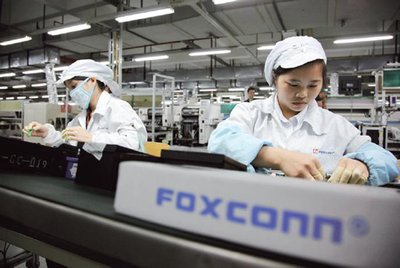
Markets mobilize both general and local knowledge, allowing individuals to use their information for personal gain, which in turn helps coordinate economic activity through price signals.
The Role of the Entrepreneur
Entrepreneurs organize resources to produce goods and services, driving innovation and economic growth. They take risks and often create products that consumers did not previously imagine.
The Legal Basis of Market Systems
Property rights: Legal rights to use, buy, or sell property are essential for market incentives.
Enforcement of contracts: Reliable legal systems ensure that agreements are honored, facilitating trade and investment.
Limitations and Equity in Market Economies
Markets may not always be fully efficient (e.g., externalities like pollution).
Equity: The fair distribution of economic benefits may require government intervention, creating a trade-off with efficiency.
Socialism and Mixed Economies
Some countries have adopted centrally planned or mixed economies, with varying degrees of government involvement. Social democratic systems often feature significant government roles in resource allocation and social welfare.