 뒤로
Short Run and Long Run in Economics: Costs and Production
스터디 가이드 - 스마트 노트
 자료에 맞춘 맞춤형 노트, 핵심 정의, 예시, 맥락을 확장해 제공합니다.
Short Run and Long Run in Economics
Distinguishing the Economic Short Run and Long Run
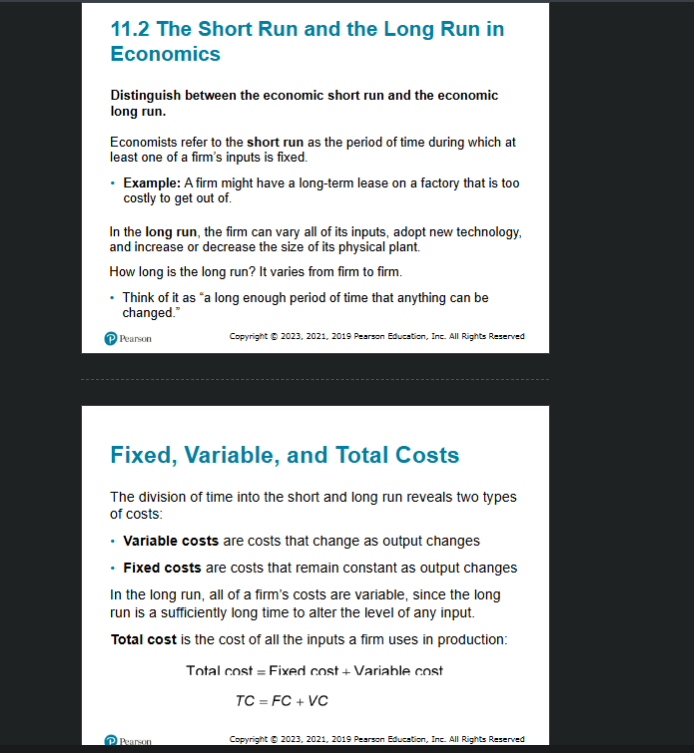
The concepts of the short run and long run are fundamental in economics, especially when analyzing production and costs. The short run is defined as the period during which at least one of a firm's inputs is fixed, meaning it cannot be changed. In contrast, the long run is a period in which all inputs can be varied, allowing firms to adjust their production processes fully.
Short Run: At least one input (such as capital or land) is fixed. Firms cannot easily change these fixed inputs.
Example: A firm may have a long-term lease on a factory, making it difficult to change the size or location of its operations in the short run.
Long Run: All inputs are variable. Firms can adopt new technologies, expand or reduce their physical plant, and adjust all factors of production.
Duration: The length of the long run varies by firm and industry, but it is generally considered "a long enough period of time that anything can be changed."
Fixed, Variable, and Total Costs
Types of Costs in Production
The distinction between the short run and long run also affects how costs are classified. In the short run, costs are divided into fixed costs and variable costs. In the long run, all costs become variable because firms can adjust all inputs.
Variable Costs: Costs that change as output changes. Examples include raw materials and labor.
Fixed Costs: Costs that remain constant regardless of output. Examples include rent, insurance, and salaries of permanent staff.
Total Cost: The sum of all costs incurred by a firm in production. It is calculated as:
Where TC is Total Cost, FC is Fixed Cost, and VC is Variable Cost.
In the long run, since all inputs can be changed, all costs are considered variable.
Example: Application of Cost Concepts
Suppose a bakery has a fixed monthly rent of $1,000 and spends $500 on ingredients and hourly wages for each batch of bread produced. If the bakery produces 10 batches in a month, its total cost would be:
This example illustrates how fixed and variable costs combine to determine total production costs.
