 뒤로
뒤로Unemployment: Concepts, Measurement, and Types in Macroeconomics
스터디 가이드 - 스마트 노트
 자료에 맞춘 맞춤형 노트, 핵심 정의, 예시, 맥락을 확장해 제공합니다.
Unemployment: Concepts and Measurement
Civilian Population and Labor Force
The civilian noninstitutional population includes all persons aged 16 and older residing in the United States (excluding those in institutions or on active military duty). This population is divided into three main groups:
Employed: Individuals who worked at least one hour for pay or 15 hours as unpaid workers in a family business during the reference week, or who were temporarily absent from their jobs.
Unemployed: Individuals not employed but actively seeking work or waiting to be recalled from a layoff.
Not in the labor force: Individuals who are neither employed nor unemployed (e.g., retirees, students, homemakers).
The labor force is the sum of employed and unemployed persons. The civilian population is the sum of the labor force and those not in the labor force.
Labor force = Employed + Unemployed
Civilian population = Labor force + Not in labor force
Defining Employment and Unemployment
Employed: Worked for pay or profit, or had a job but were temporarily absent.
Unemployed: Not employed, available for work, and actively searched for a job in the past four weeks or waiting to be recalled from a layoff.
Active job search: Actions that could directly result in a job offer (e.g., submitting applications, interviewing).
Passive job search: Actions that do not directly lead to a job offer (e.g., browsing job ads without applying).
Certain activities are not considered work by the Bureau of Labor Statistics (BLS), such as volunteer work, unpaid internships, or household chores.
Unemployment Rate
The unemployment rate is a key indicator of labor market health, calculated as:
Limitations of Unemployment Statistics
While the unemployment rate is widely used, it has several limitations:
Excludes discouraged workers (those who have stopped looking for work due to lack of opportunities).
Does not distinguish between full-time and part-time employment, potentially underestimating underemployment.
Relies on self-reported data, which may be inaccurate.
Discouraged Workers
Discouraged workers are individuals who want and are available for work, have looked for a job in the past year, but have not searched in the past four weeks due to believing no jobs are available or they lack qualifications. They are not counted as unemployed or in the labor force.
When economic conditions improve, discouraged workers may resume job searches, temporarily increasing the unemployment rate.
Types of Unemployment
Frictional, Structural, and Cyclical Unemployment
Frictional Unemployment: Short-term unemployment as workers transition between jobs or enter the labor force for the first time.
Structural Unemployment: Long-term unemployment due to mismatches between workers' skills and job requirements or geographic location.
Cyclical Unemployment: Unemployment resulting from economic downturns; the difference between the actual unemployment rate and the natural rate.
Natural Rate of Unemployment
The natural rate of unemployment is the rate that exists when the economy is at "full employment," accounting for only frictional and structural unemployment (no cyclical unemployment). In the U.S., this is typically estimated between 4% and 5%.
Even at full employment, some unemployment persists due to job transitions and skill mismatches.
Alternative Measures of Labor Underutilization
The BLS provides several alternative measures of labor underutilization, which include broader definitions than the official unemployment rate. These measures account for discouraged workers, marginally attached workers, and those working part-time for economic reasons.
Measure | Description |
|---|---|
U-3 | Official unemployment rate: total unemployed as a percent of the civilian labor force |
U-4 | U-3 plus discouraged workers |
U-5 | U-4 plus all other marginally attached workers |
U-6 | U-5 plus total employed part time for economic reasons |
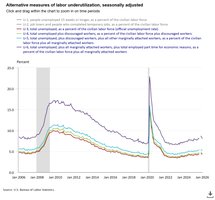

These alternative measures provide a more comprehensive view of labor market challenges, especially during and after economic downturns.
Natural Rate vs. Actual Rate of Unemployment
The actual unemployment rate fluctuates with the business cycle, while the natural rate is relatively stable. During recessions, the actual rate rises above the natural rate due to cyclical unemployment. During expansions, it may fall below the natural rate.
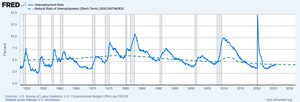
This comparison helps economists and policymakers assess the health of the labor market and the presence of cyclical unemployment.
Applications and Data Exploration
Labor market data can be accessed from the Bureau of Labor Statistics (BLS) website, including breakdowns by demographic groups and educational attainment.
Recent news and data releases provide context for current labor market conditions, such as jobless claims and unemployment trends.
Example: Labor Force Membership
An elementary school student (10 years old) with a newspaper route: Not in the labor force (too young).
An insurance salesperson: Employed (in the labor force).
An army captain on active duty: Not in the labor force (not part of the civilian population).
Summary Table: Population Groups
Group | Definition |
|---|---|
Employed | Worked for pay or profit, or temporarily absent from job |
Unemployed | Not employed, actively seeking work, or on layoff |
Not in labor force | Neither employed nor unemployed |
Additional info: The natural rate of unemployment is influenced by labor market policies, demographic trends, and technological change. Alternative measures (U-4, U-5, U-6) are especially useful during periods of economic stress to capture hidden unemployment and underemployment.
