 뒤로
뒤로Unemployment, Inflation, and Long-Run Growth: Study Notes for Macroeconomics
스터디 가이드 - 스마트 노트
 자료에 맞춘 맞춤형 노트, 핵심 정의, 예시, 맥락을 확장해 제공합니다.
Unemployment, Inflation, and Long-Run Growth
Unemployment
Unemployment is a key macroeconomic variable, regularly measured and reported by government agencies. Understanding how unemployment is defined and calculated is essential for analyzing labor market conditions and economic health.
Employed: Any person 16 years or older who works for pay (for someone else or in their own business) for at least 1 hour per week, works without pay for 15+ hours in a family enterprise, or has a job but is temporarily absent.
Unemployed: A person 16 years or older who is not working, is available for work, and has made specific efforts to find work in the previous 4 weeks.
Not in the Labor Force: Individuals not looking for work because they do not want a job or have given up searching.
Labor Force: The sum of employed and unemployed individuals.
Unemployment Rate: The ratio of the number of unemployed people to the total labor force.
Labor Force Participation Rate: The ratio of the labor force to the total population aged 16 or older.
Formula for Unemployment Rate:
Formula for Labor Force Participation Rate:
Time Use for the Unemployed
During recessions, unemployed individuals spend only a small portion of lost work hours searching for jobs. Most time is allocated to nonmarket work and leisure activities.
Job search: 2%–6%
Education/activities tied to job placement: 12%
Nonmarket work (e.g., cleaning, child care): 35%
Leisure (e.g., sleeping): 50%

Components of the Unemployment Rate
Unemployment rates vary by demographic group and are affected by discouraged-worker effects.
Discouraged-Worker Effect: When people who want to work but cannot find jobs stop looking, they are no longer counted as unemployed, lowering the measured unemployment rate.
Some economists argue for including discouraged workers in unemployment statistics for a more accurate picture.
The Duration of Unemployment
The average duration of unemployment fluctuates with economic conditions, often increasing during recessions.
Labor Force Participation Trends
Women's labor force participation rate increased significantly from 1955 to 1996, while men's participation declined. This shift reflects changing social roles and economic factors.

The Costs of Unemployment
Unemployment has economic and social costs, which are not evenly distributed. There are three main categories:
Frictional Unemployment: Short-term unemployment due to normal labor market turnover and job/skill-matching problems.
Structural Unemployment: Unemployment caused by changes in the economy's structure, leading to job losses in certain industries.
Cyclical Unemployment: Unemployment above the sum of frictional and structural unemployment, typically associated with business cycles.
Natural Rate of Unemployment: The sum of frictional and structural unemployment, representing the normal functioning of the economy.
Social consequences can be severe, especially during major economic downturns, such as the Great Depression or the 2008–2009 recession. Unemployment can lead to loss of savings, reduced income, and persistent wage effects for affected workers.

Inflation and Deflation
Inflation is the general increase in prices, while deflation is the decrease. Both are measured using price indexes.
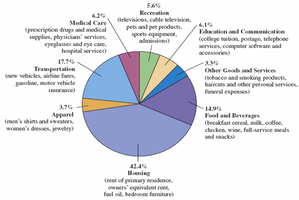
Consumer Price Index (CPI): Measures the average change in prices paid by urban consumers for a market basket of goods and services.
Producer Price Indexes (PPIs): Measure prices received by producers at various stages of production.
Formula for Real Interest Rate:
The Costs of Inflation
During inflation, most prices—including wages—rise together, so purchasing power may not necessarily decrease.
Anticipated inflation has small effects, as people adjust. Unanticipated inflation can significantly affect income distribution, benefiting debtors if inflation is higher than expected.
Administrative costs and inefficiencies arise from adjusting to inflation, such as updating prices and contracts.
Interest rates tend to rise with anticipated inflation, increasing the opportunity cost of holding cash.
Chain-Linked CPI
The chain-linked CPI adjusts for product substitution and tends to increase more slowly than the fixed-weight CPI. Using the chain-linked CPI for benefits and tax brackets would slow their growth and potentially increase government savings.

Deflation
Deflation can have significant effects, especially if unanticipated. Borrowers benefit at the expense of lenders, and those on fixed pensions gain relative to governments and firms paying those pensions.
Long-Run Growth
Long-run growth is a major concern in macroeconomics, focusing on increases in output and productivity over time.
Output Growth: The growth rate of the economy's total output.
Per-Capita Output Growth: The growth rate of output per person.
Productivity Growth: The growth rate of output per worker.
Productivity and capital per worker are key drivers of long-run growth. Productivity grew faster in the 1950s and 1960s than in later decades, and capital per worker increased until about 1980 before leveling off.
Review Terms and Concepts
Consumer Price Index (CPI)
Cyclical Unemployment
Discouraged-Worker Effect
Employed
Frictional Unemployment
Labor Force
Labor Force Participation Rate
Natural Rate of Unemployment
Not in the Labor Force
Output Growth
Per-Capita Output Growth
Producer Price Indexes (PPIs)
Productivity Growth
Real Interest Rate
Structural Unemployment
Unemployed
Unemployment Rate
Key Equations
