 뒤로
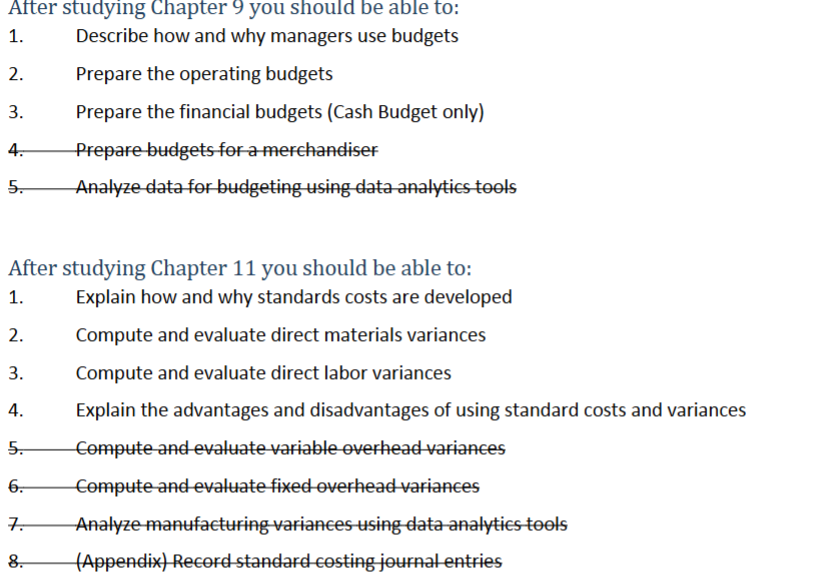
Budgeting and Standard Costs in Managerial Accounting: Study Guide
스터디 가이드 - 스마트 노트
 자료에 맞춘 맞춤형 노트, 핵심 정의, 예시, 맥락을 확장해 제공합니다.
Budgeting in Managerial Accounting
Purpose and Use of Budgets
Budgets are essential tools in managerial accounting, providing a financial plan for the organization. Managers use budgets to set targets, allocate resources, and monitor performance against expectations.
Definition: A budget is a quantitative plan for acquiring and using resources over a specified period.
Purpose: Budgets help managers coordinate activities, communicate plans, motivate employees, and evaluate performance.
Types: Operating budgets (covering income and expenses) and financial budgets (covering cash flows and financial position).
Example: A company may prepare a sales budget to forecast expected sales revenue for the upcoming quarter.
Preparation of Operating Budgets
Operating budgets are the foundation of the budgeting process, detailing expected revenues and expenses for the period.
Sales Budget: Estimates the quantity and value of sales.
Production Budget: Plans the number of units to be produced based on sales forecasts and inventory requirements.
Direct Materials, Direct Labor, and Overhead Budgets: Estimate the costs associated with production.
Formula: For production budget:
Example: If budgeted sales are 1,000 units, desired ending inventory is 200 units, and beginning inventory is 150 units, required production is 1,050 units.
Preparation of Financial Budgets (Cash Budget Only)
The cash budget is a critical financial budget that forecasts cash inflows and outflows, helping managers ensure liquidity and plan for financing needs.
Definition: A cash budget summarizes expected cash receipts and payments for a period.
Components: Cash receipts, cash disbursements, and financing activities.
Formula:
Example: If beginning cash is $5,000, receipts are $10,000, disbursements are $12,000, and financing is $2,000, ending cash is $5,000.
Standard Costs and Variances in Managerial Accounting
Development and Purpose of Standard Costs
Standard costs are predetermined costs for materials, labor, and overhead, used as benchmarks for measuring performance.
Definition: Standard costs represent the expected cost to produce a product under normal conditions.
Purpose: They facilitate budgeting, cost control, and performance evaluation.
Example: If the standard cost for direct materials is $2 per unit, actual costs can be compared to this benchmark.
Direct Materials Variances
Direct materials variances measure the difference between actual and standard costs for materials used in production.
Materials Price Variance:
Materials Quantity Variance:
Example: If actual price is $2.10, standard price is $2.00, and actual quantity is 1,000 units, MPV is $100 unfavorable.
Direct Labor Variances
Direct labor variances analyze the difference between actual and standard labor costs.
Labor Rate Variance:
Labor Efficiency Variance:
Example: If actual rate is $15, standard rate is $14, and actual hours are 500, LRV is $500 unfavorable.
Advantages and Disadvantages of Standard Costs and Variances
Standard costing systems offer several benefits but also have limitations.
Advantages:
Facilitate budgeting and planning
Enable performance evaluation
Support cost control and efficiency improvements
Disadvantages:
May be outdated if not regularly updated
Can lead to dysfunctional behavior if used improperly
May not reflect actual operating conditions
Fixed Overhead Variances
Fixed overhead variances compare actual fixed overhead costs to standard costs allocated to production.
Fixed Overhead Spending Variance:
Fixed Overhead Volume Variance:
Example: If actual fixed overhead is $10,000, budgeted is $9,500, FOSV is $500 unfavorable.
Variance Type | Formula | Purpose |
|---|---|---|
Materials Price Variance | Measures cost difference for materials | |
Materials Quantity Variance | Measures efficiency in material usage | |
Labor Rate Variance | Measures cost difference for labor | |
Labor Efficiency Variance | Measures efficiency in labor usage | |
Fixed Overhead Spending Variance | Measures cost control for overhead | |
Fixed Overhead Volume Variance | Measures production volume impact |
