 뒤로
Performance Evaluation and Budgeting in Managerial Accounting
스터디 가이드 - 스마트 노트
 자료에 맞춘 맞춤형 노트, 핵심 정의, 예시, 맥락을 확장해 제공합니다.
Performance Evaluation in Managerial Accounting
Responsibility Centers and Decentralization
Managerial accounting uses responsibility centers to evaluate the performance of managers and divisions within an organization. Decentralization delegates decision-making authority to lower-level managers, improving responsiveness and accountability. Responsibility centers are classified as cost centers, revenue centers, profit centers, and investment centers, each with distinct evaluation criteria.
Cost Center: Controls costs only; evaluated by comparing actual vs. budgeted costs.
Revenue Center: Controls sales only; evaluated by comparing actual vs. budgeted revenue.
Profit Center: Controls revenues and expenses; evaluated by segment margin and profit variance.
Investment Center: Controls revenues, expenses, and asset use; evaluated using ROI and RI.
Key Performance Measures for Investment Centers
Investment centers are evaluated using financial ratios that link income to the assets employed. The most important measures are Return on Investment (ROI), Sales Margin, Capital Turnover, and Residual Income (RI).
Return on Investment (ROI)
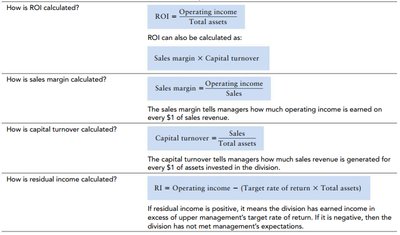
ROI measures how efficiently assets are used to generate income. It is calculated as:
Formula:
Alternatively, ROI can be calculated as:
Interpretation: A higher ROI indicates efficient use of capital.
Sales Margin
Sales margin shows the profitability of each revenue dollar. It is calculated as:
Formula:
Interpretation: Indicates how much operating income is earned on every $1 of sales revenue.
Capital Turnover
Capital turnover measures how efficiently assets produce revenue. It is calculated as:
Formula:
Interpretation: Shows how much sales revenue is generated for every $1 of assets invested in the division.
Residual Income (RI)
Residual income measures the dollar amount earned above the minimum required return. It is calculated as:
Formula:
Interpretation: If RI is positive, the division has earned income in excess of upper management’s target rate of return. If negative, the division has not met management’s expectations.
Comparing ROI and RI
ROI is a relative measure, useful for comparing divisions of different sizes.
RI is an absolute dollar measure, showing value added above the required return, but less useful for comparing divisions of different sizes.
Management often uses both measures to evaluate performance and guide investment decisions.
Application Example
Suppose a division has an operating income of $300,000, sales of $2,000,000, average operating assets of $1,000,000, and a target rate of 12%.
Sales Margin: or 15%
Capital Turnover:
ROI: or 30%
RI:
This analysis helps management assess both the efficiency and effectiveness of division managers in using assets to generate profits.
