 뒤로
Performance Evaluation: ROI, Sales Margin, Capital Turnover, and Residual Income
스터디 가이드 - 스마트 노트
 자료에 맞춘 맞춤형 노트, 핵심 정의, 예시, 맥락을 확장해 제공합니다.
Performance Evaluation in Managerial Accounting
Return on Investment (ROI)
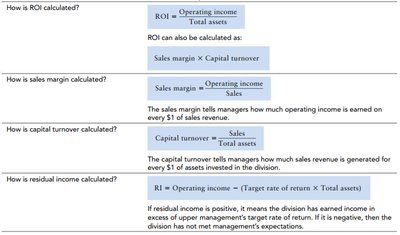
Return on Investment (ROI) is a key metric used to evaluate the efficiency of an investment center in generating income from its assets. It measures how effectively a division or manager uses assets to produce operating income.
Definition: ROI quantifies the return generated per dollar of assets invested.
Formula:
Alternatively,
Interpretation: A higher ROI indicates more efficient use of assets.
Sales Margin
Sales margin measures the profitability of each dollar of sales revenue. It shows how much operating income is earned for every $1 of sales.
Formula:
Interpretation: Indicates the proportion of sales revenue converted into operating income.
Example: If a division has \frac{100,000}{500,000} = 0.20 $ or 20%.
Capital Turnover
Capital turnover measures the efficiency of asset use in generating sales revenue. It shows how much sales revenue is produced for every $1 of assets invested.
Formula:
Interpretation: Higher capital turnover means assets are being used more efficiently to generate sales.
Example: If a division has \frac{500,000}{250,000} = 2.0 $.
Residual Income (RI)
Residual income (RI) measures the dollar amount of operating income earned above the minimum required return set by management. It is used to assess whether a division is adding value beyond the company's expectations.
Formula:
Interpretation: If RI is positive, the division has exceeded the minimum required return. If negative, it has not met expectations.
Example: If operating income is 100,000 - (0.10 \times 500,000) = 100,000 - 50,000 = 50,000 $.
Summary Table: Key Performance Measures
Measure | Formula | Purpose |
|---|---|---|
ROI | Overall return on invested capital | |
Sales Margin | Profitability per sales dollar | |
Capital Turnover | Efficiency of asset use | |
Residual Income (RI) | Value earned above required return |
Additional info: These measures are essential for evaluating investment centers in decentralized organizations, helping management assess both efficiency and effectiveness in asset utilization and profitability.
