 뒤로
Process Costing: Concepts, Calculations, and Applications in Managerial Accounting
스터디 가이드 - 스마트 노트
 자료에 맞춘 맞춤형 노트, 핵심 정의, 예시, 맥락을 확장해 제공합니다.
Process Costing
Introduction to Process Costing
Process costing is a method used by companies that produce large quantities of homogeneous products through a series of continuous processes. It is distinct from job costing, which is used for unique products or small batches. Process costing accumulates costs for each department or process and assigns them to units produced.
Job Costing: Used for unique goods or small batches; costs are traced to individual jobs.
Process Costing: Used for mass production of identical units; costs are traced to processes or departments.
Examples: Jelly Belly (candy), Shell Oil (petroleum products).
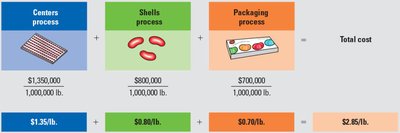
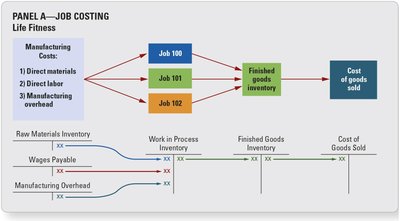
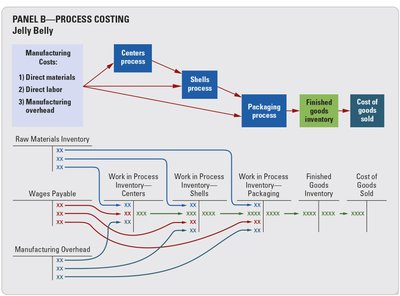
Flow of Costs in Process Costing
The flow of costs in process costing involves accumulating costs in each department and transferring them as products move through the production process.
Direct Materials: Raw materials added at various stages.
Conversion Costs: Direct labor and manufacturing overhead combined.
Work in Process (WIP) Inventory: Tracks costs for units that are not yet complete.
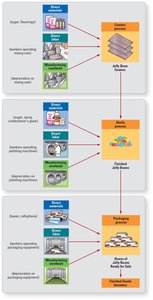
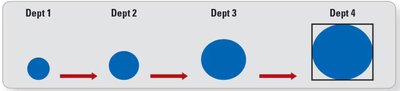
Work in Process Inventory Example
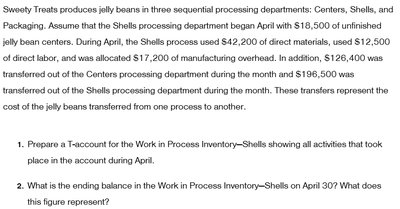
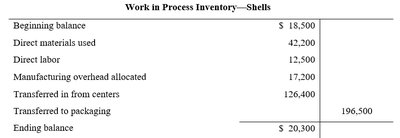
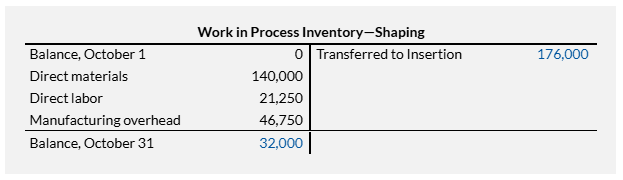
The WIP inventory account records the costs incurred in each department. The ending balance represents the cost of partially completed units.
Example: Shells department WIP account shows beginning balance, costs added, and transferred out.
Calculating Equivalent Units
Definition and Calculation
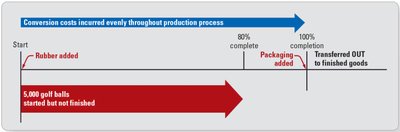
Equivalent units express the amount of work done in terms of fully completed units. This is essential for assigning costs accurately when some units are only partially complete.
Formula:
Example: 5,000 units at 80% completion = 4,000 equivalent units.
Inventory Flow Assumptions
Process costing uses either the weighted-average or FIFO method to calculate costs per equivalent unit.
Weighted-Average: Combines costs from current and prior periods; most commonly used for simplicity.
FIFO: Separates costs from prior and current periods; more complex.
Process Costing Steps in the First Production Department
Five-Step Process (Weighted-Average Method)
The weighted-average method involves five steps to assign costs in process costing.
Summarize the flow of physical units.
Calculate output in terms of equivalent units.
Summarize total costs to account for.
Calculate the cost per equivalent unit.
Assign total costs to units completed and to units in ending WIP inventory.
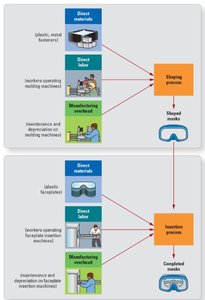
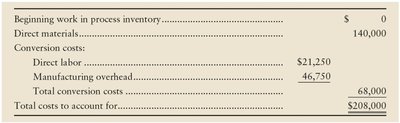
Step 1: Summarize the Flow of Physical Units
Track units started, completed, and in ending WIP.
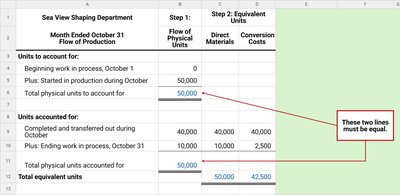
Step 2: Calculate Equivalent Units
Apply completion percentages to physical units for direct materials and conversion costs.
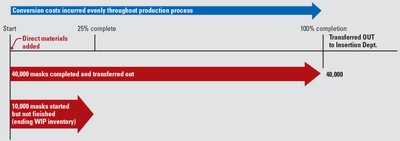
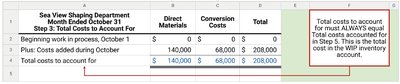
Step 3: Summarize Total Costs to Account For
Combine direct materials and conversion costs.
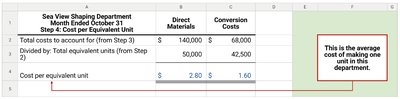
Step 4: Calculate Cost per Equivalent Unit
Divide total costs by equivalent units for each cost category.
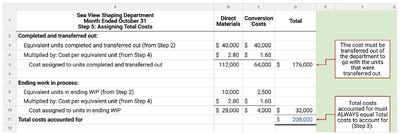
Step 5: Assign Total Costs to Units Completed and Ending WIP
Multiply equivalent units by cost per equivalent unit for completed and WIP units.
Journal Entries for Process Costing
Recording Costs in Process Costing
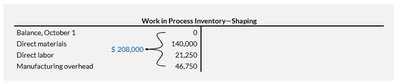
Journal entries are used to record the flow of costs through the production process.
Direct Materials: Debit WIP, credit Raw Materials Inventory.
Direct Labor: Debit WIP, credit Wages Payable.
Manufacturing Overhead: Debit WIP, credit Manufacturing Overhead.
Transferring Costs: Debit next department's WIP, credit previous department's WIP.



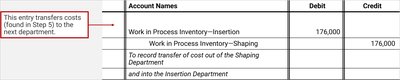
Process Costing in Subsequent Departments
Transferred-In Costs
In departments after the first, costs transferred in from previous departments must be considered separately. The same five-step process is used, but transferred-in costs are tracked as a distinct category.
Transferred-In Costs: Costs assigned to units as they move from one department to the next.
Splitting Costs in the Insertion Department
The department must allocate costs between completed units and units still in WIP.
Calculating Equivalent Units in Later Departments
Apply completion percentages for transferred-in, direct materials, and conversion costs.
Assigning Total Costs in Later Departments
Multiply equivalent units by cost per equivalent unit for each cost category.
Production Cost Reports
Purpose and Structure
Production cost reports summarize the five-step process and provide a comprehensive overview of costs and units for each department.
Includes: Physical units, equivalent units, costs to account for, cost per equivalent unit, and assignment of costs.
Practice: Equivalent Units Calculation
Example Table
Completed and transferred out: 119,000 units (100% complete).
Ending WIP: 18,000 units (0% complete for direct materials, 32% complete for conversion costs).
Total equivalent units: 119,000 for direct materials, 124,760 for conversion costs.
Physical Units | Direct Materials | Conversion Costs |
|---|---|---|
Completed and transferred out | 119,000 | 119,000 |
Ending WIP | 0 | 5,760 |
Total | 119,000 | 124,760 |
Sustainability in Process Costing
Waste Audits and Repurposing
Sustainability practices in process costing include waste audits to reclaim and repurpose waste, reducing landfill fees and generating new revenue streams. 

Summary Table: Assigning Costs in a Second Processing Department
Peterson Corp. Example
Category | Equivalent Units | Cost per Equivalent Unit | Cost Assigned |
|---|---|---|---|
Transferred-In | 72,000 | $2.34 | $168,480 |
Direct Materials | 72,000 | $0.75 | $54,000 |
Conversion Costs | 72,000 | $1.56 | $112,320 |
Total | $334,800 |
Category | Equivalent Units | Cost per Equivalent Unit | Cost Assigned |
|---|---|---|---|
Transferred-In | 9,000 | $2.34 | $21,060 |
Direct Materials | 7,900 | $0.75 | $5,925 |
Conversion Costs | 3,500 | $1.56 | $5,460 |
Total | $32,445 |
Total costs accounted for: $367,245 ($334,800 + $32,445).
Cost per unit: $4.65 ($2.34 + $0.75 + $1.56).
Key Formulas
Equivalent Units:
Cost per Equivalent Unit:
Cost Assignment:
Conclusion
Process costing is essential for companies producing large quantities of identical products. Understanding the flow of costs, calculation of equivalent units, and assignment of costs ensures accurate product costing and supports managerial decision-making. Practice with tables, journal entries, and cost reports is crucial for mastering process costing.
