 뒤로
Urinary System: Medical Terminology and Anatomy Study Guide
스터디 가이드 - 스마트 노트
 자료에 맞춘 맞춤형 노트, 핵심 정의, 예시, 맥락을 확장해 제공합니다.
Urinary System Overview
Introduction
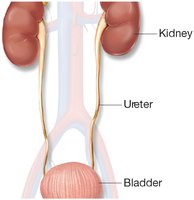
The urinary system, also known as the genitourinary (GU) system, is essential for maintaining homeostasis by filtering blood, removing waste, adjusting water and electrolyte levels, and regulating pH. The main organs include two kidneys, two ureters, one bladder, and one urethra.
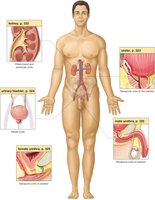
Homeostasis: The urinary system maintains a stable internal environment.
Waste Removal: Metabolic waste is filtered from the blood and excreted as urine.
Water and Electrolyte Balance: Adjusts levels to prevent dehydration or overload.
pH Regulation: Maintains acid-base balance in the body.
Anatomy and Physiology of the Urinary System
Kidneys
The kidneys are retroperitoneal organs responsible for filtering blood and producing urine. Each kidney has a concave hilum, cortex, and medulla. The hilum is the entry/exit point for the renal artery, vein, and ureter.
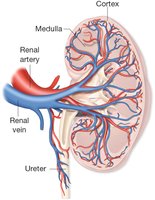
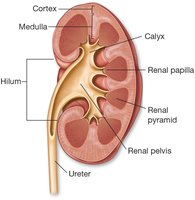
Cortex: The outer shell of the kidney.
Medulla: The inner region containing renal pyramids.
Calyx: Collects urine from pyramids and empties into the renal pelvis.
Renal Pelvis: Funnel-shaped structure that collects urine before it enters the ureter.
Nephrons
Nephrons are the functional units of the kidney, responsible for urine production. Each nephron consists of a renal corpuscle (glomerular capsule and glomerulus) and a renal tubule (proximal convoluted tubule, nephron loop, distal convoluted tubule, collecting tubule).
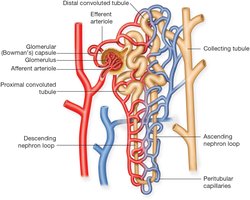
Renal Corpuscle: Filters blood via the glomerulus.
Renal Tubule: Processes filtrate into urine.
Afferent Arteriole: Brings blood to the glomerulus.
Efferent Arteriole: Carries blood away from the glomerulus.
Ureters
Ureters are muscular tubes that transport urine from the renal pelvis to the urinary bladder. They are lined with mucous membrane and are about 10-12 inches long.
Urinary Bladder
The bladder is an elastic, muscular sac located in the pelvis. It stores urine until excretion and is composed of three layers of smooth muscle lined with rugae. It can hold 300-400 mL of urine.
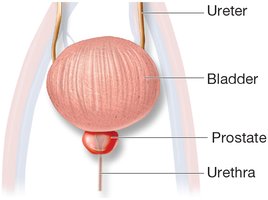
Internal Sphincter: Involuntary muscle for bladder control.
External Sphincter: Voluntary muscle for intentional emptying.
Urethra
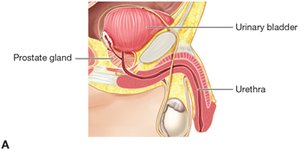
The urethra is a canal that carries urine from the bladder to the outside. It is lined with mucous membrane. The female urethra is 1-2 inches long, while the male urethra is 8 inches long and also carries semen.
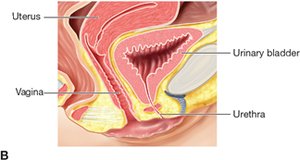
Female Urethra: Only carries urine.
Male Urethra: Carries urine and semen.
Role of Kidneys in Homeostasis
Water, Electrolyte, and pH Balance
The kidneys regulate water, electrolytes (such as sodium, potassium, chloride), and pH to maintain homeostasis. They conserve or excrete water as needed and adjust electrolyte levels through urine production.
Stages of Urine Production
Filtration, Reabsorption, and Secretion
Urine is produced in three stages: filtration, reabsorption, and secretion. These processes occur in the nephrons and ensure that waste is removed while valuable substances are retained.
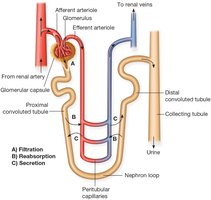
Filtration: Occurs in the renal capsule; pressure forces material out of blood into tubules.
Reabsorption: Most water, electrolytes, and nutrients are reabsorbed into blood via peritubular capillaries.
Secretion: Special cells secrete ammonia, uric acid, and other wastes into tubules.
Urine Characteristics and Urinalysis
Normal and Abnormal Findings
Urine is typically deep gold to clear, sterile during production, and contains water, electrolytes, toxins, and nitrogenous wastes. Normal urine output is 1,000-2,000 mL per day, and it is acidic. Specific gravity indicates concentration.
Normal: No glucose, blood, or albumin present.
Abnormal: Presence of glucose, blood, or albumin may indicate disease.
Urinary System Pathology
Kidney Stones (Calculi)
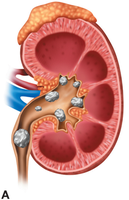
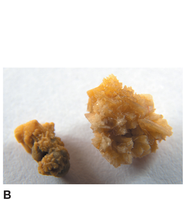
Kidney stones are solid masses formed from crystals in the urine. They can cause pain and obstruction.
Polycystic Kidney Disease
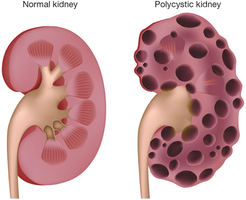
Polycystic kidney disease is characterized by multiple cysts in the kidneys, leading to impaired function.
Diagnostic Procedures
Urinalysis
Urinalysis is a laboratory test used to analyze urine for normal and abnormal components.

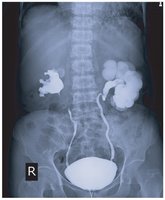
Retrograde Pyelogram
A retrograde pyelogram is an X-ray procedure using radiopaque dye to visualize the urinary tract.
Therapeutic Procedures
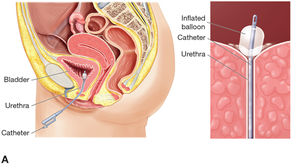
Catheterization
Catheterization involves inserting a tube into the bladder to drain urine, often used in cases of urinary retention or surgery.
Medical Terminology: Key Terms
Combining Forms, Suffixes, and Prefixes
an- + -uria: Anuria – condition of being without urine.
cyst/o + -lith: Cystolith – bladder stone.
poly- + cyst/o + -ic: Polycystic – pertaining to having multiple cysts.
pyel/o + nephr/o + -itis: Pyelonephritis – inflammation of renal pelvis and kidney.
urin/o + -meter: Urinometer – instrument to measure urine (specific gravity).
nephr/o + -gram: Nephrogram – record of the kidney.
extra- + corpor/o + -eal: Extracorporeal – pertaining to outside the body.
lith/o + -tripsy: Lithotripsy – surgical crushing of a stone.
Summary Table: Urinary System Organs and Functions
Organ | Function |
|---|---|
Kidneys | Filter blood, produce urine, regulate water/electrolytes/pH |
Ureters | Transport urine from kidneys to bladder |
Bladder | Store urine until excretion |
Urethra | Carry urine out of the body |
Additional info:
Urinary system terminology is foundational for understanding pathology, diagnostics, and treatments in medical practice.
Urinalysis is a key diagnostic tool for detecting kidney and urinary tract diseases.
