 뒤로
Bacterial Classification and Human Microbiome
스터디 가이드 - 스마트 노트
 자료에 맞춘 맞춤형 노트, 핵심 정의, 예시, 맥락을 확장해 제공합니다.
Bacterial Classification and Human Microbiome
Introduction to Disease-Causing Microorganisms
This section introduces the major groups of microorganisms associated with human disease, including Bacteria, Viruses, Fungi, Protozoans, and Helminths. The focus is on bacteria and their classification, as well as their roles in human health and disease.
Bacterial Classification
Bacteria are classified based on their structural, biochemical, and genetic characteristics. Understanding these classifications is essential for identifying disease-causing bacteria and their mechanisms of pathogenicity.
Prokaryotes are unicellular organisms lacking a nucleus and membrane-bound organelles. They include both Bacteria and Archaea.
Bacteria are classified into three domains: Bacteria, Archaea, and Eukarya.
Classification criteria include cell shape, staining patterns, biochemical properties, and genetic sequences.
Traditional classification uses Bergey's Manual of Determinative Bacteriology and Bergey's Manual of Systematic Bacteriology.
Prokaryote Habitats and Functions
Prokaryotes are ubiquitous and can survive in extreme environments. They are abundant in the human body, outnumbering human cells and playing crucial roles in health and disease.
Bacteria thrive in the mouth, nasal cavity, throat, ears, gastrointestinal tract, vagina, and on skin.
Less than 1% of prokaryotes are human pathogens, but they cause many diseases.
Prokaryotes are involved in food spoilage and foodborne illnesses.
Symbiotic Relationships
Prokaryotes interact with plants and animals in various symbiotic relationships, which can be beneficial, harmful, or neutral.
Mutualism: Both populations benefit (e.g., Bacteroides thetaiotaomicron in the human gut).
Amensalism: One population is harmed, the other is unaffected (e.g., bacteria producing bacteriocins).
Commensalism: One population benefits, the other is unaffected (e.g., Staphylococcus epidermidis on skin).
Neutralism: Neither population is affected (e.g., coexistence of vegetative bacteria and endospores).
Parasitism: One population benefits, the other is harmed (e.g., pathogenic bacteria causing disease).
Type | Population A | Population B |
|---|---|---|
Mutualism | Benefitted | Benefitted |
Amensalism | Harmed | Unaffected |
Commensalism | Benefitted | Unaffected |
Neutralism | Unaffected | Unaffected |
Parasitism | Benefitted | Harmed |
Human Microbiome
The microbiome refers to all microorganisms and their genetic material associated with a host. The human microbiome includes resident and transient microbiota, which vary by body site and over time.
Resident microbiota: Constantly live in or on the body.
Transient microbiota: Temporarily found in the body, may include pathogens.
Microbiota diversity is influenced by site, oxygen exposure, and individual differences.
Initial colonization occurs during birth, with differences between vaginal and cesarean delivery.
Resident microbiota occupy niches, preventing pathogenic colonization (e.g., Lactobacillus in the vagina inhibits yeast growth).
Taxonomy and Systematics
Assigning prokaryotes to species is challenging due to lack of sexual reproduction and limited morphological features. Classification relies on shape, staining, biochemical properties, and genetic sequences.
Bergey's Manual is a key resource for bacterial taxonomy.
Modern classification uses gene sequencing and phylogenetic analysis.
Classification by Staining Patterns
Bacteria are classified by their cell wall properties, which affect staining patterns.
Gram-positive bacteria: Thick peptidoglycan wall, retain crystal violet stain, appear purple.
Gram-negative bacteria: Thin peptidoglycan wall, lose crystal violet, appear pink/red after safranin counterstain.
Atypical bacteria: Cannot be stained by Gram stain (e.g., Mycoplasma, Chlamydia, Rickettsia).
Modern Bacterial Classification
Recent advances have led to further classification of bacteria based on genetic and biochemical features.
Deeply branching bacteria: Early evolutionary forms, live in extreme conditions.
Proteobacteria: Diverse gram-negative group, includes many pathogens (e.g., E. coli, Bordetella pertussis).
CFB group: Includes normal gut microbiota (e.g., Bacteroides).
Spirochetes: Spiral-shaped, includes Treponema pallidum (syphilis).
Low G+C gram-positive bacteria: Less than 50% guanine/cytosine, includes Bacillus anthracis, Clostridium tetani.
High G+C gram-positive bacteria: More than 50% guanine/cytosine, includes Corynebacterium diphtheriae, Mycobacterium tuberculosis.
Human Microbiome Project
The Human Microbiome Project aims to catalog the gene sequences of microbes in humans, using metagenomic analysis to study unculturable bacteria. This project has revealed unexpected diversity and the presence of pathogens in healthy individuals.
Metagenomics allows study of genetic material from entire microbial communities.
Reference databases help understand relationships between microbiota and disease.
Future goals include linking microbiome composition to disease susceptibility.
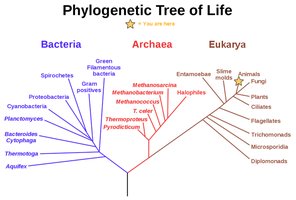
Phylogenetic Tree of Life
The phylogenetic tree illustrates the evolutionary relationships among Bacteria, Archaea, and Eukarya, highlighting the diversity and classification of life forms.
Classification of Disease-Causing Bacteria
Bacteria are classified into groups based on their cell wall structure and genetic features. The main groups include:
Proteobacteria (Gram-negative): Includes Rickettsia, Neisseria, Bordetella, Vibrios, Enterobacteriaceae, Proteus, Pseudomonas, Legionella, Salmonella, Shigella, Yersinia, Desulfovibrio, Camphylobacter, Helicobacter.
Non-proteobacteria: Includes Spirochetes, Chlamydia, Mycobacteria, Corynebacteria.
Gram-positive: Divided into High G+C (Mycobacteria, Corynebacteria) and Low G+C (Clostridium, Lactobacillus, Bacillus, Staphylococcus, Streptococcus, Enterococcus).
Deeply Branching: No known pathogens.
Summary Table: Bacterial Groups and Examples
Group | Examples | Pathogenicity |
|---|---|---|
Proteobacteria (Gram-negative) | Rickettsia, Neisseria, Bordetella, Vibrios, Enterobacteriaceae, Salmonella, Shigella, Yersinia | Many human pathogens |
Non-proteobacteria | Spirochetes, Chlamydia, Mycobacteria, Corynebacteria | Includes pathogens (e.g., syphilis, tuberculosis) |
Gram-positive (High G+C) | Mycobacteria, Corynebacteria | Tuberculosis, diphtheria |
Gram-positive (Low G+C) | Clostridium, Lactobacillus, Bacillus, Staphylococcus, Streptococcus, Enterococcus | Tetanus, anthrax, listeriosis |
Deeply Branching | None listed | No known pathogens |
Key Terms and Concepts
Microbiome: All microorganisms and their genetic material associated with a host.
Resident microbiota: Microorganisms constantly present in or on the body.
Transient microbiota: Microorganisms temporarily present in the body.
Mutualism, Amensalism, Commensalism, Neutralism, Parasitism: Types of symbiotic relationships.
Gram-positive and Gram-negative: Classification based on cell wall structure and staining.
Metagenomics: Study of genetic material from entire microbial communities.
Formulas and Equations
While this section does not include specific biochemical equations, it is important to understand the genetic basis of classification:
Percentage of G+C content in DNA:
Example: Lactobacillus species produce lactic acid, lowering vaginal pH and inhibiting pathogenic yeast growth.
Additional info: The notes expand on the classification and ecological roles of bacteria, providing context for their importance in human health and disease.
