 뒤로
Biochemical Foundations of Microbiology: Genes, Proteins, and Cellular Components
스터디 가이드 - 스마트 노트
 자료에 맞춘 맞춤형 노트, 핵심 정의, 예시, 맥락을 확장해 제공합니다.
Introduction to Microbiology and Biochemistry
Overview of Course Content
This module introduces the biochemical and molecular foundations essential for understanding microbiology, focusing on genes, proteins, and cellular structures. It covers the origin of life, cell structure, major chemical components, and the flow of genetic information, providing a basis for advanced study in microbial genetics, metabolism, and biotechnology.
Key Topics: Structure and function of DNA, proteins, genomes, principles of DNA replication, gene regulation, and molecular techniques.
Applications: Laboratory and bioinformatics skills for analyzing nucleic acids and proteins.
Origin of Life and Abiotic Synthesis of Biomolecules
Miller-Urey Experiment and Chemical Evolution
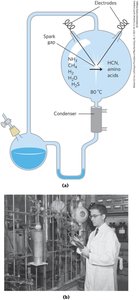
The Miller-Urey experiment demonstrated that simple biomolecules, such as amino acids, could be synthesized abiotically under conditions simulating early Earth. This experiment supports the theory that life originated from chemical evolution, possibly near hydrothermal vents or through lightning-induced reactions.
Abiotic Synthesis: Electrical sparks in a closed system containing simple gases produced amino acids and other biomolecules.
Significance: Provides evidence for the chemical origins of life.
Example: Amino acids formed in Miller-Urey apparatus.
Hydrothermal Vents and Early Metabolic Pathways
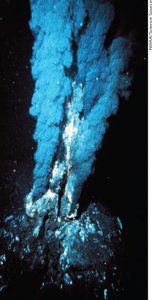
Hydrothermal vents on the ocean floor are hypothesized as sites for the evolution of simple compounds and metabolic pathways, with RNA or similar molecules possibly serving as the first catalysts and genetic material.
RNA World Hypothesis: RNA may have been the first gene and catalyst.
Evolutionary Steps: Simple compounds evolved into self-replicating RNA and protocells.
Prebiotic Evolution of Genetic Systems
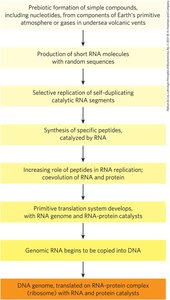
Prebiotic formation of nucleotides and short RNA molecules led to the development of catalytic RNA segments, peptide synthesis, and eventually the translation system involving both RNA and protein catalysts.
Key Steps: Formation of nucleotides, self-replicating RNA, peptide synthesis, translation system, and genomic RNA copying into DNA.
Biological Evolution and Cell Structure
Timeline of Biological Evolution
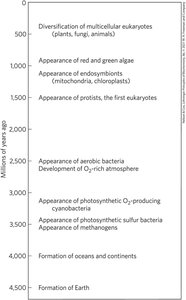
Biological evolution spans over 3.5 billion years, with major milestones including the formation of oceans, appearance of photosynthetic bacteria, development of O2-rich atmosphere, and diversification of multicellular eukaryotes.
Key Events: Formation of Earth, oceans, photosynthetic bacteria, aerobic bacteria, endosymbiosis, multicellular eukaryotes.
Cellular Structure: Prokaryotes vs. Eukaryotes
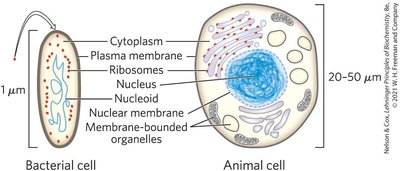
Cells are the fundamental structural and functional units of all living organisms. Prokaryotic cells lack a nucleus and membrane-bound organelles, while eukaryotic cells possess these features, allowing for greater complexity and specialization.
Prokaryotic Cells: Simple structure, nucleoid region, no membrane-bound organelles.
Eukaryotic Cells: Complex structure, nucleus, membrane-bound organelles.
Comparison: Size, complexity, organelle presence.
Plant vs. Animal Cell Structures
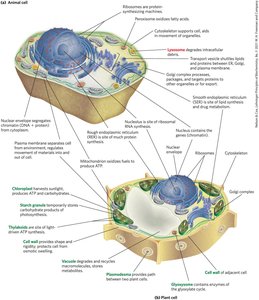
Plant and animal cells share many organelles but differ in certain structures such as cell walls, chloroplasts, and vacuoles in plant cells, which are absent in animal cells.
Plant Cells: Cell wall, chloroplasts, large central vacuole.
Animal Cells: Lysosomes, centrioles, smaller vacuoles.
Chemical Principles of Microbiology
Elements Essential for Life
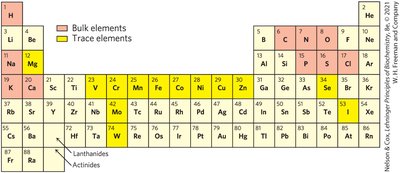
Life depends on a set of essential elements, with carbon, hydrogen, oxygen, nitrogen, phosphorus, and sulfur being the most common. Metal ions such as potassium, sodium, calcium, magnesium, zinc, and iron are crucial for metabolic processes.
Bulk Elements: C, H, O, N, P, S.
Trace Elements: Metal ions required in small amounts.
Carbon Bonding and Molecular Geometry
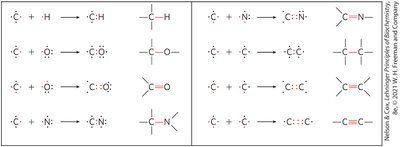
Carbon atoms form covalent single, double, and triple bonds, allowing for diverse molecular structures. The tetrahedral arrangement of carbon's four single bonds enables free rotation, while double bonds restrict rotation, influencing molecular properties.
Bond Types: Single, double, triple covalent bonds.
Geometry: Tetrahedral for single bonds, planar for double bonds.
Importance: Determines structure and function of biomolecules.

Molecules of Microbiology
Major Chemical Constituents of Cells
Cells are composed of macromolecules (polymers), oligomers, nonpolymeric molecules, and small molecules. Macromolecules include nucleic acids, proteins, and polysaccharides, while lipids, small molecules, and ions play various structural and metabolic roles.
Macromolecules: DNA, RNA, proteins, polysaccharides.
Oligomers: Peptides, small RNAs.
Nonpolymeric Molecules: Lipids, hormones, pigments.
Small Molecules: Water, amino acids, nucleotides, simple sugars, ions.
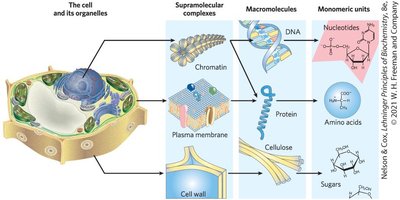
Supramolecular Structures and Non-covalent Interactions
Cells build supramolecular structures from macromolecules, held together by non-covalent interactions such as hydrogen bonds, ionic interactions, van der Waals forces, and the hydrophobic effect.
Key Interactions: Hydrogen bonds, ionic bonds, van der Waals forces, hydrophobic effect.
Examples: Chromatin, plasma membrane, cell wall.
Nucleic Acids: Structure and Function
Basic Structure of Nucleic Acids
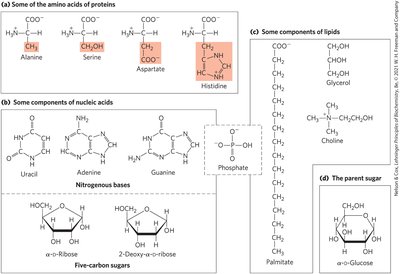
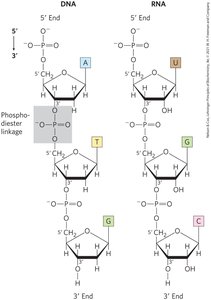
Nucleic acids are polymers of nucleotides, each consisting of a pentose sugar (deoxyribose in DNA, ribose in RNA), a nitrogenous base, and a phosphate group. Nucleotides are linked by 5'-3' phosphodiester bonds.
DNA Bases: Adenine (A), Cytosine (C), Guanine (G), Thymine (T).
RNA Bases: Adenine (A), Cytosine (C), Guanine (G), Uracil (U).
Phosphodiester Linkage: Covalent bond between C5 of one nucleotide and C3 of the next.
Functions of Nucleic Acids
DNA stores genetic information, regulates cell metabolism, and is inherited during cell division. RNA is involved in protein synthesis and various structural and regulatory roles.
DNA: Genetic information storage, regulation of protein synthesis, inheritance.
RNA: Protein synthesis, gene regulation, structural roles.
Proteins: Structure and Function
Basic Structure of Proteins
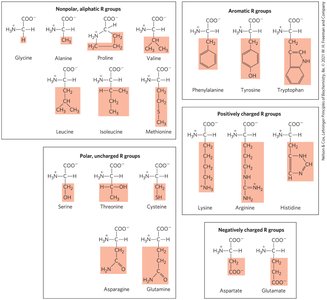
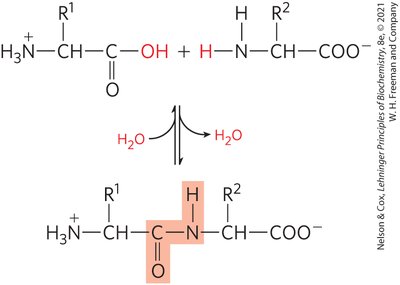
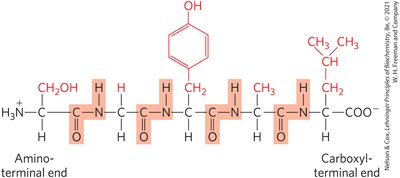
Proteins are polymers of 20 amino acids, each with a central carbon attached to an amino group, carboxyl group, hydrogen, and a unique R group. Amino acids differ in polarity, charge, and biochemical properties.
Peptide Bonds: Link consecutive amino acids.
Protein Structure: Free amino terminal and carboxyl terminal.
Genetic Determination: DNA sequence determines amino acid sequence via mRNA.
Functions of Proteins
Proteins perform diverse functions, including catalysis (enzymes), defense (antibodies), energy storage, transport, signaling, structural support, and movement.
Enzymes: Catalyze biochemical reactions.
Antibodies: Immune defense.
Transport: Channels for water, sugars, ions.
Hormones: Insulin, signaling molecules.
Structural: Collagen, keratin.
Motor Proteins: Muscle contraction, movement of cellular structures.
Carbohydrates: Structure and Function
Types of Carbohydrates
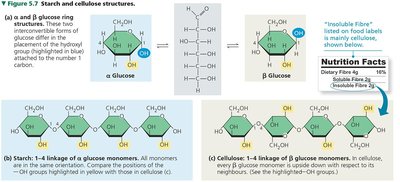
Carbohydrates include monosaccharides (simple sugars), disaccharides, and polysaccharides. Glucose, fructose, sucrose, lactose, starch, cellulose, and glycogen are key examples.
Monosaccharides: Glucose, fructose.
Disaccharides: Sucrose, lactose.
Polysaccharides: Starch (plants), cellulose (plants), glycogen (animals).
Functions of Carbohydrates
Carbohydrates serve as energy storage, provide structural support, are components of nucleic acids, and participate in cell-cell communication.
Energy Storage: Glucose, starch, glycogen.
Structural Support: Cellulose, chitin.
Nucleic Acid Component: Ribose, deoxyribose.
Cell Communication: Glycoproteins, glycolipids.
Lipids: Structure and Function
Types and Functions of Lipids
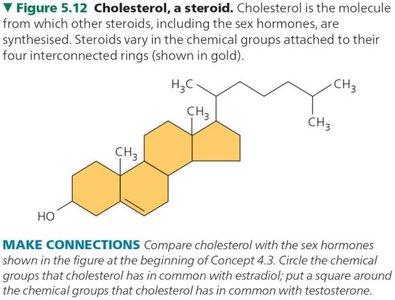
Lipids are hydrophobic molecules with diverse structures and functions, including energy storage, membrane structure, hormone synthesis, pigments, and vitamins.
Energy Storage: Triglycerides (fats and oils).
Membrane Structure: Phospholipid bilayers, cholesterol.
Hormones: Testosterone, estrogen.
Pigments: Chlorophylls, carotenoids.
Vitamins: Vitamin D.
Suggested Reading and Further Study
Recommended Textbooks and Resources
For deeper understanding, students are encouraged to consult Lehninger Principles of Biochemistry (Nelson & Cox, Ed. VIII) and Campbell Biology (Ed. XII), focusing on chapters and figures referenced in the lecture notes. Additional resources include genomics and proteomics databases, journal articles, and videos.
Lehninger Principles of Biochemistry: Chapters 1, 3, 5, 8, 24, 27.
Campbell Biology: Chapters 5, 17.
Online Databases: Human genome sequence resources.
Additional info: These notes provide foundational knowledge for understanding microbial cell structure, metabolism, genetics, and biotechnology, relevant to multiple chapters in a college-level microbiology course.
