 뒤로
뒤로Chapter 5: Microbial Genetics – Structure, Function, and Expression
스터디 가이드 - 스마트 노트
 자료에 맞춘 맞춤형 노트, 핵심 정의, 예시, 맥락을 확장해 제공합니다.
Genomic Vocabulary, Size, and Organization
Key Genetic Terms
Understanding genetics requires familiarity with foundational vocabulary and concepts that describe the structure and function of genetic material in cells.
Genome: The complete set of genetic material in a cell or virus. In cells, this is typically DNA; in some viruses, it may be RNA.
Gene: A sequence of nucleotides in DNA that codes for a specific trait or function.
Allele: Alternative forms of a gene found at the same locus on homologous chromosomes.
Genotype: The genetic makeup of an organism (e.g., homozygous dominant, heterozygous).
Phenotype: The observable physical or physiological traits of an organism, determined by genotype and environment.
Genotype influences phenotype by dictating which proteins are produced, thereby affecting cellular structure and function.
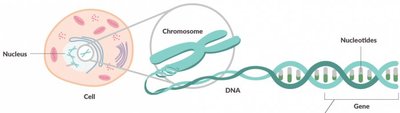
Genome Size and Organization
Genome size varies widely among organisms and is generally larger in eukaryotes than in prokaryotes. However, the number of genes does not always correlate directly with genome size due to non-coding regions in eukaryotes.
Example: E. coli K12 (nonpathogenic) has ~4,400 genes; O157:H7 (pathogenic) has ~5,500 genes.
Humans have about 24,000 genes, while the largest known bacterial genome (S. cellulosum) has 9,400 genes.
Chromosome Structure and Packaging
Genomes are organized into chromosomes, which are condensed DNA molecules associated with proteins for efficient packaging and regulation.
Histones (eukaryotes): Proteins around which DNA wraps, forming nucleosomes and further condensing into chromosomes.
Histone-like proteins (prokaryotes): Serve a similar organizational role in bacteria.
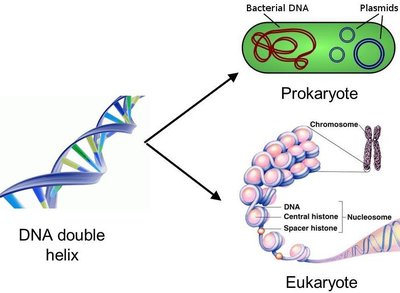
Prokaryotic vs. Eukaryotic Genomes
There are significant differences in genome structure and organization between prokaryotes and eukaryotes.
Factor | Prokaryotic Genomes | Eukaryotic Genomes |
|---|---|---|
Complexity | Simple | More complex |
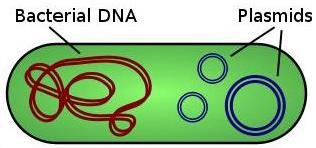
Genome can include | Chromosomal DNA and plasmids | Chromosomal DNA, DNA in mitochondria/chloroplasts, and plasmids |
Chromosomes | Few (generally only one); usually circular | Many; nuclear chromosomes are linear |
Location of chromosome(s) | Nucleoid region | Nucleus |
DNA organized by | Histone-like proteins | Histones |
Nucleic Acid Structure: DNA and RNA
Nucleotide Structure
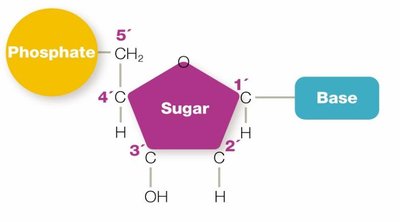
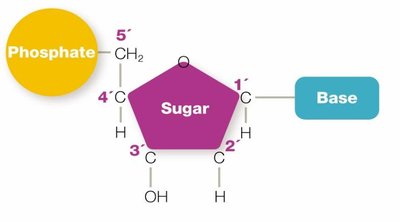
Nucleic acids are polymers of nucleotides, each consisting of:
A phosphate group (attached to the 5' carbon of the sugar)
A five-carbon sugar (deoxyribose in DNA, ribose in RNA)
A nitrogenous base (A, T, C, G in DNA; A, U, C, G in RNA)
DNA Structure
DNA is a double-stranded helix with antiparallel strands (one runs 5' to 3', the other 3' to 5'). The backbone is composed of alternating sugars and phosphates, while the "rungs" are nitrogenous base pairs (A-T, C-G).
Phosphodiester bonds link nucleotides between the 3' hydroxyl and 5' phosphate groups.
Base pairing is specific: A pairs with T (via 2 hydrogen bonds), C pairs with G (via 3 hydrogen bonds).
RNA Structure
RNA is typically single-stranded but can form secondary structures. It contains ribose sugar and uracil (U) instead of thymine (T).
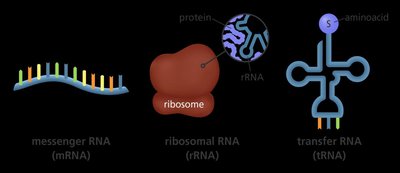
Three main types: messenger RNA (mRNA), transfer RNA (tRNA), and ribosomal RNA (rRNA).
RNA is synthesized in the 5' to 3' direction.
DNA vs. RNA Comparison
Property | DNA | RNA |
|---|---|---|
Function | Stores genetic information | Transfers and translates genetic information |
Structure | Double helix | Single strand (may form secondary structures) |
Sugar | Deoxyribose | Ribose |
Bases | A, T, C, G | A, U, C, G |
Location | Nucleus (eukaryotes), cytoplasm (prokaryotes) | Nucleus, cytoplasm, ribosome |
DNA Replication
Overview and Enzymes
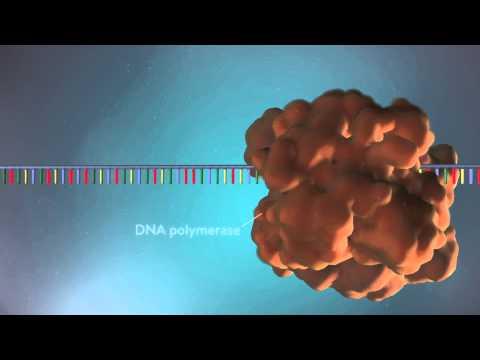
DNA replication is the process by which a cell copies its genome before division. It is semiconservative, meaning each new DNA molecule contains one original (parent) strand and one newly synthesized (daughter) strand.
Occurs in three main steps: unwinding, copying, and rewinding DNA.
Highly accurate, with proofreading mechanisms to minimize mutations.
Enzyme | Function |
|---|---|
Helicase | Unwinds DNA helix |
Primase | Builds RNA primers |
DNA polymerase III | Main enzyme for DNA synthesis |
DNA polymerase I | Replaces RNA primers with DNA |
Ligase | Seals nicks in the sugar-phosphate backbone |
Gyrase/Topoisomerases | Relieve torsion ahead of the replication fork |
Leading vs. Lagging Strand Synthesis
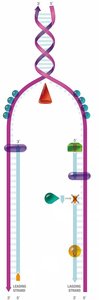
Because DNA polymerase can only synthesize DNA in the 5' to 3' direction, replication differs between the two template strands:
Leading strand: Synthesized continuously toward the replication fork.
Lagging strand: Synthesized discontinuously away from the fork in short fragments (Okazaki fragments), later joined by ligase.
Protein Synthesis: Transcription and Translation
Central Dogma of Molecular Biology
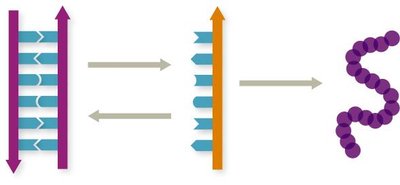
The central dogma describes the flow of genetic information: DNA is transcribed into RNA, which is then translated into protein. Some viruses and specialized cells can reverse transcribe RNA back into DNA.
Transcription (DNA to RNA)
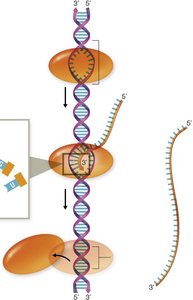
Transcription is the first step of gene expression, where a segment of DNA is used as a template to synthesize RNA. It occurs in three stages:
Initiation: RNA polymerase binds to the promoter region, and DNA unwinds.
Elongation: RNA polymerase synthesizes RNA in the 5' to 3' direction, pairing ribonucleotides with the DNA template.
Termination: A termination sequence signals RNA polymerase to release the newly made RNA.
RNA Processing (Eukaryotes)
In eukaryotes, the initial mRNA transcript (pre-mRNA) undergoes splicing to remove non-coding introns and join coding exons before export to the cytoplasm for translation.
Translation (RNA to Protein)
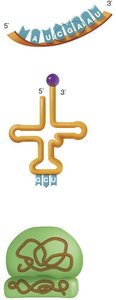
Translation is the process by which ribosomes synthesize proteins using the sequence of codons in mRNA. It involves three main types of RNA:
mRNA (messenger RNA): Carries the genetic code in codons (triplets of nucleotides).
tRNA (transfer RNA): Brings amino acids to the ribosome, matching its anticodon to the mRNA codon.
rRNA (ribosomal RNA): Combines with proteins to form ribosomes, the site of protein synthesis.
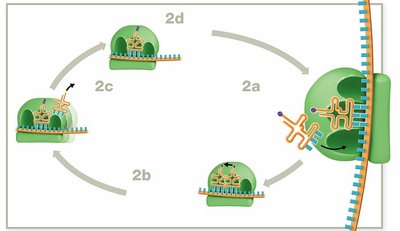
Translation occurs in three steps:
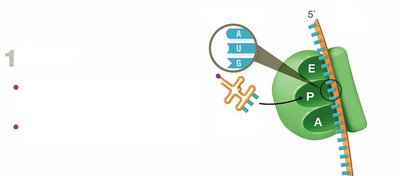
Initiation: Ribosome assembles at the start codon (AUG) on mRNA, and the initiator tRNA binds.
Elongation: tRNAs bring amino acids to the ribosome, where peptide bonds form between them, and the ribosome moves along the mRNA.
Termination: When a stop codon is reached, the ribosome releases the completed polypeptide.
Mutations and Genetic Variation
Types of Mutations
Mutations are changes in the genetic material and can be spontaneous or induced by mutagens. They are essential for evolution and can be:
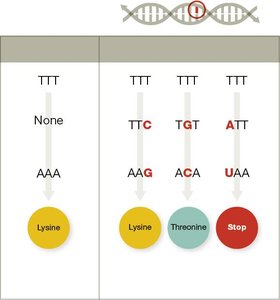
Substitution (point mutation): One nucleotide is replaced by another.
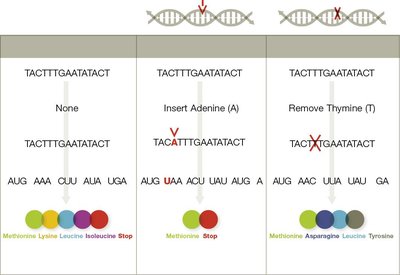
Insertion: One or more nucleotides are added.
Deletion: One or more nucleotides are removed.
Mutation Effects
Silent mutation: No change in amino acid sequence.
Missense mutation: Changes one amino acid in the protein.
Nonsense mutation: Introduces a premature stop codon.
Frameshift mutation: Alters the reading frame, usually due to insertion or deletion not in multiples of three.
Gene Transfer and Genetic Engineering
Vertical and Horizontal Gene Transfer
Genetic variation in microbes can occur through:
Vertical gene transfer: Transmission of genetic material from parent to offspring during reproduction.
Horizontal gene transfer: Transfer of genetic material between organisms without reproduction. Main mechanisms include:
Conjugation: Direct transfer of DNA via a pilus.
Transformation: Uptake of free DNA from the environment.
Transduction: Transfer of DNA by bacteriophages (viruses that infect bacteria).
Transposons: "Jumping genes" that move within and between DNA molecules.
Genetic Engineering
Genetic engineering involves the deliberate modification of an organism's genome using biotechnology, resulting in genetically modified organisms (GMOs).
Regulation of Gene Expression
Control of Protein Synthesis
Cells regulate gene expression to conserve energy and resources. Regulation can occur at multiple levels:
Pre-transcriptional regulation: Controls whether a gene is transcribed (e.g., operons, epigenetic modifications).
Post-transcriptional regulation: Controls mRNA stability, splicing, and translation efficiency (e.g., small noncoding RNAs, riboswitches).
Operons (Prokaryotes)
Operons are clusters of genes under the control of a single promoter and regulatory elements, allowing coordinated expression. Types include:
Inducible operons: Off by default, turned on in response to a signal (e.g., lac operon).
Repressible operons: On by default, turned off when not needed (e.g., trp operon).
Quorum Sensing
Bacteria communicate using chemical signals (autoinducers) to coordinate gene expression in response to population density, a process known as quorum sensing.
Small Noncoding RNAs and Riboswitches
Small noncoding RNAs can bind to mRNA to inhibit translation or promote degradation. Riboswitches are mRNA regions that change structure in response to metabolites, regulating gene expression.
Summary Table: Key Concepts in Microbial Genetics
Concept | Description |
|---|---|
Genome | All genetic material in a cell or virus |
Gene | DNA sequence coding for a trait |
Mutation | Change in DNA sequence |
Transcription | DNA to RNA |
Translation | RNA to protein |
Horizontal gene transfer | Gene transfer between organisms (not parent to offspring) |
Operon | Cluster of genes under shared regulation (prokaryotes) |
