 뒤로
Classification of Microorganisms: Taxonomy, Systematics, and Domains
스터디 가이드 - 스마트 노트
 자료에 맞춘 맞춤형 노트, 핵심 정의, 예시, 맥락을 확장해 제공합니다.
Chapter 10: Classification of Microorganisms
Introduction to Taxonomy and Systematics
Taxonomy is the science of classification, description, identification, and naming of living organisms. It organizes organisms into hierarchical categories called taxa, reflecting their degree of similarity. Systematics, also known as phylogeny, is the study of the evolutionary history and relationships among organisms. - Taxonomy: Assigns organisms to taxa based on similarities. - Systematics: Investigates evolutionary relationships using evidence such as fossils, genomes, and molecular clocks. - Phylogenetic relationships: Determined by comparing genetic material, especially ribosomal RNA (rRNA). 
Historical Development of Classification Systems
The classification of life has evolved through several key milestones: - 1735: Linnaeus established two kingdoms: Plantae and Animalia. - 1800s: Von Nägeli and Haeckel expanded classification to include bacteria, fungi, and protists. - 1937: The term 'prokaryote' was introduced to distinguish cells without a nucleus. - 1968: Murray proposed the kingdom Prokaryotae. - 1969: Whittaker introduced the five-kingdom system, adding Fungi and dividing life into Prokaryota and Eukaryota. 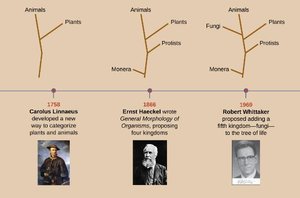
Carolus Linnaeus and the Taxonomic Hierarchy
Linnaeus established the first taxonomic hierarchy, which remains foundational in biology. - Hierarchy: Kingdom, Class, Order, Family, Genus, Species. - Systema Naturae (1735): Linnaeus's work formalized the binomial nomenclature system. 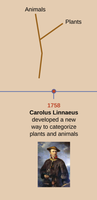
Ernst Haeckel and the Expansion of Kingdoms
Haeckel proposed additional kingdoms to accommodate microorganisms. - 1866: Introduced Protista and Monera. - Protista: Included bacteria, protozoa, algae, and fungi. 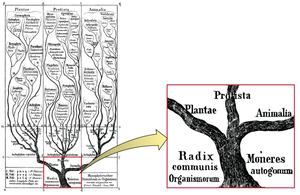
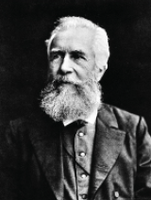
Robert Whittaker and the Five-Kingdom System
Whittaker's system added Fungi as a distinct kingdom and divided life into two empires: Prokaryota and Eukaryota. - 1969: Five kingdoms: Animalia, Plantae, Fungi, Protista, Monera. 
Three-Domain System: Woese and Fox
In 1978, Carl Woese and George Fox revolutionized classification by using rRNA sequences to define three domains: - Eukarya: Includes animals, plants, fungi, and protists. - Bacteria: True bacteria, including cyanobacteria and gram-positive/negative bacteria. - Archaea: Includes methanogens, extreme halophiles, and hyperthermophiles. - Molecular evidence: rRNA and genome sequencing are used to determine evolutionary relationships. 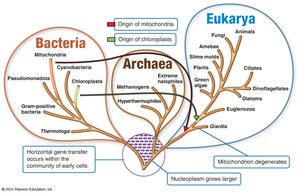
Phylogenetic Trees and Molecular Clocks
Phylogenetic trees group organisms according to common properties and evolutionary history. - Evidence: Fossils, genomes, and molecular clocks (mutations accumulate at a constant rate). - rRNA: Used to determine relationships among prokaryotes. 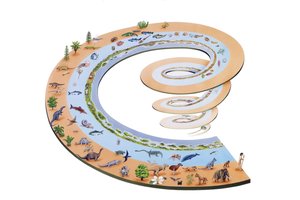
Classification of Prokaryotes
Prokaryotes are classified using Bergey's Manual of Systematics of Archaea and Bacteria. - Domains: Bacteria and Archaea. - Prokaryotic species: Population of cells with high genomic similarity. - Culture: Bacteria grown in laboratory media. - Clone: Population of cells derived from a single parent cell. - Strain: Genetically different cells within a clone. 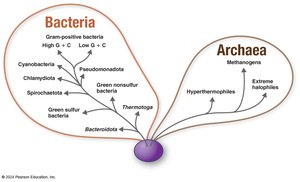
Comparison of Archaea, Bacteria, and Eukarya
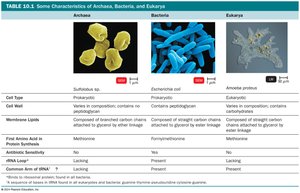
The three domains differ in cell structure, genetics, and biochemistry.
Feature | Archaea | Bacteria | Eukarya |
|---|---|---|---|
Cell Type | Prokaryotic | Prokaryotic | Eukaryotic |
Cell Wall | Varies in composition; contains no peptidoglycan | Contains peptidoglycan | Varies; contains carbohydrates |
Membrane Lipids | Composed of branched carbon chains attached to glycerol by ether linkage | Composed of straight carbon chains attached to glycerol by ester linkage | Composed of straight carbon chains attached to glycerol by ester linkage |
First Amino Acid in Protein Synthesis | Methionine | Formylmethionine | Methionine |
Antibiotic Sensitivity | No | Yes | No |
rRNA Sequence | Unique | Unique | Unique |
Classification of Eukaryotes
Eukaryotes are classified into several kingdoms based on cell structure and nutritional modes. - Protista: Mostly unicellular, nutritionally diverse, grouped into clades based on rRNA. - Fungi: Chemoheterotrophic, unicellular or multicellular, cell walls of chitin, develop from spores or hyphal fragments. - Plantae: Multicellular, cellulose cell walls, undergo photosynthesis. - Animalia: Multicellular, no cell walls, chemoheterotrophic, ingest organic matter.
Classification of Viruses
Viruses are not part of the tree of life because they are not composed of cells and require a host cell for replication. - Viral species: Population of viruses with similar characteristics, distinguished by morphology, genomes, enzymes, and ecological niche. - Genomes: Highly divergent, can be as few as 11 genes, do not fit into sequence-based alignments. 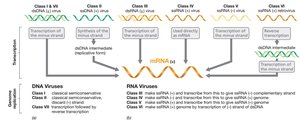
Summary Table: Key Terms in Microbial Classification
Term | Definition |
|---|---|
Taxonomy | Science of classification, description, identification, and naming of organisms |
Systematics | Study of evolutionary history and relationships among organisms |
Phylogeny | Evolutionary history of a species or group of related species |
Domain | Highest taxonomic rank; Bacteria, Archaea, Eukarya |
Kingdom | Second highest rank; Animalia, Plantae, Fungi, Protista, Monera |
Species | Group of organisms with similar characteristics |
Clone | Population of cells derived from a single parent cell |
Strain | Genetically different cells within a clone |
Additional info:
- The classification of microorganisms is foundational for understanding microbial diversity, evolution, and relationships. - Modern taxonomy relies heavily on molecular techniques, especially rRNA sequencing, to resolve evolutionary relationships. - Viruses, though not considered living, are classified based on genome type and replication strategy, which is essential for virology and disease control.
