 뒤로
Controlling Microbial Growth in the Body: Antimicrobial Drugs and Resistance
스터디 가이드 - 스마트 노트
 자료에 맞춘 맞춤형 노트, 핵심 정의, 예시, 맥락을 확장해 제공합니다.
Controlling Microbial Growth in the Body
Introduction to Antimicrobial Agents
Antimicrobial agents are essential tools in modern medicine, used to treat infections by either killing or inhibiting the growth of microbes. Understanding their types, history, and mechanisms is crucial for microbiology students.
Drug: Any substance that affects the physiology of an organism (e.g., caffeine, alcohol, nicotine).
Chemotherapeutics: Drugs that act against a disease (e.g., Lipator for cholesterol, Nexium for acid reflux).
Antimicrobial agents: Drugs specifically designed to treat infections by targeting microbes.
History of Antimicrobial Agents
The development of antimicrobial agents revolutionized the treatment of infectious diseases.
Robert Koch: Established the relationship between microbes and diseases, but early treatments were unavailable.
Paul Ehrlich: Coined 'chemotherapy' and developed Salvarsan, an arsenic compound targeting pathogens.
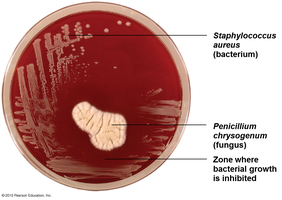
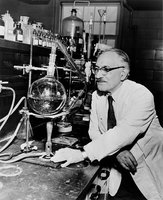
Alexander Fleming: Discovered penicillin from Penicillium fungi, which kills bacteria. The development of penicillin as a mass-producible medicine was achieved by Howard Florey, Norman Heatley, and Ernst Chain.
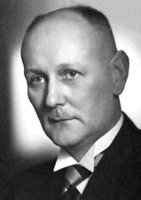
Gerhard Domagk: Discovered sulfanilamide (Prontosil), the first commercially available antibiotic.
Selman Waksman: Coined 'antibiotics' for compounds produced by microorganisms and discovered streptomycin from Streptomyces bacteria.

Types of Antimicrobial Agents
Antibiotics: Produced by microorganisms to kill other microbes.
Semisynthetic: Chemically modified antibiotics for improved efficacy.
Synthetics: Fully synthesized in laboratories.
Selective Toxicity
Selective toxicity is the principle that an antimicrobial should harm the microbe but not the host.
Antibacterial drugs: Most numerous and diverse.
Antifungal and antiviral drugs: Fewer available due to similarities between eukaryotic cells and host cells.
Mechanisms of Action of Antimicrobials
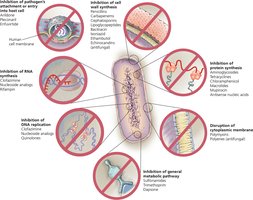
Antimicrobials act through several distinct mechanisms.
Inhibition of cell wall synthesis
Disruption of cytoplasmic membrane
Inhibition of protein synthesis
Inhibition of nucleic acid synthesis
Inhibition of metabolic pathways
Inhibition of pathogen attachment or entry
Inhibition of Cell Wall Synthesis
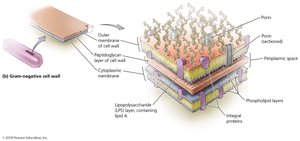
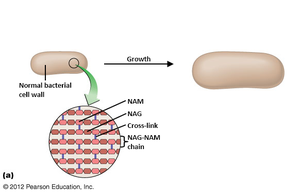
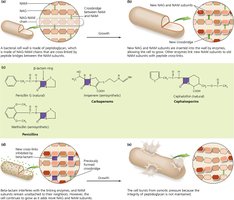
Bacterial cell walls: Composed of peptidoglycan, a mesh-like polymer of N-acetylglucosamine (NAG) and N-acetylmuramic acid (NAM).
Gram-positive: Thick peptidoglycan layer, teichoic acids, purple after Gram stain.
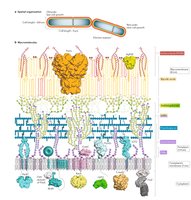
Gram-negative: Thin peptidoglycan, outer membrane with LPS, pink after Gram stain.
Beta-lactam drugs: Penicillins, cephalosporins, carbapenems inhibit cross-linking of NAM subunits.
Semisynthetic derivatives: More stable, better absorbed, broader spectrum.
Mycobacteria: Cell walls contain mycolic acids; drugs like isoniazid and ethambutol target these.
Echinocandins: Target fungal cell wall biosynthesis (e.g., caspofungin inhibits glucan synthesis).
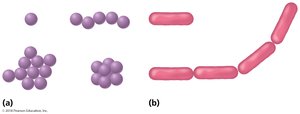
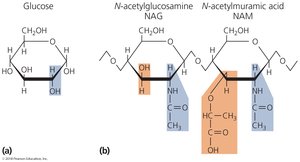
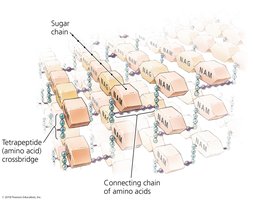
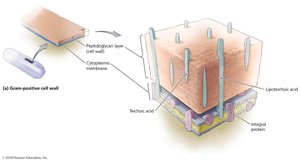
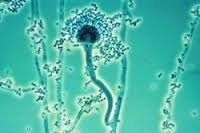
Disruption of Cytoplasmic Membrane
Polymyxins: Disrupt bacterial membranes.
Polyenes (e.g., Amphotericin B): Target ergosterol in fungal membranes, forming pores and causing cell death. Mammalian cells have cholesterol, making them less susceptible.
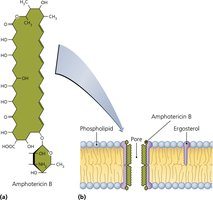
Inhibition of Protein Synthesis
Ribosomes: Prokaryotes have 70S ribosomes; eukaryotes have 80S. Drugs can selectively target bacterial ribosomes.
Examples: Aminoglycosides, tetracyclines, chloramphenicol, macrolides.
Note: Mitochondria in eukaryotes have 70S ribosomes, so some drugs may affect host cells.
Inhibition of Nucleic Acid Synthesis
Drugs: Actinomycin, nucleotide analogs, quinolones, rifampin.
Nucleotide analogs: Mimic normal nucleotides, disrupt viral replication (e.g., AZT for HIV).
Quinolones: Target DNA gyrase in bacteria.
Rifampin: Binds bacterial RNA polymerase, blocking transcription.
Inhibition of Metabolic Pathways
Sulfa drugs: Inhibit folic acid synthesis in bacteria (humans obtain folic acid from diet).
Other agents: Target unique metabolic pathways in pathogens (e.g., quinones for malaria, heavy metals for enzyme inactivation).
Inhibition of Pathogen Attachment or Entry
Arilone and pleconaril: Block viral attachment to host cells (e.g., polio and cold viruses).
Spectrum of Action
Narrow-spectrum: Effective against few organisms.
Broad-spectrum: Effective against many organisms; may lead to secondary infections by killing normal flora.
Ideal Antimicrobial Agent
Readily available
Inexpensive
Chemically stable
Easily administered
Nontoxic and nonallergenic
Selectively toxic against a wide range of pathogens
Testing Efficacy of Antimicrobials
Diffusion susceptibility test (Kirby Bauer): Measures zone of inhibition.
Minimum inhibitory concentration (MIC): Lowest concentration inhibiting visible growth.
E test: Combines MIC and diffusion test; uses a gradient strip.
Minimum bactericidal concentration (MBC): Lowest concentration that kills bacteria.
Development of Resistance
Natural resistance: Some pathogens are inherently resistant.
Acquired resistance: Through mutations or acquisition of resistance genes (R-plasmids).
Mechanisms of Microbial Resistance
Enzyme production to destroy or deactivate drug (e.g., beta-lactamases).
Prevent drug entry into cell.
Alter drug target.
Alter metabolic chemistry.
Pump drug out of cell (efflux pumps).
Biofilms retard drug diffusion.
Special proteins (e.g., MfpA in Mycobacterium tuberculosis) block drug action.
Limiting Resistance
Maintain high drug concentration for sufficient time.
Use combinations of drugs (synergism).
Restrict use to necessary cases.
Challenges in Antibiotic Development
High cost of drug development.
Antibiotics are used sparingly to prevent resistance, limiting profitability.
Summary Table: Mechanisms of Antimicrobial Action
Mechanism | Example Drugs | Target |
|---|---|---|
Cell Wall Synthesis Inhibition | Penicillins, Cephalosporins, Vancomycin | Peptidoglycan |
Cytoplasmic Membrane Disruption | Polymyxins, Amphotericin B | Membrane integrity |
Protein Synthesis Inhibition | Aminoglycosides, Tetracyclines | Ribosomes |
Nucleic Acid Synthesis Inhibition | Quinolones, Rifampin | DNA/RNA |
Metabolic Pathway Inhibition | Sulfa drugs | Folic acid synthesis |
Attachment/Entry Inhibition | Pleconaril | Viral receptors |
Summary Table: Mechanisms of Microbial Resistance
Mechanism | Description |
|---|---|
Enzyme production | Destroys drug (e.g., beta-lactamase) |
Prevent entry | Alter membrane proteins |
Alter target | Mutate drug binding site |
Alter metabolism | Change metabolic pathway |
Efflux pumps | Pump drug out |
Biofilm formation | Retard drug diffusion |
Special proteins | Block drug action (e.g., MfpA) |
Key Equations
Minimum Inhibitory Concentration (MIC):
Minimum Bactericidal Concentration (MBC):
Additional info:
Some images and figures were included to visually reinforce the mechanisms and historical context of antimicrobial drugs.
Tables were inferred and expanded for clarity and completeness.
