 뒤로
Controlling Microbial Growth in the Environment
스터디 가이드 - 스마트 노트
 자료에 맞춘 맞춤형 노트, 핵심 정의, 예시, 맥락을 확장해 제공합니다.
Controlling Microbial Growth in the Environment
Chapter Overview
This chapter explores the principles, methods, and applications of controlling microbial growth in various environments. It covers both physical and chemical methods, their mechanisms, and factors influencing their efficacy, as well as laboratory safety levels and evaluation of disinfectants.
Basic Principles of Microbial Control
Terminology of Microbial Control
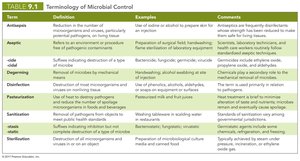
Understanding the terminology is essential for distinguishing between different levels and methods of microbial control. The following table summarizes key terms, their definitions, examples, and comments.
Term | Definition | Examples | Comments |
|---|---|---|---|
Antisepsis | Reduction in the number of microorganisms and viruses, particularly potential pathogens, on living tissue | Use of iodine or alcohol to prepare skin for an injection | Antiseptics are frequently disinfectants whose strength has been reduced to make them safe for living tissues |
Aseptic | Refers to an environment or procedure free of pathogenic contaminants | Preparation of surgical field; handwashing; flame sterilization of laboratory equipment | Scientists, laboratory technicians, and healthcare workers routinely follow standard aseptic techniques |
Degerming | Removal of microbes by mechanical means | Handwashing; alcohol swabbing at site of injection | Chemicals play a secondary role to the mechanical removal of microbes |
Disinfection | Destruction of most microorganisms and viruses on nonliving tissue | Use of phenolics, alcohols, aldehydes, or soaps on equipment or surfaces | The term is primarily in relation to pathogens; some nonpathogens and spores may remain |
Pasteurization | Use of heat to destroy pathogens and reduce the number of spoilage microorganisms in foods and beverages | Pasteurized milk and fruit juices | Heat treatment is brief to avoid altering taste; not sterilization |
Sanitization | Removal of pathogens from objects to meet public health standards | Washing tableware in scalding water in restaurants | Standards of sanitization vary among governmental jurisdictions |
Sterilization | Destruction of all microorganisms and viruses in or on an object | Preparation of microbiological culture media and canned food | Typically achieved by steam under pressure, incineration, or ethylene oxide gas |
Microbial Death Rate
Microbial death rate refers to the constant percentage of a microbial population killed per unit time when exposed to a particular agent or condition. This concept is crucial for understanding the effectiveness of sterilization and disinfection processes.
Death rate is logarithmic: A constant proportion of cells die in each time interval.
Decimal reduction time (D-value): The time required to kill 90% of the microorganisms present.
Example: If 90% of a population is killed each minute, the number of survivors decreases by one log unit per minute.

Action of Antimicrobial Agents
Targets of Antimicrobial Agents
Antimicrobial agents act by targeting essential cellular structures and functions:
Cell Walls and Membranes: Damage leads to cell lysis or leakage of cellular contents.
Proteins: Denaturation by heat or chemicals disrupts cellular metabolism.
Nucleic Acids: Damage by chemicals, radiation, or heat can cause mutations or halt protein synthesis.
Example: Nonenveloped viruses are more resistant to harsh conditions than enveloped viruses due to the absence of a lipid envelope.
Selection of Microbial Control Methods
Criteria for Selecting Control Methods
Ideal agents for microbial control should be:
Inexpensive
Fast-acting
Stable during storage
Harmless to humans, animals, and objects
Factors Affecting Efficacy
Site to Be Treated: The nature of the site (living tissue, medical instruments, etc.) determines the method used.
Relative Susceptibility: Different microbes vary in resistance (e.g., endospores are more resistant than vegetative cells).
Environmental Conditions: Temperature, pH, and presence of organic matter can affect the efficacy of antimicrobial agents.
Biosafety Levels
Laboratories are classified into four biosafety levels (BSL) based on the risk associated with the pathogens handled:
BSL-1: Non-pathogenic microbes
BSL-2: Moderate-risk agents
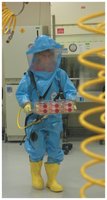
BSL-3: Pathogens handled in safety cabinets
BSL-4: Dangerous and exotic microbes requiring full containment
Physical Methods of Microbial Control
Heat-Related Methods
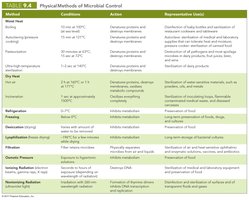
Heat is one of the most common physical methods for controlling microbial growth. It acts by denaturing proteins, disrupting membranes, and damaging nucleic acids.
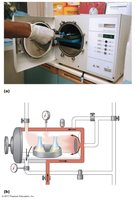
Moist Heat: More effective than dry heat; includes boiling, autoclaving, pasteurization, and ultrahigh-temperature sterilization.
Dry Heat: Used for materials that cannot be sterilized with moist heat; requires higher temperatures and longer times.
Key Terms:
Thermal Death Point: Lowest temperature that kills all cells in 10 minutes.
Thermal Death Time: Time to sterilize a volume of liquid at a set temperature.
Pasteurization
Pasteurization is a heat treatment process that reduces microbial load in food and beverages without compromising quality. It is not sterilization but is effective against pathogens such as Brucella melitensis, Mycobacterium bovis, Salmonella, Listeria, and E. coli.
Refrigeration and Freezing
Low temperatures decrease microbial metabolism, growth, and reproduction. Refrigeration halts the growth of most pathogens, while freezing is more effective when done slowly, as it forms ice crystals that damage cells.
Desiccation and Lyophilization
Desiccation (drying) inhibits microbial growth by removing water. Lyophilization (freeze-drying) is used for long-term preservation of microbial cultures by preventing ice crystal formation.

Membrane Filtration
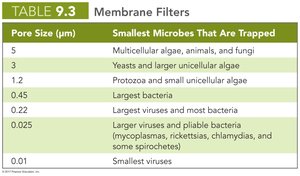
Membrane filtration is used to physically remove microbes from liquids and air. Filters with different pore sizes can trap various sizes of microorganisms.
Pore Size (µm) | Smallest Microbes That Are Trapped |
|---|---|
5 | Multicellular algae, animals, and fungi |
3 | Yeasts and larger unicellular algae |
1.2 | Protozoa and small unicellular algae |
0.45 | Largest bacteria |
0.22 | Largest viruses and most bacteria |
0.025 | Larger viruses and pliable bacteria (mycoplasmas, rickettsias, chlamydias, and some spirochetes) |
0.01 | Smallest viruses |
HEPA Filtration
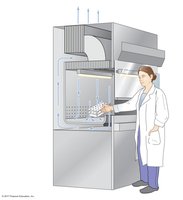
High-efficiency particulate air (HEPA) filters are used in biological safety cabinets to remove airborne microbes, providing a sterile environment for handling sensitive materials.
Osmotic Pressure
High concentrations of salt or sugar create hypertonic environments, causing cells to lose water and inhibiting microbial growth. Fungi are generally more tolerant of these conditions than bacteria.
Radiation
Ionizing Radiation: (e.g., gamma rays, X-rays) creates ions that damage DNA and other cellular molecules. Effective for sterilization but may require long exposure times.
Nonionizing Radiation: (e.g., UV light) causes DNA mutations such as pyrimidine dimers. Useful for disinfecting air, surfaces, and transparent fluids.
Summary Table: Physical Methods of Microbial Control
Chemical Methods of Microbial Control
Overview
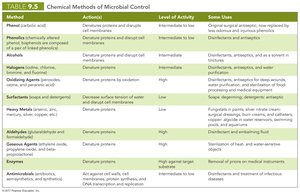
Chemical agents control microbial growth by affecting cell walls, membranes, proteins, or DNA. Their effectiveness depends on environmental conditions and the type of microbe targeted.
Major Classes of Chemical Agents
Phenol and Phenolics: Denature proteins and disrupt membranes; effective in the presence of organic matter.
Alcohols: Intermediate-level disinfectants; denature proteins and disrupt membranes.
Halogens: Damage enzymes by denaturation; used in water treatment and antiseptics (e.g., iodine, chlorine).
Oxidizing Agents: Kill by oxidation of enzymes; include hydrogen peroxide, ozone, and peracetic acid.
Surfactants: Soaps and detergents; reduce surface tension and disrupt membranes.
Heavy Metals: Denature proteins; used in antiseptics and preservatives (e.g., silver nitrate, thimerosal).
Aldehydes: Cross-link proteins and nucleic acids; used for sterilization and disinfection (e.g., glutaraldehyde, formalin).
Gaseous Agents: Sterilize in closed chambers; denature proteins and DNA but can be hazardous.
Enzymes: Target specific microbial structures; e.g., lysozyme in tears digests bacterial cell walls.
Antimicrobial Drugs: Used primarily for treatment but some for environmental control.
Methods for Evaluating Disinfectants and Antiseptics
Phenol Coefficient
Compares the efficacy of a disinfectant to phenol. A coefficient greater than 1.0 indicates higher effectiveness than phenol. This method has largely been replaced by more modern tests.
Use-Dilution Test
Metal cylinders are contaminated with bacteria, exposed to disinfectants, and then incubated in growth media. The most effective agents prevent growth at the highest dilution. This is the current standard in the United States.
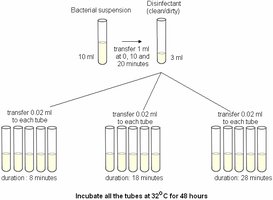
Kelsey-Sykes Capacity Test
Bacterial suspensions are exposed to the chemical being tested, and samples are taken at intervals to determine the minimum effective time. This method is approved by the European Union.
In-Use Test
Swabs are taken from objects before and after disinfectant application, inoculated into growth media, and monitored for microbial growth. This test determines the practical effectiveness of disinfectants in real-world conditions.
