 뒤로
Foundations of Microbiology: Cell Types, Microbial Diversity, and Microscopy
스터디 가이드 - 스마트 노트
 자료에 맞춘 맞춤형 노트, 핵심 정의, 예시, 맥락을 확장해 제공합니다.
Introduction to Microbiology
Definition and Scope
Microbiology is the study of microorganisms—organisms and infectious agents too small to be seen clearly without a microscope. These include bacteria, archaea, fungi, protozoa, algae, viruses, viroids, and prions. Microbiology is a foundational discipline within the natural sciences, intersecting with biology, chemistry, medicine, and environmental science.
Microorganisms (Microbes): Tiny living organisms, usually invisible to the naked eye.
Branches of Microbiology: Bacteriology, Virology, Mycology, Parasitology.
Specialties: Medical, Environmental, Evolutionary, Food, and Industrial Microbiology.
Classification of Microorganisms
Cellular vs. Acellular Microbes
Cellular Microorganisms: Made of cells; can be unicellular or multicellular (e.g., bacteria, fungi, protozoa, some algae).
Acellular Infectious Agents: Not made of cells; include viruses (DNA or RNA), viroids, and prions (misfolded proteins).
Key Distinctions:
Cellular: Has cells (e.g., yeast = unicellular fungus; mold = multicellular fungus).
Acellular: Lacks cells (e.g., viruses, prions, viroids).
Three Domain System
Bacteria: Prokaryotic, cell walls with peptidoglycan, reproduce by binary fission, can be photosynthetic or non-photosynthetic.
Archaea: Prokaryotic, cell walls lack peptidoglycan, often live in extreme environments, not pathogenic to humans.
Eukarya: Eukaryotic, includes protozoa, fungi, algae, plants, and animals; if present, cell walls lack peptidoglycan.
Prokaryotic vs. Eukaryotic Cells
Prokaryotic Cells: No nucleus, no membrane-bound organelles (e.g., bacteria, archaea).
Eukaryotic Cells: True nucleus, membrane-bound organelles (e.g., fungi, protozoa, algae, plants, animals).
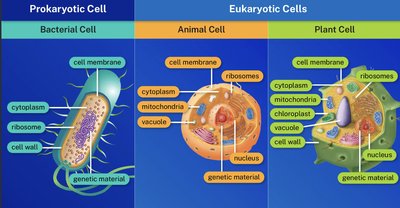
Additional info: The image above visually compares the structural differences between prokaryotic (bacterial) and eukaryotic (animal and plant) cells, highlighting the presence or absence of a nucleus, organelles, and cell wall.
Microbial Groups and Examples
Bacteria: Prokaryotic, diverse metabolism, some pathogenic.
Archaea: Prokaryotic, extremophiles (e.g., methanogens, halophiles, thermophiles).
Protozoa: Unicellular eukaryotes, motile, some pathogenic.
Fungi: Unicellular (yeasts) or multicellular (molds), non-photosynthetic, cell walls of chitin.
Algae: Unicellular or multicellular, photosynthetic, cell walls of cellulose.
Viruses: Acellular, require host cell for replication.
Prions: Infectious proteins, cause neurodegenerative diseases.
Historical Milestones in Microbiology
Key Scientists and Discoveries
Antonie van Leeuwenhoek: First to observe live microorganisms with simple microscopes; "Father of Microbiology."
Robert Hooke: Coined the term "cell"; observed cork cells with a compound microscope.
Louis Pasteur: Disproved spontaneous generation, developed pasteurization, vaccines for rabies and anthrax.
Robert Koch: Developed Koch's postulates, linked specific microbes to specific diseases.
Joseph Lister: Introduced antiseptic surgery using phenol.
Edward Jenner: Developed the smallpox vaccine using cowpox.
Alexander Fleming: Discovered penicillin, the first antibiotic.
Taxonomy and Nomenclature
Classification Hierarchy
Taxonomy: Science of classifying organisms (Domain → Kingdom → Phylum → Class → Order → Family → Genus → Species).
Binomial Nomenclature: Two-part scientific naming system (Genus species), e.g., Escherichia coli.
Cell Structure and Function
Prokaryotic Cell Structures
Capsule: Protective outer coating.
Glycocalyx: Sticky layer for attachment.
Flagellum: Motility structure.
Fimbriae/Pili: Attachment and DNA transfer.
Plasmid: Small circular DNA.
Endospore: Dormant, resistant structure.
Peptidoglycan: Main component of bacterial cell wall.
Bacterial Shapes and Arrangements
Coccus: Spherical
Bacillus: Rod-shaped
Spirillum/Spirochete: Spiral-shaped
Vibrio: Comma-shaped
Arrangements: Diplococci (pairs), Streptococci (chains), Staphylococci (clusters)
Microscopy and Staining
Microscope Types and Principles
Compound Light Microscope: Uses visible light and multiple lenses.
Electron Microscope: Uses electron beams for high resolution (Transmission EM for internal structures, Scanning EM for surfaces).
Brightfield: Dark image on bright background; requires staining.
Darkfield: Bright image on dark background; good for live, unstained specimens.
Phase Contrast: Enhances contrast in unstained cells.
Fluorescence: Uses fluorescent dyes; bright image on dark background.
Confocal: Laser scanning for 3D images.
Key Terms in Microscopy
Magnification: Enlargement of image.
Resolution: Ability to distinguish two points as separate.
Numerical Aperture: Lens's ability to gather light; higher values yield better resolution.
Immersion Oil: Used with high-power objectives to improve clarity.
Formula for Total Magnification:
Staining Techniques
Gram Stain: Differentiates bacteria into Gram-positive (purple, thick peptidoglycan) and Gram-negative (pink/red, thin peptidoglycan, outer membrane).
Capsule Stain: Identifies bacteria with capsules (appear as halos).
Acid-Fast Stain: Identifies bacteria with mycolic acid (e.g., Mycobacterium).
Endospore Stain: Detects bacterial endospores (malachite green, counterstain with methylene blue).
Microbial Metabolism and Growth
Metabolic Pathways
Metabolism: All chemical reactions in a cell.
Catabolism: Breakdown of molecules, releases energy.
Anabolism: Synthesis of molecules, requires energy.
Enzyme: Protein catalyst for reactions.
ATP: Main energy carrier in cells.
Oxygen Requirements
Obligate Aerobe: Requires oxygen.
Obligate Anaerobe: Cannot tolerate oxygen.
Facultative Anaerobe: Grows with or without oxygen.
Aerotolerant Anaerobe: Tolerates oxygen but does not use it.
Microaerophile: Requires low oxygen levels.
Bacterial Growth Phases
Lag Phase: Adaptation, little division.
Log Phase: Rapid cell division.
Stationary Phase: Growth rate equals death rate.
Death Phase: Death rate exceeds growth.
Binary Fission: Main method of bacterial reproduction.
Generation Time: Time for population to double.
Biomolecular Chemistry in Microbiology
Atoms, Molecules, and Bonds
Atom: Basic unit of matter.
Molecule: Two or more atoms bonded together.
Macromolecule: Large molecule (e.g., proteins, nucleic acids).
Monomer: Building block of polymers.
Polymer: Chain of monomers.
Covalent Bond: Shared electrons (strongest bond).
Ionic Bond: Attraction between charged ions.
Hydrogen Bond: Weak attraction between polar molecules.
Major Macromolecules
Proteins: Made of amino acids; functions include enzymes, structure, transport.
Carbohydrates: Energy storage, structure, part of DNA/RNA.
Lipids: Energy storage, membranes, insulation.
Nucleic Acids: DNA and RNA; store and transmit genetic information.
Protein Structure Levels:
Primary: Amino acid sequence.
Secondary: Alpha helices and beta sheets.
Tertiary: 3D folding of one chain.
Quaternary: Multiple polypeptide chains.
Summary Table: Prokaryotic vs. Eukaryotic Cells
Feature | Prokaryotic Cell | Eukaryotic Cell |
|---|---|---|
Nucleus | No true nucleus (DNA in nucleoid) | True nucleus (DNA in nucleus) |
Organelles | No membrane-bound organelles | Has membrane-bound organelles |
Cell Division | Binary fission | Mitosis or meiosis |
Examples | Bacteria, Archaea | Fungi, Protozoa, Algae, Plants, Animals |
Size | Usually smaller | Usually larger |
Key Concepts and Memory Tricks
Prokaryotic = No nucleus
Eukaryotic = True nucleus
Virus = Not a cell
Yeast = Unicellular fungus
Mold = Multicellular fungus
Bacteria + Archaea = Prokaryotes
Protozoa + Fungi = Eukaryotes
