 뒤로
뒤로Genetics: Structure, Function, and Variation of Genetic Material
스터디 가이드 - 스마트 노트
 자료에 맞춘 맞춤형 노트, 핵심 정의, 예시, 맥락을 확장해 제공합니다.
Genetics: Structure, Function, and Variation of Genetic Material
Introduction to Genetics
Genetics is the study of genes, their functions, and how variations arise in genomes. The genome is the entire collection of genetic material in a cell or virus. A gene is a heritable unit of genetic material that determines a particular trait. The genotype refers to the genetic makeup of an organism, while the phenotype is the observable collection of traits.
Genotype: The inherited set of genetic instructions contained in the genome.
Phenotype: The organism’s observable traits (physical and physiological characteristics).
Organization of Genetic Material
Prokaryotic vs. Eukaryotic Cells
Genetic material is organized differently in prokaryotic and eukaryotic cells:
Eukaryotic cells:
Numerous linear chromosomes housed in the nucleus
Organizational proteins called histones prevent DNA tangling
Genetic material found in chromosomal DNA, plasmids, mitochondria, and chloroplasts
Prokaryotic cells:
1-3 chromosomes (usually 1 circular chromosome) in the nucleoid region
Histone-like proteins organize DNA
Genetic material found in chromosomal DNA and plasmids
Plasmids
Plasmids are pieces of DNA that exist outside of the chromosomal DNA in bacteria and some eukaryotic cells. They often carry genes conferring antibiotic resistance.
Structure of DNA and RNA
Nucleotide Structure
Both DNA and RNA are polymers of nucleotides. Each nucleotide consists of:
Phosphate group
Sugar (deoxyribose in DNA, ribose in RNA)
Nitrogen base (Adenine, Guanine, Cytosine, Thymine in DNA; Uracil replaces Thymine in RNA)
Nitrogenous Bases: Classification and Pairing
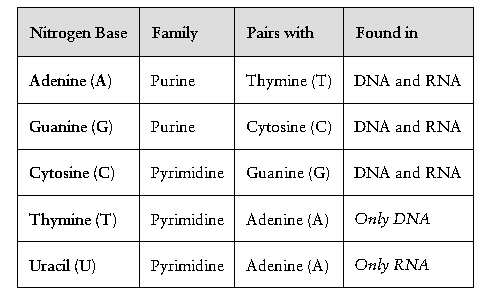
Nitrogenous bases are classified as purines (double-ring) or pyrimidines (single-ring):
Nitrogen Base | Family | Pairs with | Found in |
|---|---|---|---|
Adenine (A) | Purine | Thymine (T) | DNA and RNA |
Guanine (G) | Purine | Cytosine (C) | DNA and RNA |
Cytosine (C) | Pyrimidine | Guanine (G) | DNA and RNA |
Thymine (T) | Pyrimidine | Adenine (A) | Only DNA |
Uracil (U) | Pyrimidine | Adenine (A) | Only RNA |
DNA Structure
Double-stranded molecule forming a double helix (twisted ladder)
"Rungs" are complementary nitrogen bases (A-T, G-C)
"Side rails" are alternating sugar and phosphate groups, linked by phosphodiester bonds
Antiparallel arrangement: one strand runs 5’ to 3’, the other 3’ to 5’
RNA Structure
Usually single-stranded
Contains ribose sugar
Uracil (U) replaces thymine (T)
Can fold into helical and loop structures
Central Dogma of Molecular Biology
Flow of Genetic Information
The central dogma describes the flow of genetic information:
Transcription: DNA → RNA
Translation: RNA → Protein
DNA directs the production of RNA, which then directs the assembly of proteins.
DNA Replication
Overview and Enzymes
DNA replication is the process by which a cell copies its genome before division. It is semiconservative: each new DNA molecule contains one original and one new strand.
Helicase: Unwinds the DNA helix
Gyrase/Topoisomerases: Relieve supercoiling ahead of the replication fork
Primase: Lays down RNA primers
DNA Polymerase III: Main enzyme that adds nucleotides (5’→3’ direction)
DNA Polymerase I: Removes RNA primers and replaces them with DNA
Ligase: Seals nicks in the sugar-phosphate backbone, joining Okazaki fragments
Single-strand DNA-binding proteins: Stabilize separated DNA strands
Leading vs. Lagging Strand
Leading strand: Synthesized continuously toward the replication fork
Lagging strand: Synthesized discontinuously away from the fork in Okazaki fragments
Transcription and Translation
Transcription (DNA → RNA)
Initiation: RNA polymerase binds to the promoter and unwinds DNA
Elongation: RNA polymerase adds complementary ribonucleotides
Termination: RNA polymerase reaches a termination sequence and releases the RNA transcript
Types of RNA produced:
mRNA (messenger RNA): Carries genetic instructions to ribosomes
tRNA (transfer RNA): Brings amino acids to ribosomes; contains an anticodon loop
rRNA (ribosomal RNA): Forms part of the ribosome and catalyzes peptide bond formation
RNA Processing (Eukaryotes)
Splicing: Removal of introns (non-coding regions); exons (coding regions) are joined together
Translation (RNA → Protein)
Ribosomes decode mRNA in sets of three nucleotides (codons)
Each codon specifies an amino acid or a stop signal
tRNA molecules bring the correct amino acids to the ribosome
Ribosomes have large and small subunits, with E (exit), P (peptidyl), and A (acceptor) sites
Multiple ribosomes can translate a single mRNA simultaneously (polysomes)
Genetic Code
There are 64 codons (triplets of nucleotides)
Genetic code is redundant: multiple codons can specify the same amino acid
Start codon: AUG (methionine)
Stop codons: UAA, UAG, UGA
Gene Regulation
Pre-Transcriptional Regulation
Operons (in prokaryotes): clusters of genes regulated together
Quorum sensing, epigenetic control (e.g., DNA methylation), recruitment of transcription factors
Post-Transcriptional Regulation
Control of mRNA stability and translation
Small noncoding RNAs, riboswitches
RNA processing and nuclear export (eukaryotes)
Mutations and Genetic Variation
Types of Mutations
Insertion: Addition of one or more nucleotides
Deletion: Loss of one or more nucleotides
Substitution: Replacement of one nucleotide with another
Silent: No change in amino acid sequence
Missense: Changes one amino acid
Nonsense: Changes a codon to a stop codon
Frameshift: Insertion or deletion not in multiples of three, shifting the reading frame
Causes of Mutations
Spontaneous mutations: Natural errors during DNA replication
Induced mutations: Caused by mutagens (chemical, physical, or biological agents)
Carcinogens: Mutagens that promote cancer development
DNA Repair Mechanisms
Proofreading: DNA polymerases correct errors during replication
Excision repair: Damaged or mismatched nucleotides are removed and replaced
Horizontal Gene Transfer in Bacteria
Mechanisms
Conjugation: Direct transfer of DNA via a pilus
Transformation: Uptake of free DNA from the environment
Transduction: Transfer of DNA by bacteriophages (viruses)
Transposons
"Jumping genes" that can move within the genome
Retrotransposons use reverse transcriptase to copy RNA into DNA
DNA transposons can move by "copy-and-paste" or "cut-and-paste" mechanisms
Summary Table: Nitrogenous Bases
Nitrogen Base | Family | Pairs with | Found in |
|---|---|---|---|
Adenine (A) | Purine | Thymine (T) | DNA and RNA |
Guanine (G) | Purine | Cytosine (C) | DNA and RNA |
Cytosine (C) | Pyrimidine | Guanine (G) | DNA and RNA |
Thymine (T) | Pyrimidine | Adenine (A) | Only DNA |
Uracil (U) | Pyrimidine | Adenine (A) | Only RNA |
Key Equations and Concepts
Phosphodiester bond formation: Covalent bonds linking nucleotides in DNA and RNA
Directionality: DNA and RNA are synthesized in the 5’ → 3’ direction
Central Dogma: $\text{DNA} \rightarrow \text{RNA} \rightarrow \text{Protein}$
Genetic Code: $4 \times 4 \times 4 = 64$ codons
Additional info: These notes integrate foundational concepts from Chapter 5 (Genetics) and related molecular biology topics, providing a comprehensive overview suitable for exam preparation in a college-level microbiology course.
