 뒤로
Hydrolytic Enzymes and Biochemical Testing in Microbiology
스터디 가이드 - 스마트 노트
 자료에 맞춘 맞춤형 노트, 핵심 정의, 예시, 맥락을 확장해 제공합니다.
Hydrolytic Enzymes in Microbiology
Definition and Mechanism of Hydrolysis
Hydrolysis is a biochemical process involving the splitting of large molecules into smaller units through the addition of water. This reaction is catalyzed by specialized proteins known as hydrolytic enzymes. These enzymes can function either inside the cell (intracellular) or outside the cell (extracellular), depending on the substrate and organism.
Intracellular hydrolysis: The reaction occurs within the cell. Examples include the hydrolysis of bile esculin and urea.
Extracellular hydrolysis: Enzymes are secreted outside the cell to break down large molecules such as starch and gelatin, which cannot pass through the cell membrane.
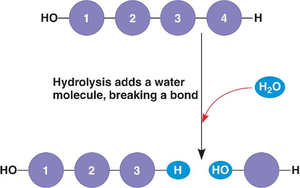
Key Point: Hydrolytic enzymes are essential for microbial nutrition, pathogenesis, and identification in laboratory diagnostics.
Bile Esculin Test
Principle and Application
The Bile Esculin Test is used to identify Enterococcus species and members of the Streptococcus bovis group (Group D Streptococci). The medium is both selective and differential, containing bile (which inhibits most Gram-positive bacteria except enterococci), esculin (the substrate), and ferric citrate (a source of Fe3+).
Selective agent: Bile inhibits non-target Gram-positive organisms.
Differential agent: Esculin hydrolysis differentiates positive from negative organisms.
Indicator: Ferric citrate reacts with esculetin (a hydrolysis product) to form a brown-black precipitate, indicating a positive result.
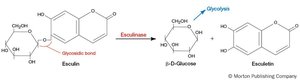
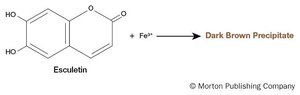
Example: A positive bile esculin test is indicated by the formation of a dark brown or black coloration in the medium.
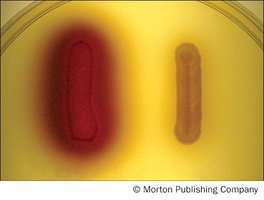
Starch Hydrolysis Test
Principle and Application
The Starch Hydrolysis Test is used to differentiate bacteria based on their ability to hydrolyze starch using extracellular enzymes such as amylase and oligo-1,6-glucosidase. Starch is too large to enter the cell, so only bacteria that secrete these enzymes can utilize it as a nutrient source.
Substrate: Starch in the agar medium.
Detection: After incubation, iodine is added to the plate. Iodine reacts with intact starch to produce a dark brown color. A clear zone around bacterial growth indicates starch hydrolysis.
Applications: Differentiates genera such as Bacillus, Clostridium, and Enterococcus.
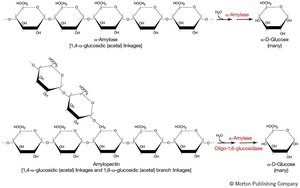
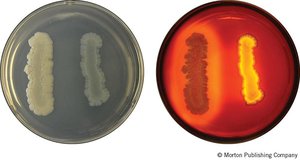
Example: A clear zone around the bacterial growth after iodine addition indicates a positive result for starch hydrolysis.
Urea Hydrolysis Test
Principle and Application
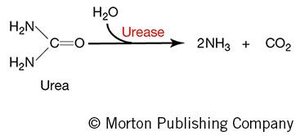
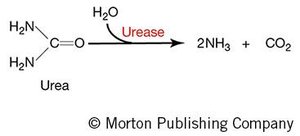
The Urea Hydrolysis Test detects the ability of bacteria to hydrolyze urea into ammonia and carbon dioxide using the enzyme urease. This test is particularly useful for differentiating members of the family Enterobacteriaceae, especially Proteus, Morganella, and Providencia.
Reaction: Urea + H2O → 2NH3 + CO2 (catalyzed by urease)
Indicator: Phenol red is used as a pH indicator. It turns yellow/orange at pH < 8.4 and red/pink at pH > 8.4.
Interpretation: Rapid urease-positive organisms turn the medium pink within 24 hours. Slower positives take longer, and negatives remain yellow or orange.
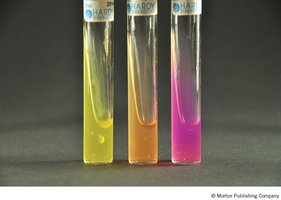
Example: Proteus vulgaris is a rapid urease-positive organism, turning the medium pink within 24 hours.
Gelatin Hydrolysis Test
Principle and Application
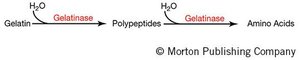
The Gelatin Hydrolysis Test identifies bacteria capable of producing gelatinase, an enzyme that hydrolyzes gelatin (a protein derived from collagen) into polypeptides and amino acids. This test is used to differentiate species such as Serratia, Proteus, Bacillus, and Clostridium.
Substrate: Gelatin in the medium serves as both the solidifying agent and the substrate for gelatinase.
Detection: Liquefaction of the medium after incubation indicates gelatin hydrolysis. Since gelatin melts at 28°C, tubes must be cooled before interpretation to distinguish enzymatic hydrolysis from melting.
Interpretation: If the medium remains liquid after cooling, the organism is gelatinase-positive.
Example: Bacillus subtilis is often gelatinase-positive, while Escherichia coli is typically negative.
Laboratory Procedures for Hydrolytic Enzyme Tests
Summary of Inoculation and Incubation
Bile Esculin Plate: Divide plate in half, inoculate with Lactococcus lactis and Enterococcus faecalis, incubate at 37°C for 48 hours.
Starch Agar Plate: Divide plate in thirds, inoculate with control, Escherichia coli, and Bacillus subtilis, incubate at 37°C for 48 hours.
Urea Slants: Inoculate with control, Escherichia coli, and Proteus vulgaris, incubate at 37°C for 24 hours.
Gelatin Stabs: Inoculate with control, Escherichia coli, and Bacillus subtilis, incubate at 37°C for 48 hours, then cool before interpretation.
Note: Always cool gelatin tubes after incubation to 4°C or in an ice bath for 10 minutes before assessing liquefaction.
Summary Table: Hydrolytic Enzyme Tests
Test | Substrate | Enzyme | Indicator/Detection | Positive Result | Example Organisms |
|---|---|---|---|---|---|
Bile Esculin | Esculin | Esculinase | Ferric citrate (brown/black precipitate) | Dark brown/black medium | Enterococcus faecalis |
Starch Hydrolysis | Starch | Amylase, Oligo-1,6-glucosidase | Iodine (clearing around growth) | Clear zone after iodine | Bacillus subtilis |
Urea Hydrolysis | Urea | Urease | Phenol red (pink color) | Pink medium | Proteus vulgaris |
Gelatin Hydrolysis | Gelatin | Gelatinase | Liquefaction after cooling | Liquid medium | Bacillus subtilis |
