 뒤로
Infection, Infectious Diseases, and Epidemiology: Study Notes
스터디 가이드 - 스마트 노트
 자료에 맞춘 맞춤형 노트, 핵심 정의, 예시, 맥락을 확장해 제공합니다.
Stages of Infectious Diseases
Progression of Disease in the Host
The development of an infectious disease in a host follows a series of stages, each characterized by specific signs and symptoms. Understanding these stages is crucial for diagnosis, treatment, and prevention.
Incubation Period: The time between exposure to the pathogen and the appearance of initial symptoms. No signs or symptoms are present.
Prodromal Period: Early, mild symptoms begin to appear, often vague and nonspecific.
Illness: The period when symptoms are most severe and characteristic of the disease.
Decline: Symptoms begin to subside as the immune response or treatment reduces pathogen numbers.
Convalescence: Recovery phase; no signs or symptoms remain, and the host returns to normal health.
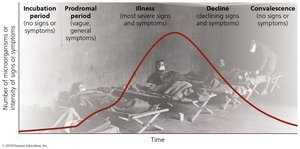
Example: Influenza typically has a short incubation period, followed by rapid onset of symptoms, and a recovery phase.
Incubation Periods of Selected Infectious Diseases
The incubation period varies widely among different infectious diseases, affecting how quickly symptoms appear and how diseases are managed.
Disease | Incubation Period |
|---|---|
Staphylococcus foodborne infection | <1 day |
Influenza | About 1 day |
Cholera | 2 to 3 days |
Genital herpes | About 5 days |
Tetanus | 5 to 15 days |
Syphilis | 10 to 21 days |
Hepatitis B | 70 to 100 days |
AIDS | 1 to >8 years |
Leprosy | 10 to >30 years |
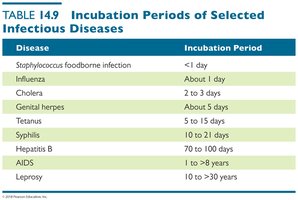
Example: Foodborne infections like Staphylococcus can cause symptoms within hours, while leprosy may take decades to manifest.
Portals of Exit
Movement of Pathogens Out of Hosts
Pathogens exit the host through specific portals, often the same as their entry points. These exits are critical for the spread of infectious diseases.
Common Portals: Respiratory tract, gastrointestinal tract, genitourinary tract, skin, and blood.
Materials: Pathogens are often shed in secretions or excretions such as saliva, sputum, feces, urine, blood, and semen.
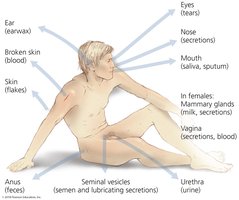
Example: Influenza viruses are expelled in droplets from the respiratory tract during coughing or sneezing.
Modes of Infectious Disease Transmission
Overview of Transmission
Transmission occurs from a reservoir or portal of exit to another host’s portal of entry. There are three main groups of transmission: contact, vehicle, and vector.
Contact Transmission: Direct, indirect, or droplet contact between hosts.
Vehicle Transmission: Transmission via air, water, food, or bodily fluids.
Vector Transmission: Transmission by biological or mechanical vectors, often arthropods.
Contact Transmission
Contact transmission involves the direct or indirect transfer of pathogens between hosts.
Direct Contact: Physical contact between individuals (e.g., touching, kissing).
Indirect Contact: Transfer via fomites (inanimate objects).
Droplet Transmission: Pathogens spread in droplets of mucus expelled by coughing, sneezing, or exhaling.
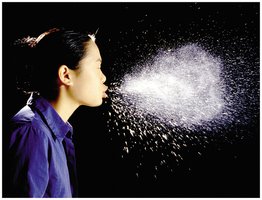
Example: The common cold is often spread by droplets from sneezing.
Vehicle Transmission
Vehicle transmission occurs when pathogens are carried by a medium such as air, water, food, or bodily fluids.
Airborne Transmission: Pathogens travel more than 1 meter via aerosols.
Waterborne Transmission: Pathogens spread through contaminated water, often causing gastrointestinal diseases.
Foodborne Transmission: Pathogens spread through contaminated or improperly stored foods.
Bodily Fluid Transmission: Pathogens in blood, urine, or saliva can infect new hosts through contact with mucous membranes or broken skin.
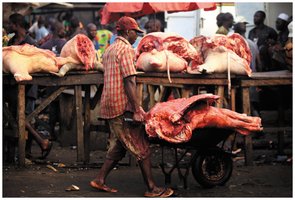
Example: Salmonella can be transmitted through undercooked or contaminated food.
Vector Transmission
Vectors are organisms, typically arthropods, that transmit pathogens between hosts. Transmission can be biological or mechanical.
Biological Vectors: The vector serves as a host for part of the pathogen’s life cycle (e.g., mosquitoes transmitting malaria).
Mechanical Vectors: The vector passively carries pathogens on its body (e.g., houseflies spreading bacteria).
Vector | Disease | Causative Agent |
|---|---|---|
Mosquitoes | Malaria | Plasmodium spp. |
Ticks | Lyme disease | Borrelia burgdorferi |
Houseflies | Foodborne infections | Shigella spp., Salmonella spp., Escherichia coli |
Cockroaches | Foodborne infections | Shigella spp., Salmonella spp., Escherichia coli |
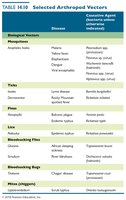
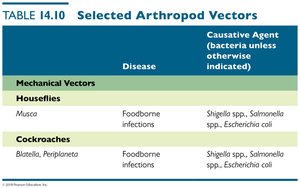
Example: Mosquitoes are biological vectors for malaria, while houseflies are mechanical vectors for foodborne infections.
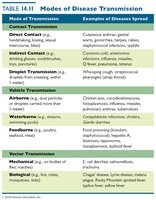
Summary Table: Modes of Disease Transmission
This table summarizes the main modes of disease transmission and examples of diseases spread by each mode.
Mode of Transmission | Examples of Diseases Spread |
|---|---|
Direct Contact | Herpes, rabies |
Indirect Contact | Common cold, pneumonia |
Droplet Transmission | Influenza, pertussis |
Airborne | Chickenpox, tuberculosis |
Waterborne | Cholera, giardiasis |
Foodborne | Food poisoning, tapeworms |
Vector (Biological) | Malaria, Lyme disease |
Vector (Mechanical) | Foodborne infections |
Classification of Infectious Diseases
Methods of Classification
Infectious diseases can be classified based on taxonomy, affected body system, longevity and severity, mode of transmission, and population effects.
Taxonomic Categories: Classification by pathogen type (bacteria, virus, etc.).
Body System: Classification by the system affected (respiratory, digestive, etc.).
Longevity and Severity: Acute, chronic, latent, etc.
Mode of Transmission: Contact, vehicle, vector.
Population Effects: Endemic, epidemic, pandemic.
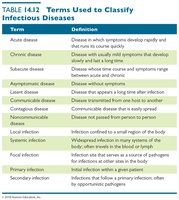
Term | Definition |
|---|---|
Acute disease | Rapid onset, short duration |
Chronic disease | Slow onset, long duration |
Latent disease | Inactive for a period, then active |
Contagious disease | Easily spread from person to person |
Local infection | Confined to a small region |
Systemic infection | Widespread throughout the body |
Epidemiology of Infectious Diseases
Frequency of Disease
Epidemiologists track disease occurrence using incidence and prevalence. These measures help understand the spread and impact of diseases.
Incidence: Number of new cases in a given area during a specific period.
Prevalence: Total number of cases (new and existing) in a given area during a specific period.
Equation for Prevalence:
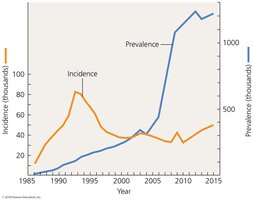
Example: AIDS prevalence has increased over time, even as incidence fluctuates.
Reporting and Mapping Disease Data
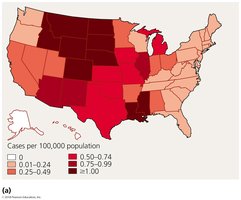
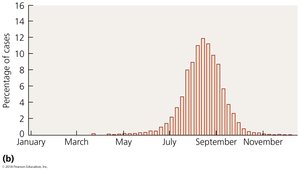
Epidemiologists use various methods to report and visualize disease data, including maps, graphs, and tables.
Geographic Distribution: Maps show cases per population in different regions.
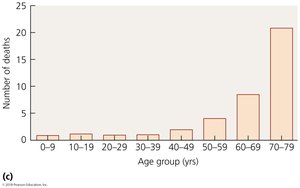
Temporal Distribution: Graphs show cases over time or by age group.
Occurrence Terms: Endemic, Sporadic, Epidemic, Pandemic
Diseases are described by their occurrence patterns:
Endemic: Constantly present in a population.
Sporadic: Occurs occasionally and irregularly.
Epidemic: Sudden increase in cases above expected levels.
Pandemic: Epidemic that spreads across countries or continents.
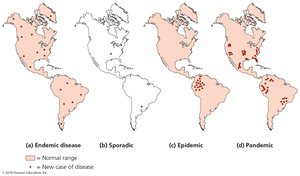
Example: Influenza can be endemic in some regions, but may cause epidemics or pandemics globally.
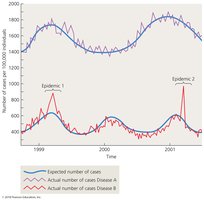
Epidemics vs. Nonepidemics
Epidemics are characterized by a spike in cases, which may be fewer than nonepidemics if the expected baseline is low.
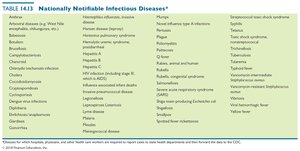
Nationally Notifiable Infectious Diseases
Public health agencies track certain diseases that must be reported to authorities. These are known as nationally notifiable infectious diseases.
Disease |
|---|
Anthrax |
Cholera |
Hepatitis |
Measles |
Rabies |
Tuberculosis |
Yellow fever |
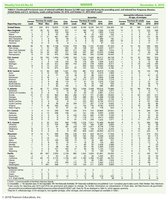
MMWR: Morbidity and Mortality Weekly Report
The MMWR is a publication by the CDC that reports data on notifiable diseases, helping track trends and outbreaks.
Epidemiological Studies
Descriptive Epidemiology
Descriptive epidemiology involves careful tabulation of data, recording location, time, and patient information to identify the index case.
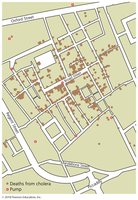
Example: John Snow’s investigation of cholera in London used descriptive epidemiology to trace the source to a contaminated water pump.
Analytical Epidemiology
Analytical epidemiology seeks to determine the probable cause, mode of transmission, and methods of prevention. It is often retrospective, occurring after an outbreak.
Useful when Koch’s postulates cannot be applied.
Focuses on identifying risk factors and transmission pathways.
Experimental Epidemiology
Experimental epidemiology tests hypotheses concerning the cause of a disease, often applying Koch’s postulates.
Involves controlled experiments.
Used to confirm causative agents and evaluate interventions.
Hospital Epidemiology: Healthcare-Associated (Nosocomial) Infections
Types of Healthcare-Associated Infections
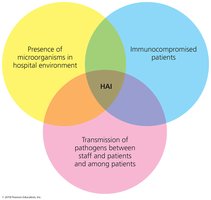
Healthcare-associated infections (HAIs) are acquired in medical settings. They are classified based on their source:
Exogenous: Pathogen acquired from the healthcare environment.
Endogenous: Pathogen arises from the patient’s own microbiota.
Iatrogenic: Resulting from medical procedures.
Superinfections: Occur when antimicrobial drugs disrupt normal microbiota, allowing other microbes to thrive.
Control of Healthcare-Associated Infections
Effective control of HAIs requires aggressive measures. Handwashing is the most effective method to reduce HAIs.
Other measures: Sterilization, isolation, and proper use of personal protective equipment.
Epidemiology and Public Health
Role of Public Health Agencies
Public health agencies at local, national, and global levels work to limit disease transmission and promote health.
U.S. Public Health Service: National agency; CDC is a branch.
World Health Organization (WHO): Coordinates global public health efforts.
Interrupting Disease Transmission
Public health agencies enforce cleanliness, reduce vectors and reservoirs, establish immunization schedules, treat exposed individuals, and implement isolation and quarantine.
Clean water and food supplies
Immunization programs
Education campaigns
Public Health Education
Education is essential for controlling diseases, especially those transmitted sexually or through the air. Agencies campaign to inform the public about healthful choices.
Examples: Safe sex practices, respiratory hygiene, vaccination awareness.
