 뒤로
Introduction to Microbiology: Microorganisms, Infectious Diseases, and Classification
스터디 가이드 - 스마트 노트
 자료에 맞춘 맞춤형 노트, 핵심 정의, 예시, 맥락을 확장해 제공합니다.
Microbiology: Scope and Importance
Definition and Significance
Microbiology is the scientific study of microorganisms, including their physiology, interactions with the environment, and impact on human life. Microorganisms are essential to life, playing both beneficial and detrimental roles. - Microorganisms include bacteria, viruses, fungi, protozoa, algae, and helminths. - The human body contains more bacterial cells than human cells, highlighting the importance of microbes in health and disease. - Microbes are found everywhere, from soil and water to extreme environments.
Global Impact of Microbes
Microbes have a profound effect on global biogeochemical cycles and human health. - The total number of microbial cells on Earth is estimated at 5 x 1030. - Prokaryotes contain more nitrogen and phosphorus than all plant biomass combined. - Bacteriophages (viruses that infect bacteria) are the most numerous biological entities on the planet.
Microorganisms: Friends or Foes?
Benefits and Detriments
Microorganisms can be both beneficial and harmful. Understanding their biology allows us to harness their benefits and mitigate their risks. - Beneficial roles: Decomposition, nutrient cycling, food production, biotechnology. - Detrimental roles: Infectious diseases, food spoilage, bioterrorism.
Historical Impact of Infectious Diseases
Infectious diseases have shaped human history, causing significant mortality and influencing migration and societal development. - Example: Cholera epidemics in the 19th century caused massive death tolls among migrants.
Emerging and Reemerging Infectious Diseases
Definition and Examples
Emerging infections are new, reemerging, or drug-resistant diseases whose incidence has increased recently or threatens to increase. - Examples include MDR TB, Cryptosporidiosis, Hantavirus, Ebola, SARS, Chikungunya, Salmonella outbreaks, MERS-CoV, Listeria, and SARS-CoV-2.
Global Distribution of Emerging Diseases
Emerging and reemerging diseases are distributed worldwide, affecting both developed and developing regions. 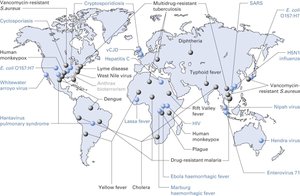
Infectious Diseases: Mortality and Trends
Global Mortality
Infectious diseases remain a leading cause of death worldwide, surpassing deaths from wars and natural disasters. - AIDS, TB, and malaria alone have caused over 200 million deaths since 1945. - About one-third of global deaths are due to infectious diseases. 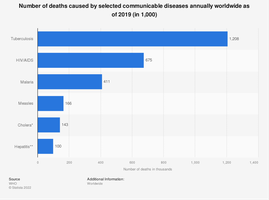
Historical Trends in the United States
The perceived conquest of infectious diseases in the mid-20th century was premature. - From 1980-1992, infectious disease deaths increased by 22% (excluding AIDS). - By 1996, deaths caused by microbes had increased by 50% since 1980.
Death Rates and Causes
Death rates from infectious diseases have declined due to public health interventions, but new threats continue to emerge. 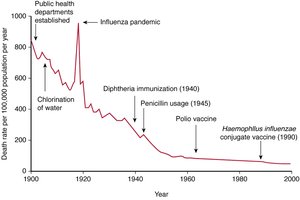
Comparison of Causes of Death (1990 vs. 2000)
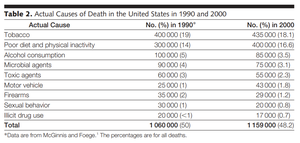
Microbial agents remain a significant cause of death, though lifestyle factors (tobacco, diet, alcohol) are also prominent.
Actual Cause | No. (1990) | No. (2000) |
|---|---|---|
Tobacco | 400,000 (19%) | 435,000 (18.1%) |
Poor diet and physical inactivity | 300,000 (14%) | 400,000 (16.6%) |
Alcohol consumption | 100,000 (5%) | 85,000 (3.5%) |
Microbial agents | 90,000 (4%) | 75,000 (3.1%) |
Toxic agents | 60,000 (3%) | 55,000 (2.3%) |
Motor vehicle | 43,000 (2%) | 43,000 (1.8%) |
Firearms | 35,000 (1%) | 29,000 (1.2%) |
Sexual behavior | 30,000 (1%) | 20,000 (0.8%) |
Illicit drug use | 20,000 (<1%) | 20,000 (<1%) |
Total | 1,060,000 (50%) | 1,159,000 (48%) |
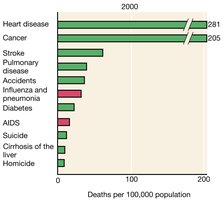
Changes in Disease Patterns (1900 vs. 2000)
Infectious diseases were leading causes of death in 1900, but chronic diseases predominate in 2000. 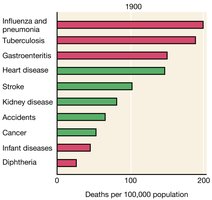
Classification of Microorganisms
Taxonomy and Classification Systems
Classification of microorganisms is based on cellular structure, complexity, and genetic relationships. - Carolus Linnaeus developed the system for naming and grouping organisms. - Robert Whittaker proposed the five-kingdom system: Fungi, Protozoa, Algae, Prokaryotes (Bacteria), Small animals (Helminths). - Carl Woese introduced the three-domain system based on 16S rRNA: Bacteria, Archaea, Eukarya.
Degrees of Complexity and Sizes
Microorganisms vary in complexity and size, from viruses (smallest, simplest) to multicellular fungi and algae. 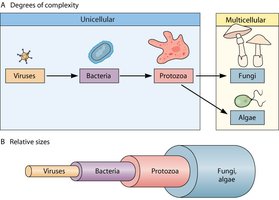
Types of Microbes
Prokaryotes: Bacteria and Archaea
Prokaryotes are unicellular organisms lacking a nucleus. - Bacteria: Cell walls contain peptidoglycan; most are harmless or beneficial. - Archaea: Cell walls lack peptidoglycan; often found in extreme environments; not associated with disease.
Fungi
Fungi are eukaryotic organisms with cell walls made of chitin. - Molds: Multicellular, have hyphae, reproduce by spores. - Yeasts: Unicellular, reproduce by budding. - Fungi are important decomposers and can cause diseases such as ringworm and yeast infections.
Protozoa
Protozoa are single-celled eukaryotes, classified by their motility mechanisms. - Pseudopodia: Cell extensions for movement (e.g., Amoeba). - Cilia: Short, hair-like structures (e.g., Paramecium). - Flagella: Long, whip-like structures (e.g., Trypanosoma). - Nonmotile: Includes Plasmodium (malaria), Toxoplasma, Cryptosporidium.
Algae
Algae are unicellular or multicellular, photosynthetic organisms. - Categorized by pigmentation, storage products, and cell wall composition. - Generally non-pathogenic, but can cause red tides and shellfish poisoning.
Helminths
Helminths are parasitic worms of medical importance. - Types include cestodes (tapeworms), trematodes (flukes), and nematodes (roundworms).
Viruses
Viruses are acellular entities that require a host cell for replication. - Examples include bacteriophages, human papillomavirus, and SARS-CoV-2.
Summary
Microbiology is a foundational discipline for understanding the diversity, classification, and impact of microorganisms on human health and the environment. The study of microbes is essential for combating infectious diseases, harnessing beneficial microbes, and advancing biotechnology. Key concepts: - Microorganisms are diverse and ubiquitous. - Infectious diseases remain a major global health challenge. - Classification systems help organize microbial diversity. - Understanding microbial biology is crucial for public health and scientific progress.
