 뒤로
Microbial Culture Media and Oxygen Requirements
스터디 가이드 - 스마트 노트
 자료에 맞춘 맞춤형 노트, 핵심 정의, 예시, 맥락을 확장해 제공합니다.
Microbial Culture Media
Introduction to Culture Media
Microorganisms require specific nutrients and environmental conditions for survival and growth. A culture medium is a solution containing nutrients such as ions, cofactors, carbohydrates, amino acids, and vitamins, used to cultivate microorganisms in laboratory settings.
All-purpose (general purpose) media: Supports growth of most bacteria. Example: Trypticase soy agar.
Special-purpose media: Designed for isolation and differentiation of specific bacterial groups.
Types of Culture Media
Selective media: Suppresses unwanted microbes and encourages growth of desired microbes by including inhibitory ingredients.
Differential media: Allows distinction between colonies of different microbes based on observable changes.
Enriched media: Supplemented with highly nutritious materials (e.g., blood, serum, yeast extract) for cultivating fastidious organisms.
Selective Media
Selective media contain ingredients that inhibit the growth of certain microorganisms while promoting the growth of others.
Phenylethyl alcohol agar (PEA): Inhibits Gram-negative organisms; selects for Gram-positive bacteria.
Crystal violet agar: Inhibits Gram-positive organisms; selects for Gram-negative bacteria.
7.5% Sodium chloride agar: Inhibits most bacteria except halophilic (salt-loving) microorganisms, useful for detecting Staphylococcus.
Differential Media
Differential media allow the identification of microbial species based on their biochemical properties. They contain compounds (e.g., specific carbohydrates) that are metabolized differently by various organisms, resulting in visible changes.
Mannitol Salt Agar (MSA): Selective for Staphylococcus due to high salt concentration; differential based on mannitol fermentation. Contains phenol red as a pH indicator:
pH 6.8 or below (acidic): yellow color
pH 7.0 (neutral): red color
pH 7.2 or higher (alkaline): deep pink (fuchsia) color
MacConkey agar: Selective for Gram-negative bacteria (contains crystal violet); differential based on lactose fermentation.
Lactose fermenters (e.g., E. coli): red colonies
Non-lactose fermenters: tan and transparent growth
Eosin Methylene Blue agar (EMB): Selective for Gram-negative bacteria (contains methylene blue); differential based on lactose fermentation.
Lactose fermenters (e.g., E. coli): dark black-blue colonies with green sheen
Non-lactose fermenters: colorless colonies
Enterobacter aerogenes: thick, mucoid, pink colonies (produces alcohol as waste product)
Enriched Media
Enriched media are designed to support the growth of fastidious organisms by adding highly nutritious substances.
Blood Agar: Both enriched (contains 5% sheep blood) and differential (distinguishes hemolysis patterns):
Gamma hemolysis: No lysis of red blood cells
Alpha hemolysis: Incomplete lysis of red blood cells
Beta hemolysis: Complete lysis of red blood cells
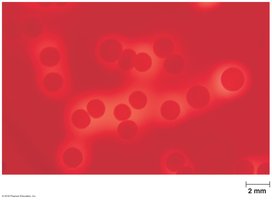
Examples of Differential Media
Differential media produce characteristic changes in the appearance of bacterial growth and/or the medium, permitting differentiation among species. 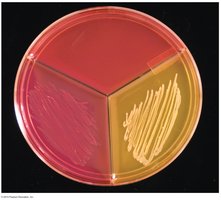
Atmospheric Oxygen Requirements
Classification of Microorganisms by Oxygen Needs
Microorganisms are classified based on their oxygen requirements, which affect their growth and metabolism.
Obligate aerobes: Require oxygen for growth.
Facultative anaerobes: Can grow with or without oxygen, using fermentation or anaerobic respiration.
Obligate anaerobes: Cannot use oxygen and are harmed by it.
Aerotolerant anaerobes: Tolerate oxygen but do not use it.
Microaerophiles: Require oxygen at concentrations lower than atmospheric levels.
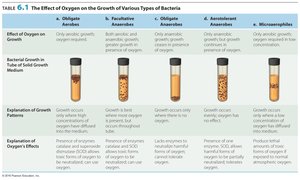
Toxic Oxygen Products
Oxygen metabolism can produce toxic derivatives that must be neutralized by specific enzymes.
Singlet oxygen (1O2): Highly reactive form of oxygen.
Superoxide radicals (O2-): Converted to hydrogen peroxide (H2O2) by the enzyme superoxide dismutase.
Hydrogen peroxide (H2O2): Further broken down to water and oxygen by catalase.
Hydroxyl radical (OH•): Highly reactive and damaging to cells.
Peroxide anion (O22–): Toxic to cells.

Enzymatic Detoxification of Oxygen Radicals
The following reaction demonstrates the conversion of superoxide radicals to hydrogen peroxide and oxygen: Superoxide dismutase catalyzes this reaction, protecting cells from oxidative damage.
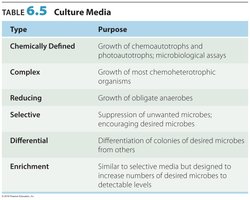
Summary Table: Types of Culture Media
Type | Purpose |
|---|---|
Chemically Defined | Growth of chemoautotrophs and photoautotrophs; microbiological assays |
Complex | Growth of most chemoheterotrophic organisms |
Reducing | Growth of obligate anaerobes |
Selective | Suppression of unwanted microbes; encouraging desired microbes |
Differential | Differentiation of colonies of desired microbes from others |
Enrichment | Similar to selective media but designed to increase numbers of desired microbes to detectable levels |
Summary Table: Oxygen Requirements of Bacteria
Type | Effect of Oxygen | Bacterial Growth Pattern | Explanation |
|---|---|---|---|
Obligate Aerobes | Only aerobic growth; oxygen required | Growth occurs only where high concentrations of oxygen have diffused into the medium | Presence of enzymes catalase and superoxide dismutase allows toxic forms of oxygen to be neutralized |
Facultative Anaerobes | Aerobic and anaerobic growth; greater growth in presence of oxygen | Growth occurs throughout tube; best at top | Presence of enzymes catalase and superoxide dismutase |
Obligate Anaerobes | Only anaerobic growth; ceases in presence of oxygen | Growth occurs only where there is no oxygen | Lacks enzymes to neutralize toxic oxygen |
Aerotolerant Anaerobes | Only anaerobic growth; but continues in presence of oxygen | Growth occurs evenly throughout tube | Presence of superoxide dismutase |
Microaerophiles | Only aerobic growth; oxygen required in low concentration | Growth occurs only where a low concentration of oxygen has diffused into medium | Produce lethal amounts of toxic oxygen if exposed to normal atmospheric oxygen |
