 뒤로
Microbial Genetics: Structure, Function, and Mechanisms of Genetic Change
스터디 가이드 - 스마트 노트
 자료에 맞춘 맞춤형 노트, 핵심 정의, 예시, 맥락을 확장해 제공합니다.
Microbial Genetics
Overview of Genetics in Microbiology
Microbial genetics is the study of how microorganisms inherit traits, how their genetic information is expressed, and how it can be altered. Understanding these processes is fundamental for comprehending microbial physiology, evolution, and the development of antibiotic resistance.
Genetics: The study of genes, their functions, and replication.
Chromosomes: Structures containing DNA that carry hereditary information.
Genes: Segments of DNA encoding functional products, usually proteins.
Genome: All genetic information in a cell.
Genomics: Sequencing and molecular characterization of genomes.
The Central Dogma of Molecular Biology
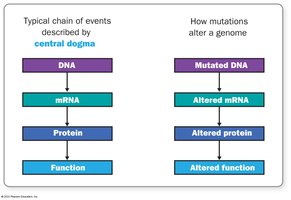
The central dogma describes the flow of genetic information from DNA to RNA to protein, which determines cellular function. Mutations can alter this flow, leading to changes in phenotype.
DNA is transcribed to mRNA, which is translated to protein.
Mutations in DNA can result in altered mRNA, protein, and function.

Genotype and Phenotype
The genotype is the genetic makeup of an organism, while the phenotype is the observable expression of those genes.
Genotype: The set of genes an organism possesses.
Phenotype: The physical and functional expression of the genotype.
Structure and Function of Genetic Material
DNA and Chromosomes in Bacteria
Bacterial chromosomes are typically single, circular DNA molecules, highly supercoiled for efficient packaging. The genome includes both protein-coding genes and noncoding regions such as short tandem repeats (STRs).
STRs: Repeating sequences (2-5 base pairs) of noncoding DNA.
Example: E. coli chromosome contains 4.6 million base pairs.
The Flow of Genetic Information
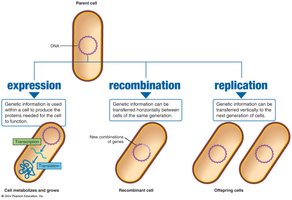
Genetic information can be transferred vertically (from parent to offspring) or horizontally (between cells of the same generation). Expression, recombination, and replication are key processes.
Vertical gene transfer: Parent to offspring.
Horizontal gene transfer: Between cells of the same generation.
Expression: Use of genetic information to produce proteins.
Recombination: Exchange of genetic material.
Replication: Copying DNA for cell division.
DNA Replication
Structure of DNA
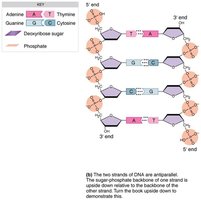
DNA is a double helix with antiparallel strands. The backbone consists of deoxyribose-phosphate, and the strands are held together by hydrogen bonds between complementary bases (A-T, C-G).
Antiparallel: Strands run in opposite directions.
Complementary: Each strand can serve as a template for synthesis.
Mechanism of DNA Replication
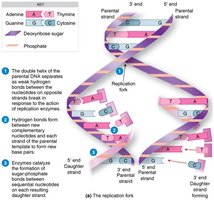
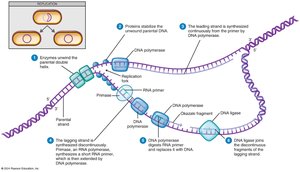
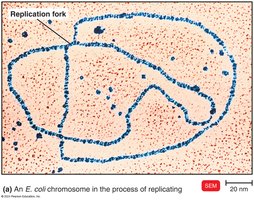
Replication is a highly regulated process involving several enzymes. It begins at a replication fork, where the DNA strands are separated and copied.
Topoisomerase and gyrase: Relax DNA strands.
Helicase: Separates DNA strands.
DNA polymerase: Adds nucleotides to the new strand.
RNA primer: Initiates synthesis.
Leading strand: Synthesized continuously.
Lagging strand: Synthesized discontinuously (Okazaki fragments).
DNA ligase: Joins Okazaki fragments.
Energy Requirements
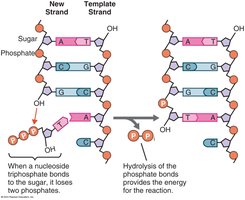
Replication requires energy, supplied by nucleotides. Hydrolysis of phosphate bonds provides the necessary energy.
Energy is released when nucleoside triphosphates are added to the growing DNA strand.
Bidirectional Replication
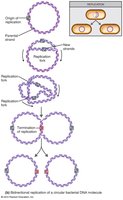
Most bacterial DNA replication is bidirectional, ensuring each daughter cell receives a complete copy. DNA polymerase proofreading ensures high accuracy.
RNA and Protein Synthesis
Types of RNA
RNA is a single-stranded molecule with ribose sugar and uracil instead of thymine. There are three main types:
rRNA: Integral part of ribosomes.
tRNA: Transports amino acids during protein synthesis.
mRNA: Carries coded information from DNA to ribosomes.
Transcription in Prokaryotes
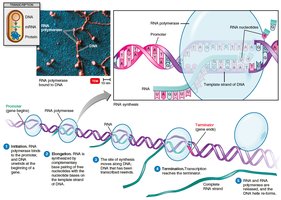
Transcription is the synthesis of a complementary mRNA strand from a DNA template. It involves initiation, elongation, and termination.
Initiation: RNA polymerase binds to the promoter.
Elongation: RNA is synthesized in the 5' to 3' direction.
Termination: Transcription stops at the terminator sequence.
Translation
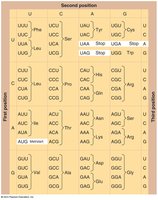
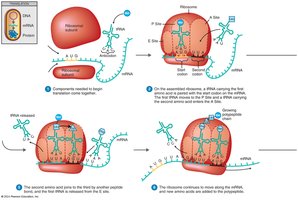
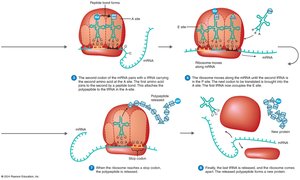
Translation converts mRNA into protein. Codons (three-nucleotide sequences) specify amino acids. The process begins at the start codon (AUG) and ends at stop codons (UAA, UAG, UGA).
Codons: 64 possible, 61 sense codons for 20 amino acids, 3 stop codons.
Degeneracy: Multiple codons can code for the same amino acid.
Mechanism of Translation
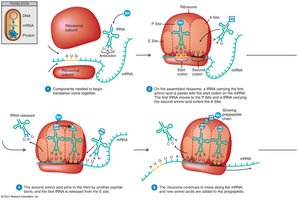
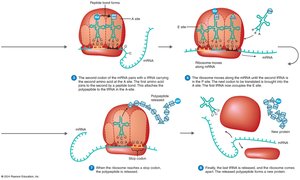
tRNA transports amino acids to the ribosome.
tRNA anticodon pairs with mRNA codon.
Amino acids are joined by peptide bonds.
Simultaneous Transcription and Translation in Bacteria
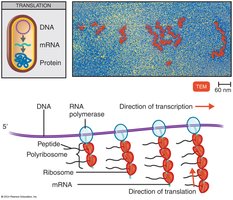
In bacteria, translation can begin before transcription is complete because both processes occur in the cytoplasm.
Mutations
Definition and Types
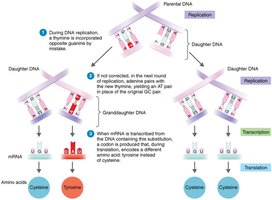
A mutation is a permanent change in the DNA sequence. Mutations can be neutral, beneficial, or harmful. Mutagens are agents that cause mutations, while spontaneous mutations occur without external influence.
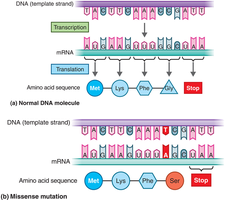
Silent (neutral) mutation: No effect on protein function.
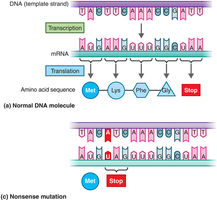
Base substitution (point mutation): Change in one base.
Missense mutation: Base substitution changes an amino acid.
Nonsense mutation: Base substitution creates a stop codon.
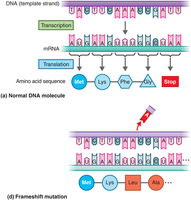
Frameshift mutation: Insertion or deletion shifts the reading frame.
Effects of Radiation
Ionizing radiation (X-rays, gamma rays) can break DNA strands, while UV radiation causes thymine dimers, disrupting replication and transcription.
Genetic Transfer and Recombination
Genetic Recombination
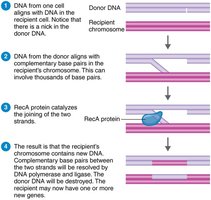
Genetic recombination is the exchange of genes between DNA molecules, increasing genetic diversity. Crossing over involves the breaking and rejoining of DNA strands, allowing insertion of foreign DNA.
Vertical and Horizontal Gene Transfer
Vertical gene transfer: Parent to offspring.
Horizontal gene transfer: Between cells of the same generation; involves donor and recipient cells.
Recipient cell incorporating donor DNA becomes a recombinant.
Plasmids and Transposons
Plasmids
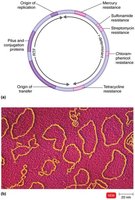
Plasmids are self-replicating, circular DNA molecules found mainly in bacteria. They may carry genes for antibiotic resistance or toxin production and can be transferred horizontally.
Conjugative plasmid: Carries genes for sex pili and plasmid transfer.
Dissimilation plasmids: Encode enzymes for catabolism of unusual compounds.
Resistance factors (R factors): Encode antibiotic resistance.
R factors contain genes for replication/conjugation (RTF) and resistance (R-determinant).
Transposons
Transposons are mobile genetic elements that can move between chromosomes or cells, found in both prokaryotes and eukaryotes.
Mechanisms of Genetic Transfer in Bacteria
Transformation
Transformation involves the uptake of "naked" DNA from the environment by a bacterial cell, which can then incorporate the DNA into its chromosome by recombination. Occurs naturally in certain genera.
Conjugation
Conjugation is the transfer of plasmids between bacteria via cell-to-cell contact. Gram-negative bacteria use sex pili, while Gram-positive use sticky substances. Donor cells have a conjugative plasmid; recipients do not.
Conjugation in E. coli
Donor cells carry the F factor plasmid.
Recipient cells become F+ after receiving the plasmid.
Hfr cells have the F factor integrated into the chromosome and can transfer chromosomal genes.
Transduction
Transduction is the transfer of DNA from a donor to a recipient cell via a bacteriophage. Generalized transduction involves random DNA, while specialized transduction involves specific genes.
Summary Table: Types of Mutations
Type | Description | Effect |
|---|---|---|
Silent | Base change with no effect on protein | Neutral |
Missense | Base change alters amino acid | Protein function may change |
Nonsense | Base change creates stop codon | Protein truncated |
Frameshift | Insertion/deletion shifts reading frame | Many amino acids altered |
Key Equations
DNA Replication:
Transcription:
Translation:
Conclusion
Microbial genetics encompasses the structure, function, and transfer of genetic material in microorganisms. Understanding these processes is essential for studying microbial physiology, evolution, and the development of resistance mechanisms.
