 뒤로
Microbial Genetics: Structure, Replication, Transcription, and Translation
스터디 가이드 - 스마트 노트
 자료에 맞춘 맞춤형 노트, 핵심 정의, 예시, 맥락을 확장해 제공합니다.
Structure and Function of Nucleic Acids
Parts of Nucleic Acids and Their Bonds
Nucleic acids, including DNA and RNA, are polymers composed of nucleotides. Each nucleotide consists of a pentose sugar (ribose in RNA, deoxyribose in DNA), a phosphate group, and a nitrogenous base. The nitrogenous bases are classified as purines (adenine, guanine) or pyrimidines (cytosine, thymine in DNA, uracil in RNA). Complementary base pairing occurs via hydrogen bonds: in DNA, adenine pairs with thymine (two hydrogen bonds), and guanine pairs with cytosine (three hydrogen bonds). In RNA, uracil replaces thymine and pairs with adenine.
Key Point: Hydrogen bonds hold the nitrogenous bases together, forming the double helix structure in DNA.
Key Point: Purines always pair with pyrimidines, ensuring uniform width of the DNA molecule.
Example: In DNA, A-T and G-C pairs; in RNA, A-U and G-C pairs.
Microbial Genomes: Prokaryotic vs. Eukaryotic Chromosomes
Comparison of Chromosome Structure
Prokaryotic cells (bacteria and archaea) typically possess a single, circular chromosome located in the nucleoid region of the cytoplasm and are haploid. Eukaryotic cells have multiple, linear chromosomes sequestered within a membrane-bound nucleus and are often diploid. Plasmids, small circular DNA molecules, are found in many prokaryotes and some eukaryotes, providing additional genetic traits.
Prokaryotic Chromosomes: Circular, haploid, nucleoid location, may contain plasmids.
Eukaryotic Chromosomes: Linear, diploid, nuclear location, may contain extranuclear DNA (mitochondria, chloroplasts).
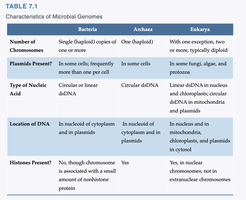
Bacteria | Archaea | Eukarya | |
|---|---|---|---|
Number of Chromosomes | Single (haploid) | One (haploid) | Multiple, typically diploid |
Plasmids Present? | In some cells, often more than one per cell | In some cells | In some fungi, algae, and protozoa |
Type of Nucleic Acid | Circular or linear dsDNA | Circular dsDNA | Linear dsDNA in nucleus, circular dsDNA in mitochondria/chloroplasts |
Location of DNA | Nucleoid of cytoplasm and plasmids | Nucleoid of cytoplasm and plasmids | Nucleus, mitochondria, chloroplasts, plasmids |
Histones Present? | No (small associated protein) | Yes | Yes (nuclear chromosomes), not in extranuclear chromosomes |
Central Dogma of Genetics
DNA, RNA, and Protein Synthesis
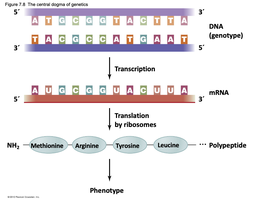
The central dogma describes the flow of genetic information: DNA is transcribed into RNA, which is then translated into protein. Genes (DNA sequences) are transcribed to produce messenger RNA (mRNA), which is translated by ribosomes to synthesize polypeptides (proteins). The genotype (DNA sequence) determines the phenotype (observable traits) via protein expression.
Key Point: Transcription copies DNA into RNA; translation converts RNA into protein.
Example: DNA sequence ATG codes for methionine (start codon) in protein synthesis.
Transcription: Steps and Mechanisms
Initiation of Transcription
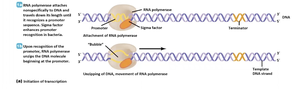
Transcription begins when RNA polymerase binds to a promoter region on DNA, aided by sigma factors in prokaryotes. The enzyme unwinds the DNA and starts synthesizing RNA complementary to the template strand.
Key Point: Promoter recognition is essential for transcription initiation.
Key Point: Sigma factors enhance promoter recognition in bacteria.
Elongation of Transcription
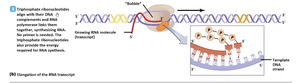
During elongation, RNA polymerase moves along the DNA, synthesizing RNA by linking ribonucleotides complementary to the DNA template. No primer is needed, and triphosphate ribonucleotides provide both building blocks and energy.
Key Point: RNA is synthesized in the 5′ to 3′ direction.
Key Point: Multiple RNA polymerases can transcribe the same gene simultaneously.
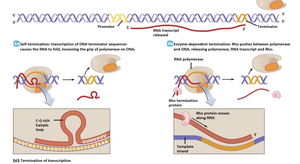
Termination of Transcription
Transcription ends when RNA polymerase encounters a terminator sequence. Termination can occur via self-termination (hairpin loop formation) or enzyme-dependent termination (Rho protein displaces RNA polymerase).
Key Point: Self-termination involves GC-rich hairpin loops.
Key Point: Rho-dependent termination uses a protein to release the RNA transcript.
DNA Replication: Steps and Enzymes
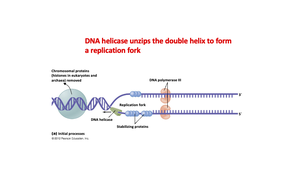
Initial Processes in Replication
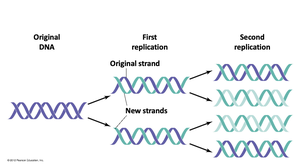
DNA replication is a semiconservative process, meaning each new DNA molecule contains one original and one new strand. Replication begins at the origin, where DNA helicase unzips the double helix, forming a replication fork. Stabilizing proteins keep the strands apart, and topoisomerases relieve supercoiling.
Key Point: Replication is bidirectional in bacteria, proceeding from a single origin.
Key Point: DNA polymerase synthesizes new DNA only in the 5′ to 3′ direction.
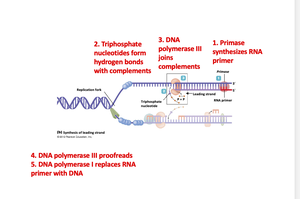
Synthesis of the Leading Strand
The leading strand is synthesized continuously. Primase creates an RNA primer, triphosphate nucleotides form hydrogen bonds with their complements, DNA polymerase III joins them, proofreads, and DNA polymerase I replaces the RNA primer with DNA.
Key Point: Leading strand synthesis is continuous and efficient.
Key Point: Proofreading ensures high fidelity in DNA replication.
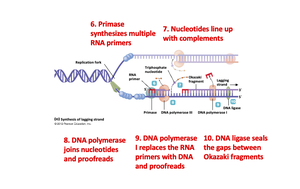
Synthesis of the Lagging Strand
The lagging strand is synthesized discontinuously in short segments called Okazaki fragments. Primase synthesizes multiple RNA primers, DNA polymerase III joins nucleotides and proofreads, DNA polymerase I replaces RNA primers with DNA, and DNA ligase seals the gaps between fragments.
Key Point: Lagging strand synthesis is discontinuous due to antiparallel strand orientation.
Key Point: Okazaki fragments are joined to form a continuous strand.
Semiconservative Model of DNA Replication
Each daughter DNA molecule consists of one original (parental) strand and one newly synthesized strand. This model ensures genetic continuity and minimizes errors.
Key Point: Semiconservative replication preserves genetic information across generations.
Summary Table: Replication, Transcription, and Translation
Process | Purpose | Template | Building Blocks | Main Enzyme | Primer? | Starts at | Ends at | Product | Location (Eukaryote) |
|---|---|---|---|---|---|---|---|---|---|
Replication | Copy all DNA before cell division | Both DNA strands | DNA nucleotides | DNA polymerase | Yes (RNA primer) | Origin | Forks meet/end of DNA | Two identical DNA molecules | Nucleus |
Transcription | Copy one gene into RNA | One DNA strand | RNA nucleotides | RNA polymerase | No | Promoter | Terminator | RNA (mRNA, tRNA, rRNA) | Nucleus |
Translation | Make a protein from mRNA | mRNA | Amino acids | Ribosome | No | Start codon (AUG) | Stop codon | Polypeptide (protein) | Cytoplasm |
Additional info:
DNA methylation in bacteria controls gene expression, initiates replication, protects against viral infection, and aids in DNA repair.
Plasmids are used as vectors in genetic engineering to transfer genes between cells.
Mutations (point, frameshift) and gene recombination contribute to genetic diversity and evolution in microbes.
