 뒤로
Microbial Genetics: Study Notes for BIO 214 Week 7
스터디 가이드 - 스마트 노트
 자료에 맞춘 맞춤형 노트, 핵심 정의, 예시, 맥락을 확장해 제공합니다.
Chapter 8: Microbial Genetics
I. Learning Objectives
This chapter focuses on understanding the molecular basis of genetics in microorganisms, including the structure and function of DNA, the processes of transcription and translation, and mechanisms of genetic recombination in bacteria.
II. Historical Hypotheses: Proteins vs. DNA as Genetic Material
In the early to mid-20th century, scientists debated whether proteins or DNA served as the genetic material. Proteins were initially favored due to their complexity and diversity, but experiments such as the Avery-MacLeod-McCarty and Hershey-Chase experiments demonstrated that DNA is the hereditary material in cells.
Key Point: DNA, not protein, is the molecule responsible for inheritance.
Example: The Hershey-Chase experiment used bacteriophages to show that DNA, not protein, enters bacterial cells and directs viral replication.
III. Basic Genetics Terminology
Understanding genetics requires familiarity with several key terms:
Genetics: The study of heredity and variation in organisms.
Gene: A segment of DNA that encodes a functional product, usually a protein.
Chromosome: A DNA molecule with part or all of the genetic material of an organism.
Genotype: The genetic makeup of an organism.
Phenotype: The observable characteristics resulting from the genotype.
Bacterial vs. Human Chromosomes: Bacteria typically have a single, circular chromosome, while humans have multiple, linear chromosomes.
Genomics: The study of the entire genome of an organism.
IV. Central Dogma of Biology
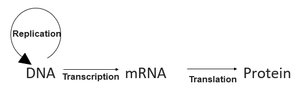
The central dogma describes the flow of genetic information within a biological system. It states that DNA is transcribed into mRNA, which is then translated into protein. DNA can also replicate itself to pass genetic information to daughter cells.
Key Point: Information flows from DNA → RNA → Protein.
Replication: DNA makes copies of itself.
Transcription: DNA is used as a template to synthesize mRNA.
Translation: mRNA is used as a template to synthesize proteins.
Equation:
Example: In Escherichia coli, the lac operon is transcribed into mRNA, which is then translated into enzymes that metabolize lactose.
V. DNA
A. Historical Figures Important in Determining DNA Structure
Several scientists contributed to the discovery of DNA's structure:
James Watson and Francis Crick: Proposed the double helix model of DNA.
Rosalind Franklin: Used X-ray crystallography to provide key evidence for the helical structure.
Maurice Wilkins: Collaborated with Franklin and contributed to the understanding of DNA structure.
B. Molecular Structure of DNA
DNA is a double-stranded helix composed of nucleotides. Each nucleotide consists of a phosphate group, a deoxyribose sugar, and a nitrogenous base (adenine, thymine, cytosine, or guanine).
Base Pairing: Adenine pairs with thymine, cytosine pairs with guanine.
Antiparallel Strands: The two strands run in opposite directions (5' to 3' and 3' to 5').
Equation:
C. DNA Replication/Synthesis
DNA replication is the process by which DNA makes a copy of itself before cell division. It is semi-conservative, meaning each new DNA molecule contains one original strand and one new strand.
Key Enzymes: DNA polymerase, helicase, primase, ligase.
Steps: Unwinding, priming, elongation, and joining of fragments.
Equation:
VI. Transcription (Making mRNA from DNA)
Transcription is the process by which a segment of DNA is copied into mRNA by the enzyme RNA polymerase. This mRNA carries the genetic code from the DNA to the ribosome for protein synthesis.
Key Steps: Initiation, elongation, termination.
Example: The transcription of the lac operon in bacteria produces mRNA for lactose metabolism enzymes.
Equation:
VII. Translation (Making Proteins from mRNA)
Translation is the process by which the sequence of bases in mRNA is decoded to produce a specific sequence of amino acids, forming a protein. This occurs at the ribosome and involves tRNA molecules bringing amino acids to the growing polypeptide chain.
Key Steps: Initiation, elongation, termination.
Example: Translation of mRNA coding for beta-galactosidase in E. coli.
Equation:
VIII. DNA/Genetic Recombination in Bacteria
Bacteria can exchange genetic material through several mechanisms, increasing genetic diversity and adaptability.
A. Conjugation
Conjugation is the transfer of genetic material between bacterial cells via direct contact, often mediated by a pilus.
Example: Transfer of antibiotic resistance genes via plasmids.
B. Transformation
Transformation involves the uptake of free DNA fragments from the environment by a bacterial cell.
Example: Streptococcus pneumoniae acquiring new traits by taking up DNA from dead cells.
C. Transduction
Transduction is the transfer of genetic material from one bacterium to another via bacteriophages (viruses that infect bacteria).
Example: Phage-mediated transfer of toxin genes in Corynebacterium diphtheriae.
D. Transposons
Transposons, or "jumping genes," are DNA sequences that can move from one location to another within the genome, causing mutations and gene rearrangements.
Example: Insertion of transposons can disrupt gene function or confer antibiotic resistance.
Additional info: These mechanisms are crucial for microbial evolution and adaptation, especially in response to environmental pressures such as antibiotics.
