 뒤로
Microbial Growth: Colony Morphology and Growth Patterns in Culture Media
스터디 가이드 - 스마트 노트
 자료에 맞춘 맞춤형 노트, 핵심 정의, 예시, 맥락을 확장해 제공합니다.
Microbial Growth
Plates, Slants, and Broth: Overview of Culture Media
Microbiologists use various types of culture media—such as agar plates, slants, and liquid broths—to observe and characterize microbial growth. The appearance of microbial colonies and growth patterns in these media provide essential clues for identification and classification.
Agar Plates: Used to isolate and observe individual colonies, allowing for the study of colony morphology.
Agar Slants: Provide a solid surface in a test tube, useful for maintaining cultures and observing growth patterns along the surface.
Broth Media: Liquid medium used to assess patterns of microbial growth in suspension.

Colony Features on Agar Plates
Describing Colony Morphology
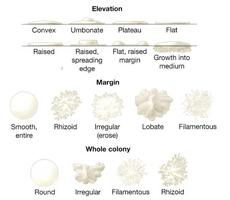
Colony morphology refers to the visible characteristics of microbial colonies grown on solid media. These features are critical for preliminary identification and include elevation, margin, whole colony shape, pigment production, texture, and optical properties.
Elevation: The side view profile of a colony (e.g., convex, umbonate, plateau, flat, raised, growth into medium).
Margin: The edge of the colony (e.g., smooth/entire, rhizoid, irregular/erose, lobate, filamentous).
Whole Colony Shape: The overall outline (e.g., round, irregular, filamentous, rhizoid).
Pigment Production: Some microbes produce colored pigments, which may be temperature-dependent.
Texture: Describes the surface (e.g., moist, mucoid, dry, friable/crusty).
Optical Properties: Colonies may be opaque, translucent, shiny, or dull.
Growth on Agar Slants
Patterns and Pigmentation
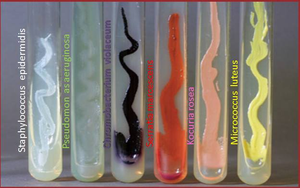
Microbial growth on agar slants can be described by the density, opacity, and edge characteristics of the growth. Pigmentation is also an important diagnostic feature and may vary with temperature.
Filiform: Dense, opaque growth with smooth edges.
Friable: Crusty, brittle growth.
Translucent: Growth that allows light to pass through.
Spreading Edge: Growth that spreads out from the line of inoculation.
Pigmentation: Some bacteria produce colored growth, which can be species-specific.
Growth in Broth Media
Patterns of Microbial Growth in Liquid Culture
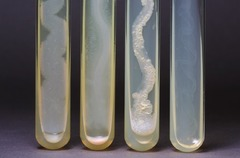
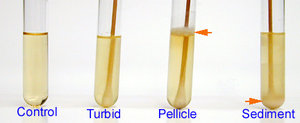
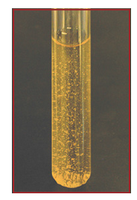
Microbial growth in broth can be classified based on the distribution and appearance of cells in the liquid medium. These patterns help distinguish between different microbial species and their oxygen requirements.
Uniform Fine Turbidity: Evenly cloudy appearance throughout the broth, indicating dispersed growth.
Flocculent: Clumps or flakes of cells suspended in the broth.
Pellicle: Growth at the surface of the broth, often forming a film.
Sediment: Cells settle at the bottom of the tube.
Control: Clear broth with no microbial growth (used as a negative control).
Summary Table: Colony Morphology Features
Feature | Examples | Description |
|---|---|---|
Elevation | Convex, Umbonate, Plateau, Flat, Raised, Growth into medium | Side view profile of the colony |
Margin | Smooth/entire, Rhizoid, Irregular/erose, Lobate, Filamentous | Edge appearance of the colony |
Whole Colony Shape | Round, Irregular, Filamentous, Rhizoid | Overall outline of the colony |
Pigment Production | Varies by species | Color produced by the colony, may be temperature-dependent |
Texture | Moist, Mucoid, Dry, Friable | Surface feel and appearance |
Optical Properties | Opaque, Translucent, Shiny, Dull | Light transmission and reflectivity |
Additional info:
Colony morphology is a preliminary tool and should be combined with biochemical and genetic tests for definitive identification.
Environmental factors such as temperature, medium composition, and incubation time can influence colony appearance.
