 뒤로
Microbial Growth: Requirements, Classification, and Measurement
스터디 가이드 - 스마트 노트
 자료에 맞춘 맞춤형 노트, 핵심 정의, 예시, 맥락을 확장해 제공합니다.
Microbial Growth
Overview
Microbial growth refers to the increase in the number of cells in a population, not the size of individual cells. Understanding the requirements and mechanisms of microbial growth is essential for microbiology, as it impacts food safety, disease, and industrial processes.
The Requirements for Growth
Physical Requirements
Microbes require specific physical conditions for optimal growth, including temperature, pH, and osmotic pressure.
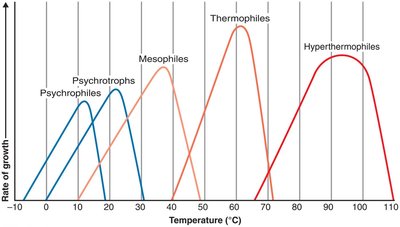
Temperature: Microbes are classified based on their preferred temperature ranges.
Psychrophiles: Grow at 0°C, optimum at 15°C; found in polar regions and deep oceans.
Psychrotrophs: Grow at 0°C, optimum between 20–30°C; cause food spoilage in refrigerators.
Mesophiles: Optimum growth at 25–40°C; includes most human pathogens.
Thermophiles: Optimum growth at 50–60°C; found in hot springs and compost piles.
Hyperthermophiles: Optimum growth above 80°C; found in extreme environments.
pH: Most bacteria grow best between pH 6.5 and 7.5. Molds and yeasts prefer pH 5–6. Acidophiles thrive in acidic environments. Laboratory media often include buffers to maintain stable pH.
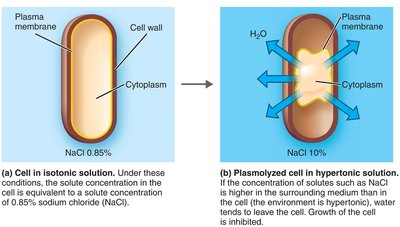
Osmotic Pressure: Hypertonic environments cause plasmolysis, inhibiting growth. Extreme or obligate halophiles require high salt concentrations (up to 30% NaCl), while facultative halophiles tolerate 2–10% NaCl.
Food Safety and Temperature
Temperature control is crucial for preventing microbial growth in food. The 'danger zone' (15–50°C) allows rapid bacterial growth and toxin production. 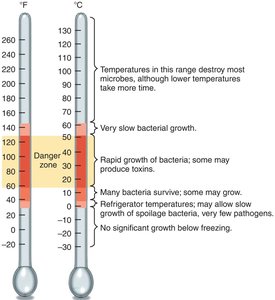
Effect of Food Amount on Cooling Rate
Larger volumes of food cool more slowly, increasing the risk of spoilage by bacteria such as Bacillus cereus. 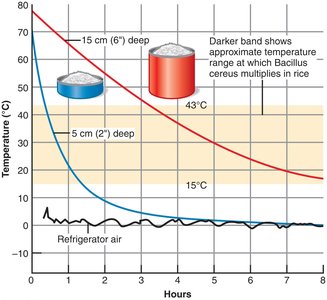
Chemical Requirements
Microbes need various chemical elements for growth:
Carbon: Structural backbone of organic molecules. Chemoheterotrophs use organic molecules for carbon and energy; autotrophs use CO2 as their carbon source.
Nitrogen: Essential for proteins, DNA, and ATP. Most bacteria decompose protein-containing material; some use NH4+ or NO3-; a few fix atmospheric N2.
Sulfur: Used in amino acids, thiamine, and biotin. Most bacteria decompose protein for sulfur; some use SO42- or H2S.
Phosphorus: Used in DNA, RNA, ATP, and phospholipids. PO43- is a common source.
Trace Elements: Required in small amounts as enzyme cofactors (e.g., iron, copper, molybdenum, zinc).
Oxygen Requirements
Classification Based on Oxygen Tolerance
Microbes are classified by their oxygen requirements:
Obligate aerobes: Require oxygen for growth.
Facultative anaerobes: Can grow with or without oxygen; use fermentation or anaerobic respiration when oxygen is absent.
Obligate anaerobes: Cannot tolerate oxygen; growth ceases in its presence.
Aerotolerant anaerobes: Tolerate oxygen but do not use it.
Microaerophiles: Require oxygen at lower concentrations than atmospheric levels.
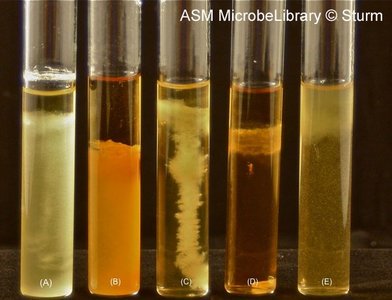
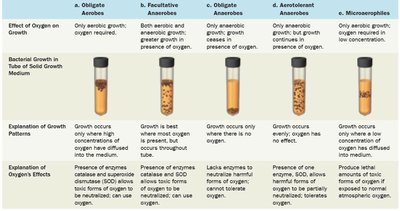
Type | Effect of Oxygen | Growth Pattern | Enzymes Present |
|---|---|---|---|
Obligate Aerobes | Only aerobic growth; oxygen required | Cluster at top | Catalase, SOD |
Facultative Anaerobes | Both aerobic and anaerobic; more growth with oxygen | Cluster at top, spread throughout | Catalase, SOD |
Obligate Anaerobes | Only anaerobic; growth ceases with oxygen | Cluster at bottom | None |
Aerotolerant Anaerobes | Only anaerobic; growth continues with oxygen | Evenly distributed | SOD |
Microaerophiles | Only aerobic; oxygen required in low concentration | Cluster at center | Produce lethal amounts of toxic oxygen if exposed to normal levels |
Detoxification of Toxic Oxygen Forms
Aerobes and some anaerobes possess enzymes to neutralize toxic forms of oxygen:
Superoxide dismutase (SOD): Converts superoxide radicals to hydrogen peroxide and oxygen.
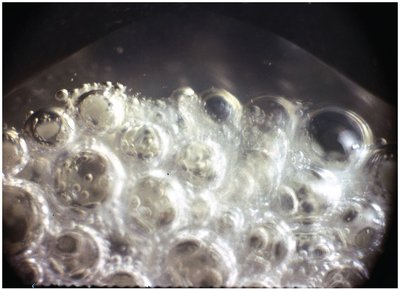
Catalase: Converts hydrogen peroxide to water and oxygen.
Peroxidase: Converts hydrogen peroxide to water.
Biofilms
Formation and Significance
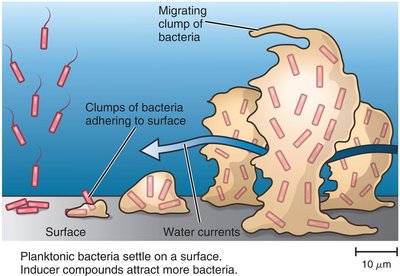
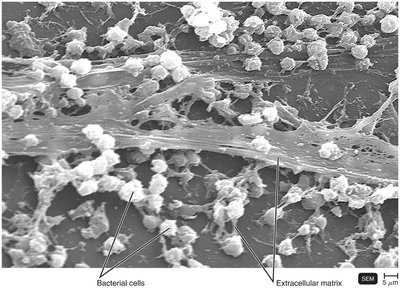
Biofilms are complex microbial communities that adhere to surfaces and are embedded in a self-produced matrix. They form via quorum sensing, where bacteria communicate and attract others by secreting signaling chemicals.
Biofilms share nutrients and protect bacteria from environmental hazards.
They are highly resistant to microbicides and are implicated in 70% of infections (e.g., catheters, heart valves, dental caries).
Obtaining Pure Cultures
Streak Plate Method
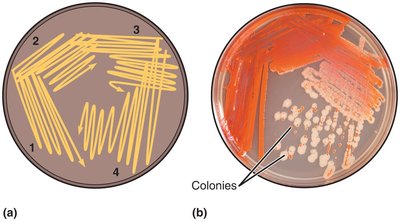
A pure culture contains only one species or strain. The streak plate method is used to isolate pure cultures by spreading bacteria across an agar plate to obtain individual colonies.
A colony-forming unit (CFU) arises from a single cell or group of attached cells.
Preserving Bacterial Cultures
Methods
Microorganisms can be preserved by:
Deep-freezing: Storage at -50°C to -95°C.
Lyophilization (freeze-drying): Frozen at -54°C to -72°C and dehydrated in a vacuum.
The Growth of Bacterial Cultures
Bacterial Division
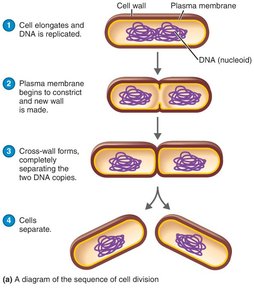
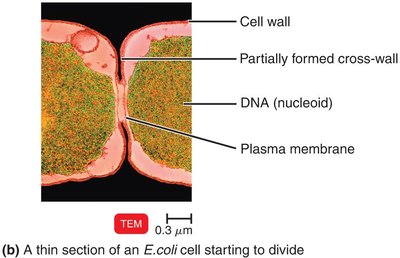
Bacterial growth is primarily through binary fission, where a cell divides into two identical cells. Some bacteria reproduce by budding.
Binary fission doubles the number of cells each generation.
Generation Time
The time required for a cell to divide varies from 20 minutes to 24 hours. The total number of cells after n generations is:
Bacterial Growth Curve
Bacterial populations follow a sequential series of growth phases:
Lag Phase: Intense metabolic activity, no increase in cell number.
Log Phase: Rapid, exponential increase in cell number.
Stationary Phase: Growth slows, cell deaths balance new cells.
Death Phase: Deaths exceed new cell production, population decreases.
Measuring Microbial Growth
Direct Methods
Plate Count: Count colonies on plates with 30–300 CFUs; requires serial dilution.
Filtration: Solution passed through a filter that collects bacteria, which are then cultured.
Direct Microscopic Count: Uses a Petroff-Hausser cell counter to count cells in a known volume.
Indirect Methods
Turbidity: Measures cloudiness with a spectrophotometer; higher turbidity indicates more cells.
Metabolic Activity: Amount of metabolic product is proportional to cell number.
Dry Weight: Cells are filtered, dried, and weighed; useful for filamentous organisms.
*Additional info: Academic context and explanations have been expanded for clarity and completeness. Only images directly relevant to the adjacent content have been included as per instructions.*
