 뒤로
Microbial Metabolism and Growth: Environmental and Nutritional Factors Affecting Bacterial Growth
스터디 가이드 - 스마트 노트
 자료에 맞춘 맞춤형 노트, 핵심 정의, 예시, 맥락을 확장해 제공합니다.
Microbial Metabolism and Growth
Principles of Bacterial Growth
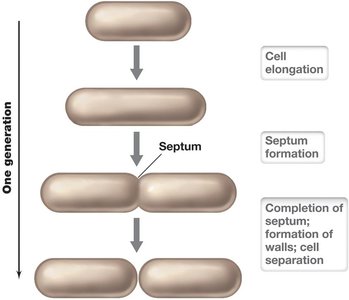
Bacterial growth is a fundamental process in microbiology, involving the increase in cell number through cell division. Most prokaryotic cells divide by binary fission, resulting in exponential population growth. Each division cycle, or generation, doubles the population, and the time required for this is called the generation time.
Binary fission: A process where one cell divides into two identical daughter cells. Each daughter cell receives a complete chromosome and sufficient cellular components to survive independently.
Septum formation: The partition that forms between dividing cells, eventually leading to cell separation.
Generation time: The time required for a population to double in number; varies among species.
Alternatives to Binary Fission
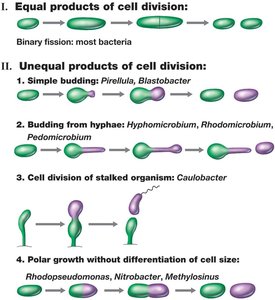
Not all bacteria divide by binary fission. Some utilize alternative mechanisms such as budding, hyphal growth, and multiple fission, which result in unequal cell division or the formation of specialized structures.
Budding: Unequal cell growth where a new daughter cell forms as an outgrowth of the parent. Some bacteria form cytoplasmic extensions like stalks or appendages (e.g., Caulobacter, Hyphomicrobium).
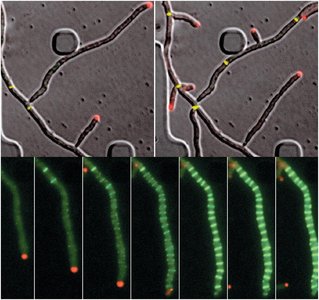
Hyphal growth: Characteristic of actinomycetes (e.g., Streptomyces), where long filaments (hyphae) grow at the tip, forming a network called mycelia. Arthrospores may form for survival.
Multiple fission: A process where a filament forms many septa simultaneously, producing multiple daughter cells.
Elemental and Macromolecular Composition of Bacterial Cells
Major Elements and Macromolecules
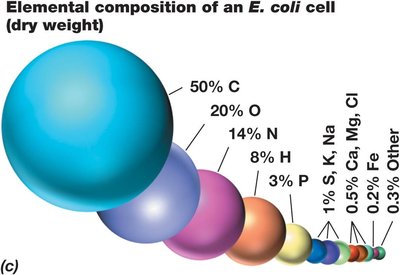
Bacterial cells are composed of a limited set of elements, with carbon, oxygen, nitrogen, hydrogen, phosphorus, and sulfur making up the majority of the dry weight. These elements are assembled into macromolecules such as proteins, lipids, polysaccharides, and nucleic acids.
Macronutrients: Elements required in large amounts (C, O, N, H, P, S, K, Na, Ca, Mg, Cl, Fe).
Micronutrients: Elements required in trace amounts, often as enzyme cofactors (e.g., Mn, Zn, Co, Mo, Ni, Cu).
Macromolecules: Proteins and RNA constitute the majority of cellular dry weight, with DNA being a smaller fraction.

Cell Nutrition: Macronutrients and Micronutrients
Macronutrients
Microbes require a variety of nutrients for growth, which are classified based on the quantity needed and their function in cellular processes.
Carbon (C): The main element in cellular macromolecules. Heterotrophs obtain carbon from organic compounds, while autotrophs fix carbon dioxide to synthesize organics.
Nitrogen (N): Essential for proteins and nucleic acids. Sources include ammonia (NH3), nitrate (NO3-), nitrogen gas (N2), and organic compounds.
Oxygen (O) and Hydrogen (H): Primarily derived from water.
Phosphorus (P): Required for nucleic acids and phospholipids, usually supplied as inorganic phosphate (PO43-).
Sulfur (S): Found in certain amino acids and vitamins; assimilated as sulfate (SO42-), sulfide (H2S), or organics.
Potassium (K), Magnesium (Mg), Calcium (Ca), Sodium (Na): Involved in enzyme function, membrane stability, and other cellular processes.
Micronutrients: Trace Metals and Growth Factors
Trace metals and organic growth factors are required in minute amounts, often as enzyme cofactors or coenzymes.
Iron (Fe): Essential for cellular respiration and redox reactions.
Growth factors: Organic compounds such as vitamins, amino acids, purines, and pyrimidines that some microbes cannot synthesize and must obtain from the environment.
Energy and Carbon Sources
Classification of Microorganisms by Energy and Carbon Source
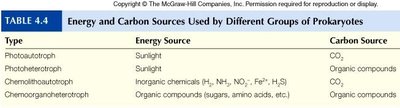
Microorganisms are classified based on their energy and carbon sources, which determines their metabolic strategies.
Type | Energy Source | Carbon Source |
|---|---|---|
Photoautotroph | Sunlight | CO2 |
Photoheterotroph | Sunlight | Organic compounds |
Chemolithoautotroph | Inorganic chemicals (H2, NH3, NO2-, Fe2+, H2S) | CO2 |
Chemoorganoheterotroph | Organic compounds (sugars, amino acids, etc.) | Organic compounds |

Physical and Environmental Factors Affecting Microbial Growth
Temperature
Microorganisms are classified by their optimal growth temperatures, which reflect adaptations to their environments.
Psychrophiles: Optimum -5°C to 15°C; found in Arctic and Antarctic regions.
Psychrotolerant: Optimum 20°C to 30°C; important in food spoilage.
Mesophiles: Optimum 25°C to 45°C; includes most human pathogens.
Thermophiles: Optimum 45°C to 70°C; common in hot springs.
Hyperthermophiles: Optimum 70°C to 110°C; usually Archaea, found in hydrothermal vents.
Molecular Adaptations to Temperature Extremes
Cold adaptation: Enzymes with more α-helices, higher unsaturated fatty acid content in membranes, cold shock proteins, and cryoprotectants.
Heat adaptation: Heat-stable enzymes, increased ionic bonding, hydrophobic interiors, and specialized membrane lipids (e.g., ether-linked isoprenoids in Archaea).
pH
Microorganisms are adapted to grow at specific pH ranges, but all maintain a near-neutral internal pH for macromolecular stability.
Neutrophiles: Grow best at pH 5–8 (e.g., Escherichia coli).
Acidophiles: Thrive at pH below 5.5; maintain neutral cytoplasm by pumping out protons.
Alkaliphiles: Grow at pH above 8.5; use sodium ion exchange to maintain internal pH.
Physiological Class | pH Optimum | Example Organism |
|---|---|---|
Neutrophile | 7 | Escherichia coli |
Acidophile | 5 | Rhodopila globiformis |
Acidophile | 3 | Acidithiobacillus ferrooxidans |
Acidophile | 1 | Picrophilus oshimae |
Alkaliphile | 8 | Chloroflexus aurantiacus |
Alkaliphile | 9 | Bacillus firmus |
Alkaliphile | 10 | Natronobacterium gregoryi |
Water Availability and Osmolarity
Water is essential for microbial growth. Water availability is measured as water activity (aw), which ranges from 0 (no free water) to 1 (pure water). High solute concentrations can cause plasmolysis, but microbes have adaptations to survive in such environments.
Halophiles: Require high salt concentrations for growth.
Halotolerant: Can tolerate some salt but grow best without it.
Osmophiles: Thrive in high-sugar environments.
Xerophiles: Grow in very dry environments.
Compatible solutes: Small organic molecules synthesized or accumulated to maintain positive water balance without inhibiting cellular processes (e.g., proline, glycine betaine, KCl).
Oxygen Requirements and Toxicity
Oxygen Relationships of Microorganisms
Microorganisms are classified based on their oxygen requirements, which reflect their metabolic capabilities and environmental niches.
Group | Relationship to O2 | Type of Metabolism | Example | Habitat |
|---|---|---|---|---|
Obligate aerobe | Required | Aerobic respiration | Micrococcus luteus | Skin, dust |
Facultative anaerobe | Not required, but better with O2 | Aerobic/anaerobic respiration, fermentation | Escherichia coli | Mammalian intestine |
Microaerophile | Required at low levels | Aerobic respiration | Spirillum volutans | Lake water |
Aerotolerant anaerobe | Not required, indifferent | Fermentation | Streptococcus mutans | Oral cavity |
Obligate anaerobe | Harmful or lethal | Fermentation or anaerobic respiration | Methanobacterium formicicum | Sewage sludge |
Toxic oxygen species: Byproducts of oxygen metabolism (superoxide anion, hydrogen peroxide, hydroxyl radical) are harmful to cells.
Protective enzymes: Superoxide dismutase, catalase, and peroxidase detoxify reactive oxygen species.
Microbial Communities and Biofilms
Biofilm Formation and Significance
Microbes often exist in complex, mixed communities where they interact cooperatively or competitively. Biofilms are structured communities encased in a polysaccharide matrix, attached to surfaces, and exhibit unique properties compared to planktonic (free-living) cells.
Stages of biofilm development: Attachment, colonization (EPS production), development (metabolic changes), and dispersal.
Biofilm architecture: Contains channels for nutrient and waste exchange; resists immune responses and antimicrobials.
Medical and industrial relevance: Biofilms are implicated in chronic infections, device-related infections, dental plaque, and industrial fouling.
Example: Pseudomonas aeruginosa biofilm development is a model for studying biofilm formation and resistance mechanisms.
