 뒤로
ch 5
스터디 가이드 - 스마트 노트
 자료에 맞춘 맞춤형 노트, 핵심 정의, 예시, 맥락을 확장해 제공합니다.
Microbial Metabolism
Metabolism: An Overview
Metabolism encompasses all chemical reactions within a living organism, serving as an energy-balancing act. It is divided into two fundamental processes:
Catabolism: Reactions that break down complex molecules, releasing energy and providing building blocks for anabolism. These are often hydrolytic and exergonic (produce more energy than they consume). Example: Breakdown of sugars into carbon dioxide and water.
Anabolism: Reactions that use energy and building blocks to synthesize complex molecules. Also known as biosynthetic reactions, they are typically dehydration synthesis and endergonic (consume more energy than they produce). Example: Formation of proteins from amino acids, nucleic acids from nucleotides, and polysaccharides from simple sugars.
ATP: The Energy Connection
ATP (Adenosine Triphosphate) acts as the energy intermediary between catabolism and anabolism.
Catabolic reactions release energy, which is used to synthesize ATP.
ATP stores usable energy and releases it to power anabolic reactions.
Metabolic pathways are sequences of chemical reactions, each step catalyzed by specific enzymes determined by the cell’s genetic makeup.
Enzymes: Structure and Function
Enzymes are biological catalysts that accelerate chemical reactions by lowering activation energy.
Some enzymes are purely proteins.
Apoenzyme: Protein portion, inactive alone.
Cofactor: Nonprotein component (e.g., iron, zinc, magnesium, calcium).
Coenzyme: Organic cofactor.
Holoenzyme: Complete, active enzyme (apoenzyme + cofactor).
Collision Theory: Chemical reactions occur as atoms, ions, and molecules collide.
Activation Energy: Minimum collision energy required for a reaction.
Reaction Rate: Frequency of effective collisions; increased by enzymes, temperature, pressure, or concentration.
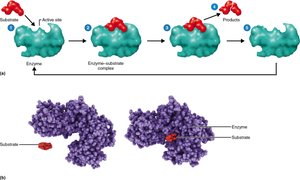
Mechanism of Enzymatic Action
Enzymes facilitate reactions through a specific sequence:
Substrate contacts the enzyme's active site.
Substrate binds to the active site, forming an enzyme-substrate complex.
Substrate is transformed into products.
Products are released as they no longer fit the active site.
Enzyme is recovered unchanged and can catalyze further reactions.
Factors Influencing Enzymatic Activity
Several factors affect enzyme function:
Temperature: Activity increases with temperature up to an optimum; excessive heat denatures enzymes.
pH: Each enzyme has an optimal pH; extreme pH can denature proteins.
Substrate Concentration: Increased concentration raises reaction rate until enzymes are saturated.
Inhibitors: Decrease or interfere with enzyme activity.
Enzyme Inhibition
Competitive Inhibition: Inhibitor competes for the active site, preventing substrate binding.
Noncompetitive Inhibition: Inhibitor binds to an allosteric site, altering enzyme shape and rendering the active site nonfunctional. Can be reversible or irreversible.
Feedback Inhibition: Final product inhibits an earlier enzyme in the pathway, a form of noncompetitive inhibition.
Ribozymes
Ribozymes are RNA molecules functioning as catalysts. They bind and act on substrates, are not consumed in reactions, and play roles in RNA splicing and protein synthesis in ribosomes.
Oxidation-Reduction (Redox) Reactions
Oxidation: Removal of electrons from a molecule, often producing energy.
Reduction: Gain of electrons.
Redox reactions involve one substance being oxidized and another reduced. Mnemonic: OIL RIG (Oxidation Is Loss, Reduction Is Gain).
Dehydrogenation: Biological oxidations often involve loss of hydrogen atoms.
Phosphorylation Reactions Generating ATP
Energy from redox reactions is trapped by ATP formation.
Phosphorylation: Addition of a phosphate group (🅟) to a compound, generating ATP from ADP.
Substrate-Level Phosphorylation: Direct transfer of a high-energy phosphate to ADP. Example: Glycolysis and Krebs cycle.
Oxidative Phosphorylation: ATP synthesis via electron transport chain. Example: Aerobic respiration.
Photophosphorylation: ATP production using light energy, electrons from chlorophyll initiate reactions. Example: Photosynthesis.
Metabolic Pathways: Function and Purpose
Metabolic pathways are series of enzyme-catalyzed reactions.
Break down nutrients.
Extract energy from organic molecules.
Store energy in ATP.
Produce molecules needed by the cell.
Glycolysis: Reactants, Products, and By-Products
Reactant: Glucose
Products: 2 Pyruvic acid, 2 ATP (net), 2 NADH
Stages:
Preparatory: 2 ATP used, glucose phosphorylated and split into two 3-carbon molecules.
Energy Conserving: 4 ATP produced, 2 NADH produced, 2 pyruvic acid formed.
Net gain: 2 ATP per glucose oxidized.
Krebs Cycle: Products
Before entering, pyruvic acid is converted to acetyl-CoA.
For one acetyl-CoA: 3 NADH, 1 FADH₂, 1 ATP, 2 CO₂
Per glucose: 6 NADH, 2 FADH₂, 2 ATP, 4 CO₂
Chemiosmotic Model for ATP Generation
ATP synthesis via electron transport chain (oxidative phosphorylation).
Uses proton (H⁺) gradient across membrane.
Steps:
Electrons move through electron transport chain.
Energy pumps H⁺ across membrane, creating proton motive force.
H⁺ returns via ATP synthase, providing energy for ATP formation:
In prokaryotes: ETC in plasma membrane; in eukaryotes: inner mitochondrial membrane.
Aerobic vs. Anaerobic Respiration
Feature | Aerobic Respiration | Anaerobic Respiration |
|---|---|---|
Final Electron Acceptor | O₂ | Other inorganic molecule |
ATP Yield | High | Lower |
End Product | H₂O | Varies (e.g., NO₃⁻, SO₄²⁻) |
ETC Used? | Yes | Yes |
Fermentation: Reactions and Products
Regenerates NAD⁺ for glycolysis in absence of oxygen.
Does not require oxygen, Krebs cycle, or electron transport chain.
Uses organic molecule (e.g., pyruvate) as final electron acceptor.
Produces small amount of ATP.
Lactic Acid Fermentation: Glucose → Pyruvic acid → Lactic acid
Alcohol Fermentation: Glucose → Pyruvic acid → Acetaldehyde → Ethanol
Products: Lactic acid, ethanol, acetic acid, propionic acid, butanol
Example: Saccharomyces cerevisiae (yeast) produces ethanol for beer and wine.
Biochemical Tests for Bacterial Identification
Fermentation Test: Determines if bacterium can ferment carbohydrate; acid production changes pH indicator color, gas production detected. Example: Escherichia
Oxidase Test: Detects cytochrome c oxidase. Example: Pseudomonas
Photosynthesis: Purpose and Reactions
Converts light energy to chemical energy, producing organic compounds (e.g., sugars).
Provides organic material for metabolic processes.
Light-Dependent vs. Light-Independent Reactions
Feature | Light-Dependent | Light-Independent |
|---|---|---|
Energy Source | Light | ATP & NADPH |
Products | ATP, NADPH | Sugar (via Calvin-Benson Cycle) |
Oxygen Production | Oxygenic (plants, algae, cyanobacteria) or anoxygenic (purple/green sulfur bacteria) | No direct oxygen production |
Nutritional Patterns Among Organisms
Nutritional Type | Energy Source | Carbon Source | Examples |
|---|---|---|---|
Photoautotroph | Light | CO₂ | Plants, cyanobacteria, green/purple bacteria |
Photoheterotroph | Light | Organic compounds | Green bacteria, purple nonsulfur bacteria |
Chemoautotroph | Inorganic chemicals | CO₂ | Iron-oxidizing bacteria |
Chemoheterotroph | Chemicals | Organic compounds | Animals, fungi, protozoa, many bacteria |
Additional info: Expanded explanations and tables were added for completeness and clarity.
