 뒤로
뒤로Microbial Metabolism: Foundations and Pathways
스터디 가이드 - 스마트 노트
 자료에 맞춘 맞춤형 노트, 핵심 정의, 예시, 맥락을 확장해 제공합니다.
Microbial Metabolism
Introduction to Metabolism
Microbial metabolism encompasses all controlled biochemical reactions that occur within microbial cells. These reactions are essential for cellular life, growth, development, and reproduction. Metabolism is the sum of all synthesis (anabolic) and decomposition (catabolic) reactions in the cell.
Anabolism: Building reactions that synthesize macromolecules from smaller precursors. These processes require energy input.
Catabolism: Breakdown reactions that decompose substrates, releasing energy.
Metabolic reactions provide the energy and building blocks necessary for cellular processes and structures.
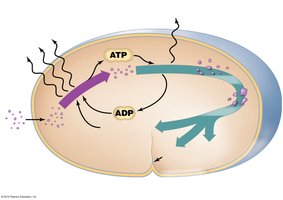
Basic Chemical Reactions Underlying Metabolism
Catabolism and Anabolism
Catabolic and anabolic reactions are interconnected. Catabolic reactions release energy, some of which is stored as ATP and used to drive anabolic reactions. The balance between these processes is vital for cell function.
Oxidation and Reduction Reactions
Oxidation-reduction (redox) reactions are central to energy transfer in cells. As one molecule is oxidized (loses electrons), another is reduced (gains electrons). Cells use electron carriers such as NAD+, NADP+, and FAD to shuttle electrons during metabolic reactions.
NAD+: Nicotinamide adenine dinucleotide
NADP+: Nicotinamide adenine dinucleotide phosphate
FAD: Flavine adenine dinucleotide
ATP Production and Energy Storage
ATP (adenosine triphosphate) is the primary energy currency of the cell. It links catabolic and anabolic reactions by storing and releasing energy as needed.
ATP hydrolysis releases energy:
ATP is regenerated from ADP by phosphorylation during catabolic reactions.
The Roles of Enzymes in Metabolism
Enzyme Structure and Function
Enzymes are organic catalysts that increase the likelihood of chemical reactions without being permanently changed. They are highly specific for their substrates and lower the activation energy required for reactions.
Apoenzyme: The protein portion of an enzyme.
Cofactor: A non-protein component (often a metal ion) required for enzyme activity.
Coenzyme: An organic cofactor, often derived from vitamins (e.g., NAD+, FAD).
Holoenzyme: The complete, active enzyme with its cofactor/coenzyme.
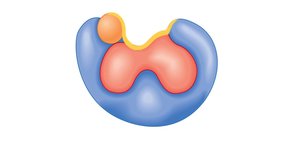
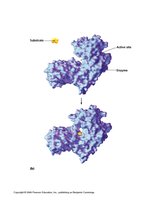
Enzyme Activity
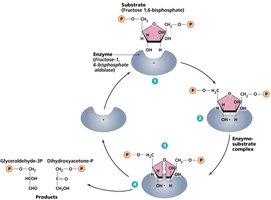
Enzymes function by binding substrates at their active sites, forming enzyme-substrate complexes, and converting substrates into products. The process is highly efficient and regulated.
Enzyme names typically end in -ase (e.g., hydrolase, ligase, ATP synthase).
Enzymes are classified by their mode of action (e.g., hydrolases, isomerases, oxidoreductases).
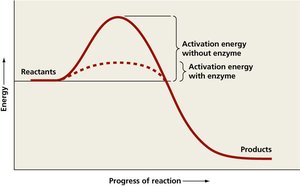
Factors Affecting Enzyme Activity
Several factors influence the rate of enzymatic reactions:
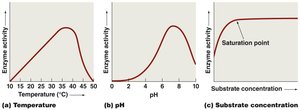
Temperature: Each enzyme has an optimal temperature; too high or too low can denature or inactivate the enzyme.
pH: Enzymes have an optimal pH range; deviations can alter enzyme structure and function.
Substrate concentration: Increasing substrate increases reaction rate until saturation is reached.
Enzyme concentration: More enzyme increases reaction rate, provided substrate is available.
Presence of inhibitors: Molecules that decrease enzyme activity.
Enzyme Inhibition and Regulation
Enzyme activity can be regulated by inhibitors and activators:
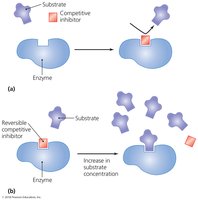
Competitive inhibitors: Bind to the active site, blocking substrate binding (may be reversible or irreversible).
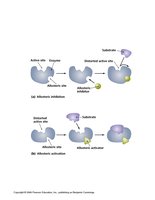
Noncompetitive inhibitors: Bind to an allosteric site, changing enzyme shape and function (usually reversible).
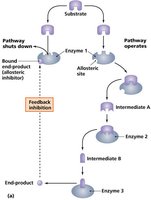
Feedback inhibition: End product of a pathway inhibits an earlier enzyme, regulating pathway activity.
Allosteric activation: Activators bind to allosteric sites, enhancing enzyme activity.
ATP, ADP, and AMP
ATP as the Energy Currency
ATP is hydrolyzed to ADP and AMP to release energy for cellular processes. The formation and breakdown of ATP is central to metabolism.
ATP hydrolysis:
ADP hydrolysis:
ATP is regenerated by phosphorylation during catabolic reactions.
Carbohydrate Catabolism
Overview of Glucose Catabolism
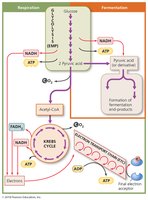
Microbes catabolize glucose via two main pathways: cellular respiration and fermentation.
Cellular respiration: Complete breakdown of glucose to CO2 and H2O via glycolysis, Krebs cycle, and electron transport chain.
Fermentation: Incomplete breakdown of glucose, producing organic waste products (e.g., ethanol, lactic acid).
Glycolysis (Embden-Meyerhof Pathway)
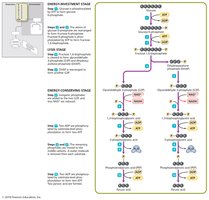
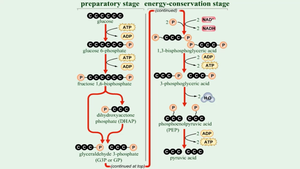
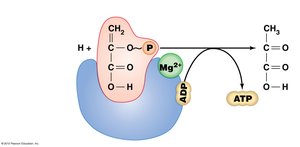
Glycolysis is an anaerobic process that occurs in the cytoplasm and is mediated by enzymes. It converts one molecule of glucose into two molecules of pyruvic acid, yielding a net gain of two ATP and two NADH.
Requires ATP to initiate the process.
Produces intermediates used in anabolic pathways.
Alternatives to Glycolysis
Some bacteria use alternative pathways for glucose catabolism:
Pentose phosphate pathway: Produces NADPH, ATP, and five-carbon sugars for biosynthesis.
Entner-Doudoroff pathway: Found only in bacteria; yields ATP, NADPH, and precursor metabolites.
Fermentation
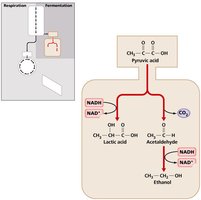
Fermentation allows cells to regenerate NAD+ for glycolysis under anaerobic conditions. It produces organic acids, alcohols, or gases as waste products. Fermentation is less efficient than respiration and is used for identification and industrial applications.
Cellular Respiration
Stages of Cellular Respiration
Cellular respiration involves three main stages:
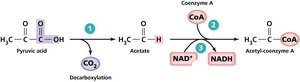
Synthesis of Acetyl-CoA: Pyruvic acid is converted to acetyl-CoA, producing CO2 and NADH.
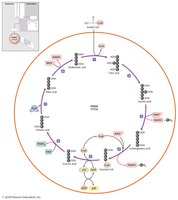
Krebs Cycle (Citric Acid Cycle): Acetyl-CoA is oxidized, generating NADH, FADH2, ATP, and CO2.
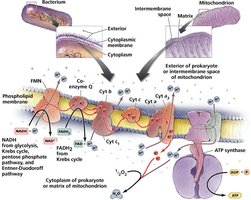
Electron Transport Chain (ETC): Electrons from NADH and FADH2 are transferred through membrane-bound carriers, generating a proton gradient used to produce ATP.
Electron Transport Chain and Chemiosmosis
The ETC is located in the cytoplasmic membrane of prokaryotes and the inner mitochondrial membrane of eukaryotes. It consists of carrier molecules (flavoproteins, ubiquinones, metal-containing proteins, cytochromes) that transfer electrons to a final electron acceptor (O2 in aerobic respiration).
Proton gradient (proton motive force) is established across the membrane.
ATP synthase uses this gradient to phosphorylate ADP to ATP (oxidative phosphorylation).
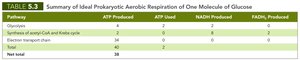
Aerobic respiration yields up to 38 ATP per glucose in prokaryotes.
Total Net Theoretical Yield of Aerobic Respiration
Pathway | ATP Produced | ATP Used | NADH Produced | FADH2 Produced |
|---|---|---|---|---|
Glycolysis | 4 | 2 | 2 | 0 |
Synthesis of Acetyl-CoA and Krebs cycle | 2 | 0 | 8 | 2 |
Electron Transport Chain | 34 | 0 | 0 | 0 |
Total Net | 40 | 2 | 10 | 2 |
Other Catabolic Pathways
Lipid Catabolism
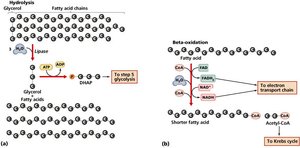
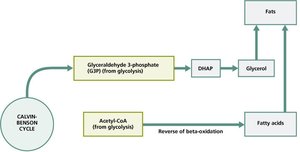
Lipids are hydrolyzed by lipases into glycerol and fatty acids. Fatty acids undergo beta-oxidation to generate acetyl-CoA, which enters the Krebs cycle. Glycerol can be converted to DHAP, an intermediate of glycolysis.
Protein Catabolism
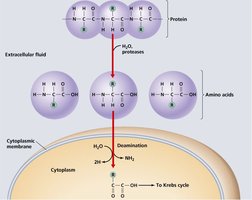
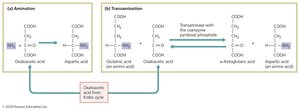
Proteins are broken down by proteases into amino acids, which are deaminated to remove the amino group. The remaining carbon skeletons are converted into intermediates that enter the Krebs cycle.
Anabolic Pathways
Overview of Anabolism
Anabolic reactions synthesize macromolecules and cellular structures from precursor metabolites. These reactions require energy, usually derived from ATP produced during catabolism. Many anabolic pathways are the reverse of catabolic pathways and are termed amphibolic.
Gluconeogenesis and Biosynthesis
Gluconeogenesis is the synthesis of glucose from non-carbohydrate precursors. It is essential for organisms to maintain glucose levels for energy and biosynthesis of complex carbohydrates, such as starch, cellulose, glycogen, and peptidoglycan.
Lipid, Amino Acid, and Nucleotide Biosynthesis
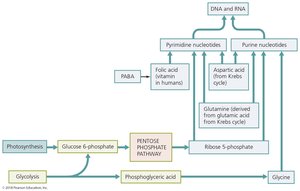
Lipids, amino acids, and nucleotides are synthesized from intermediates of glycolysis, the Krebs cycle, and the pentose phosphate pathway. These pathways are tightly regulated and integrated with catabolic processes.
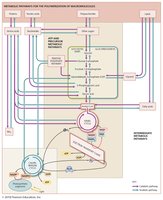
Additional info: Many anabolic and catabolic pathways are interconnected, allowing cells to efficiently manage resources and respond to environmental changes. The integration of these pathways is essential for cellular homeostasis and adaptation.
