 뒤로
Lecture 11 Microbio
스터디 가이드 - 스마트 노트
 자료에 맞춘 맞춤형 노트, 핵심 정의, 예시, 맥락을 확장해 제공합니다.
Microbial Metabolism: Energy Conservation and Metabolic Pathways
Overview of Chemoorganotrophic Metabolism
Chemoorganotrophs utilize organic carbon molecules to fuel their metabolism, generating energy through a series of interconnected pathways. These include glycolysis, the transition reaction, the tricarboxylic acid (TCA) cycle, electron transport chain, and fermentation. Each pathway plays a distinct role in energy conservation and redox balance within the cell.
Key Pathways: Glycolysis, TCA cycle, Electron Transport Chain, Fermentation
Energy Conservation: Occurs via substrate-level phosphorylation (SLP) and oxidative phosphorylation
Redox Balance: Essential for sustaining life; achieved through electron transport or fermentation
Glycolysis
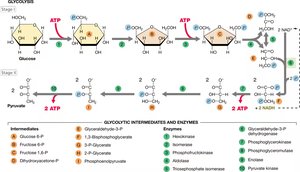
Glycolysis is the central pathway for the catabolism of glucose, converting it into pyruvate while generating ATP and NADH. It consists of two main stages: the preparatory phase and the pay-off phase.
Preparatory Phase: Involves phosphorylation and rearrangement of glucose; no energy released
Pay-off Phase: Redox reactions occur, energy is conserved as ATP and NADH
Products (per glucose): 2 ATP, 2 NADH, 2 pyruvate
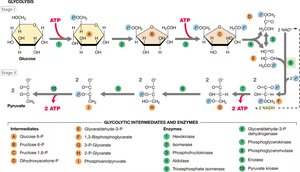
Redox Balance: Glycolysis alone is insufficient for redox balance; further pathways are required to recycle NADH.
Transition Reaction
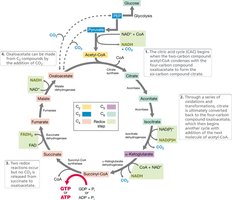
The transition reaction links glycolysis to the TCA cycle. Pyruvate is decarboxylated and oxidized to form acetyl-CoA, NADH, and CO2.
Products (per 2 pyruvate): 2 NADH, 2 CO2, 2 Acetyl-CoA
Tricarboxylic Acid Cycle (TCA/Citric Acid/Krebs Cycle)
The TCA cycle is a series of redox reactions that fully oxidize acetyl-CoA to CO2, generating NADH, FADH2, and GTP (or ATP). It also provides precursors for biosynthesis.
Products (per 2 acetyl-CoA): 6 NADH, 2 FADH2, 2 GTP (ATP), 4 CO2
Biosynthetic Role: Provides α-ketoglutarate and oxaloacetate for amino acid synthesis; succinyl-CoA for cytochromes and chlorophyll; acetate for fatty acid biosynthesis
Glyoxylate Cycle
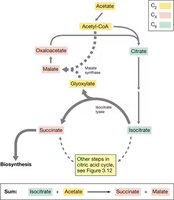
The glyoxylate cycle is a variation of the TCA cycle that enables cells to grow on two-carbon compounds (e.g., acetate) by bypassing decarboxylation steps and regenerating oxaloacetate.
Key Enzymes: Isocitrate lyase, malate synthase
Function: Maintains acetyl acceptor for TCA cycle during growth on C2 compounds
Electron Transport Chain (ETC) and Respiration
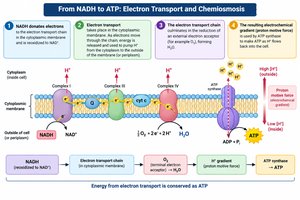
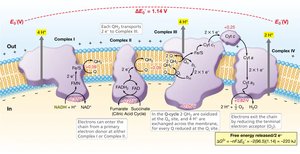
Respiration involves the transfer of electrons from NADH and FADH2 to external electron acceptors (e.g., O2), generating a proton motive force (pmf) across the membrane. This electrochemical gradient is used to synthesize ATP.
Electron Flow: From lower-potential carriers to higher-potential carriers, ending with reduction of terminal electron acceptor
Proton Motive Force: Removal of H+ creates an electrochemical gradient (pmf)
ATP Synthesis: Driven by pmf via ATP synthase (oxidative phosphorylation)
ATP Synthase and Oxidative Phosphorylation
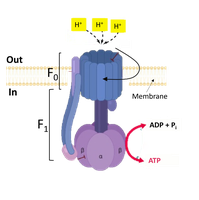
ATP synthase is a membrane-bound enzyme complex that converts ADP and inorganic phosphate (Pi) into ATP using the energy from the pmf. The Fo subunit acts as a rotor, while the F1 subunit catalyzes ATP formation.
Oxidative Phosphorylation: ATP synthesis driven by respiratory electron flow
Photophosphorylation: ATP synthesis driven by light energy in phototrophs
ATP Yield:
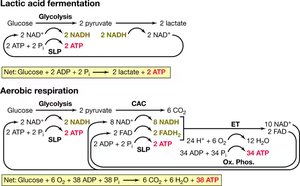
1 NADH produces 3 ATP
1 FADH2 produces 2 ATP
Total yield from aerobic respiration of glucose: 38 ATP (34 from oxidative phosphorylation)
Metabolic Diversity in Microbes
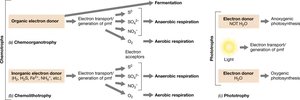
Microbes exhibit diverse metabolic strategies. Chemoorganotrophs can be fermentative or engage in aerobic/anaerobic respiration. Chemolithotrophs typically use inorganic electron donors, and phototrophs utilize light energy.
Fermentation: Occurs in absence of external electron acceptors
Aerobic Respiration: Uses O2 as terminal electron acceptor
Anaerobic Respiration: Uses alternative acceptors (e.g., nitrate)
Fermentation
Fermentation is a metabolic process that allows cells to achieve redox balance in the absence of external electron acceptors. NADH is oxidized by reducing pyruvate (or other organic molecules), which are then excreted as waste products.
ATP Yield: Only 2 ATP per glucose (via substrate-level phosphorylation)
Redox Balance: Achieved by reducing pyruvate to lactic acid or ethanol
Examples: Lactic acid fermentation (Lactobacillus spp.), alcoholic fermentation (yeast)
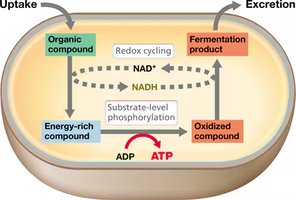
Fermentation Products: Organic acids, alcohols, and gases; these contribute to food preservation, flavor, and nutrition.
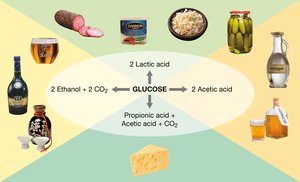
Energetics in Fermentation: Lactic acid bacteria excrete lactate, which retains considerable free energy.
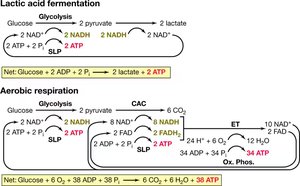
Respiration in E. coli
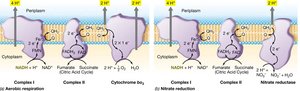
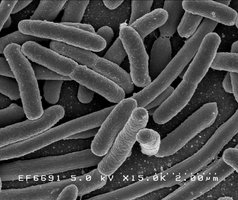
E. coli is a metabolically versatile chemoorganotroph capable of aerobic respiration, fermentation, and anaerobic respiration (using nitrate as an electron acceptor). Its electron transport chain contains multiple proteins, allowing adaptation to various environmental conditions.
Aerobic Respiration: Maximum ATP yield and growth rate
Anaerobic Respiration: Uses nitrate as terminal electron acceptor
Fermentation: Occurs in absence of external electron acceptors
Summary Table: Comparison of Metabolic Pathways
Pathway | Electron Donor | Electron Acceptor | ATP Yield (per glucose) | Key Products |
|---|---|---|---|---|
Glycolysis | Glucose | NAD+ (internal) | 2 ATP | Pyruvate, NADH |
Aerobic Respiration | Glucose | O2 | 38 ATP | CO2, H2O |
Anaerobic Respiration | Glucose | Nitrate, sulfate, etc. | Variable (less than aerobic) | CO2, reduced acceptor |
Fermentation | Glucose | Pyruvate (internal) | 2 ATP | Lactic acid, ethanol, CO2 |
Additional info: The notes cover core concepts from Ch. 3 (Microbial Metabolism), Ch. 4 (Microbial Growth and Its Control), and Ch. 14 (Metabolic Diversity of Microorganisms), providing a comprehensive overview of energy conservation and metabolic diversity in microbes.
