 뒤로
Microbial Nutrition and Growth: Requirements, Biofilms, and Population Dynamics
스터디 가이드 - 스마트 노트
 자료에 맞춘 맞춤형 노트, 핵심 정의, 예시, 맥락을 확장해 제공합니다.
Microbial Nutrition and Growth Requirements
Sources of Carbon, Energy, and Electrons
Microorganisms require specific sources of carbon, energy, and electrons to grow and reproduce. These requirements define their ecological roles and metabolic strategies.
Autotrophs: Utilize inorganic CO2 to synthesize organic compounds.
Heterotrophs: Catabolize reduced organic molecules acquired from other organisms.
Chemotrophs: Acquire energy from redox reactions involving inorganic and organic molecules (aerobic respiration, anaerobic respiration, fermentation).
Phototrophs: Use light as their energy source.
Microbial nutritional types are classified as follows:
Photoautotrophs: Light as energy, CO2 as carbon source.
Chemoautotrophs: Chemical compounds as energy, CO2 as carbon source.
Photoheterotrophs: Light as energy, organic compounds as carbon source.
Chemoheterotrophs: Chemical compounds as energy, organic compounds as carbon source.
Oxygen Requirements and Toxic Forms
Oxygen is essential for some microbes but toxic for others due to the formation of reactive oxygen species (ROS). Microbes possess various enzymes to detoxify these forms.
Obligate aerobes: Require oxygen as the final electron acceptor (FEA).
Obligate anaerobes: Oxygen is toxic; lack enzymes to detoxify ROS.
Facultative anaerobes: Can use oxygen or other electron acceptors.
Aerotolerant anaerobes: Do not use oxygen but tolerate its presence.
Microaerophiles: Require oxygen at lower concentrations.
Major toxic forms of oxygen:
Singlet Oxygen: High-energy form, produced during photosynthesis.
Superoxide Radicals (O2-): Produced during incomplete reduction in aerobic respiration; removed by superoxide dismutase (SOD).
Peroxide Anions (O22-): Formed from hydrogen peroxide; broken down by catalase and peroxidase.
Hydroxyl Radicals (OH·): Result from radiation and incomplete breakdown of peroxides; generally low due to catalase and peroxidase activity.
Microbial groups differ in their enzyme content for detoxifying ROS:
Obligate aerobes: SOD and catalase present.
Facultative anaerobes: SOD and catalase present.
Aerotolerant anaerobes: SOD present, catalase absent.
Strict anaerobes: SOD and catalase absent.
Microaerophiles: SOD and catalase present at low levels.
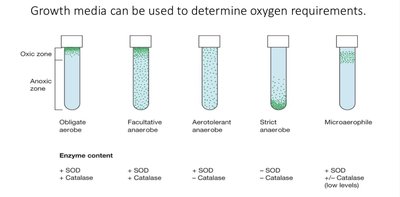
Aerotolerance of Microbes
Microbes are classified based on their relationship to oxygen:
Obligate aerobes: Only grow in the presence of oxygen.
Obligate anaerobes: Only grow in the absence of oxygen.
Facultative anaerobes: Grow better with oxygen but can grow without it.
Aerotolerant anaerobes: Grow equally well with or without oxygen.
Microaerophiles: Grow best with low levels of oxygen.
Physical Requirements for Growth
Microbial growth is influenced by temperature, pH, osmotic pressure, and hydrostatic pressure.
Temperature:
Psychrophiles: Grow at low temperatures (lakes, oceans, fridge).
Mesophiles: Grow at moderate temperatures; most pathogens.
Thermophiles: Grow at high temperatures (compost, hot springs).
Hyperthermophiles: Grow above 80°C; some archaea.
pH:
Neutrophiles: pH 6.5–7.5; most pathogens.
Acidophiles: Grow in acidic environments.
Alkaliphiles: Grow in basic environments (e.g., Vibrio cholerae at pH 9).
Osmotic Pressure:
Most organisms cannot tolerate large changes.
Halophiles: Tolerate high salt concentrations (e.g., Staphylococcus aureus up to 20% salt).
Biofilms and Quorum Sensing
Biofilm Formation
Biofilms are complex communities of microbes attached to surfaces, protected by a self-produced matrix. Up to 70% of bacterial diseases are caused by biofilm-associated organisms.
Free-living cells are vulnerable to environmental stresses.
Microbes settle and attach to a surface.
They develop a gooey extracellular matrix (DNA, proteins, polysaccharides).
Biofilms form via quorum sensing: microbes communicate using signaling molecules, triggering gene expression changes.
New microbes arrive, forming synergistic relationships and specialized roles within the biofilm.
Some cells or groups may leave the biofilm.
Biofilm matrix functions:
Adheres cells to each other and substrate.
Forms microenvironments and water channels.
Protects against environmental stresses (UV, drugs, pH, temperature).
Conserves digestive enzymes.
Strategies to prevent biofilms:
Drugs blocking cell receptors.
Amplifying quorum sensing.
Slippery device surfaces.
Culturing Microorganisms: Media Types
Selective and Differential Media
Microbial culture media are designed to support growth and identification of specific organisms.
Selective Media: Contains substances that encourage or inhibit growth of certain species (e.g., high salt, acid).
Differential Media: Allows different species to display distinct chemical changes or reactions (e.g., blood agar, starch agar).
Some media are both selective and differential (e.g., MSA selects for Staphylococcus and differentiates S. aureus by mannitol fermentation; EMB selects against Gram-positive bacteria and differentiates lactose fermenters).
Growth of Microbial Populations
Binary Fission
Bacteria reproduce by binary fission, a process involving four main steps:
Cell replicates its chromosome, attaching it to the membrane.
Cell elongates, separating chromosomes.
New membrane and wall form across the midline.
Septum completes; daughter cells may separate.
Generation Time and Logarithmic Growth
Generation time is the period required for a bacterial cell to divide. It varies by species:
S. aureus and E. coli: ~20 minutes
Many bacteria: 1–3 hours
Mycobacteria: 7–10 days
Bacterial growth is exponential:
Formula:
i: Initial number of bacteria (or CFU)
f: Final number of bacteria (or CFU)
n: Number of generations
Bacterial Growth Curve
Bacterial populations progress through four phases:
Lag Phase: Adaptation, no cell growth.
Log Phase: Exponential growth; disease symptoms appear; target for drugs.
Stationary Phase: Nutrient depletion; cell division equals cell death.
Death Phase: Cell death exceeds division; persister cells and endospores may form.
Methods of Measuring Bacterial Reproduction
Microbial growth can be measured by several direct and indirect methods:
Microscopic counts (special slides/counters)
Serial dilutions (pour/spread plates)
Turbidity (optical density)
Dry weight measurement
Nutrient usage
Genetic methods
Persister cells: Dormant, non-dividing variants tolerant to antibiotics.
Endospores: Tough, dormant survival structures produced by certain Gram-positive bacteria (e.g., Clostridia, Bacillus).
