뒤로
Microbial Nutrition and Growth: Study Notes
스터디 가이드 - 스마트 노트
 자료에 맞춘 맞춤형 노트, 핵심 정의, 예시, 맥락을 확장해 제공합니다.
Microbial Growth and Its Requirements
Definition and Overview
Microbial growth refers to an increase in the number of cells within a population, not the size of individual cells. The result of microbial growth is the formation of discrete colonies, which are aggregations of cells arising from a single parent cell. Growth is fundamentally linked to reproduction, which is driven by metabolism.
Microbial growth: Increase in cell numbers, not cell size.
Colony: Aggregation of cells from a single parent cell.
Metabolism: Provides energy and building blocks for reproduction.
Growth Requirements
Major Nutrient Categories
Microbes require a variety of nutrients for energy and to build cellular structures. The most common nutrients contain elements such as carbon, oxygen, nitrogen, and hydrogen. Microbes obtain these nutrients from diverse sources.
Carbon – Essential for organic molecules.
Oxygen – Required for aerobic metabolism.
Nitrogen – Needed for proteins and nucleic acids.
Hydrogen – Important for redox reactions and organic molecules.
Classification Based on Carbon and Energy Sources
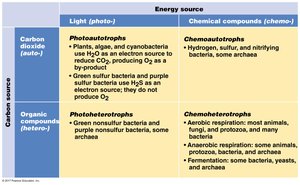
Organisms are classified based on their sources of carbon and energy. This classification is fundamental to understanding microbial ecology and metabolism.
Autotrophs: Use inorganic carbon (CO2) as their carbon source.
Heterotrophs: Use organic molecules (proteins, carbohydrates, etc.) as their carbon source.
Chemotrophs: Acquire energy from chemical compounds.
Phototrophs: Acquire energy from light.
Four Basic Groups of Organisms:
Carbon Source | Energy Source | Type | Examples |
|---|---|---|---|
CO2 (auto-) | Light (photo-) | Photoautotrophs | Plants, algae, cyanobacteria |
CO2 (auto-) | Chemical compounds (chemo-) | Chemoautotrophs | Hydrogen, sulfur, nitrifying bacteria |
Organic compounds (hetero-) | Light (photo-) | Photoheterotrophs | Green nonsulfur bacteria, purple nonsulfur bacteria |
Organic compounds (hetero-) | Chemical compounds (chemo-) | Chemoheterotrophs | Most animals, fungi, protozoa, many bacteria |
Oxygen Requirements and Toxicity
Oxygen as a Double-Edged Sword
Oxygen is essential for obligate aerobes, serving as the final electron acceptor in the electron transport chain (ETC). However, oxygen can be deadly for obligate anaerobes due to the formation of toxic oxygen intermediates.
Obligate aerobes: Require oxygen for growth.
Obligate anaerobes: Oxygen is toxic; cannot survive in its presence.
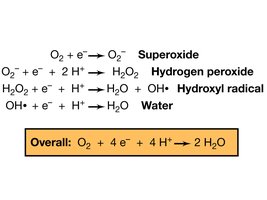
Toxic forms of oxygen: Superoxide anion, peroxide anion, hydroxyl radical.
Toxic Forms of Oxygen
Three major toxic forms of oxygen are produced during metabolism:
Superoxide anion (O2-): Formed during incomplete reduction of oxygen.
Peroxide anion (O22-): Formed during reactions catalyzed by superoxide dismutase.
Hydroxyl radical (OH·): Highly reactive, formed from ionizing radiation and incomplete reduction of hydrogen peroxide.
Enzymatic Detoxification Systems
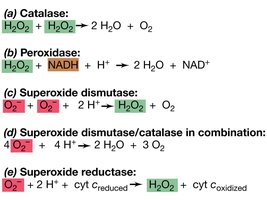
Microbes use specific enzymes to detoxify these toxic forms of oxygen:
Catalase: Converts hydrogen peroxide to water and oxygen.
Peroxidase: Reduces hydrogen peroxide using NADH.
Superoxide dismutase (SOD): Converts superoxide anion to hydrogen peroxide.
Superoxide reductase: Reduces superoxide anion to hydrogen peroxide.
Classification Based on Oxygen Requirements
Microbes are classified according to their oxygen requirements:
Aerobes: Undergo aerobic respiration.
Anaerobes: Do not use aerobic metabolism.
Facultative anaerobes: Can use fermentation, aerobic, or anaerobic respiration.
Aerotolerant anaerobes: Do not use aerobic metabolism but can detoxify oxygen.
Microaerophiles: Require low oxygen levels (2-10%).
Physical and Chemical Requirements for Growth
Nitrogen, Phosphorus, Sulfur, Trace Elements, and Growth Factors
Microbes require additional elements and organic compounds for growth:
Nitrogen: Essential for proteins and nucleotides; some bacteria fix nitrogen from the atmosphere.
Phosphorus: Required for membranes, DNA, RNA, ATP.
Sulfur: Component of amino acids and vitamins.
Trace elements: Needed in small amounts (Co, Cu, Mo, Se, Zn).
Growth factors: Organic chemicals that cannot be synthesized by certain organisms (e.g., vitamins, amino acids).
Temperature
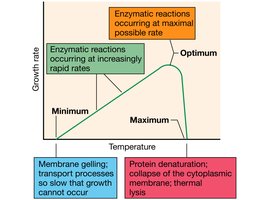
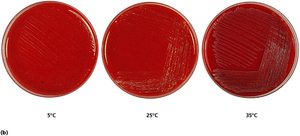
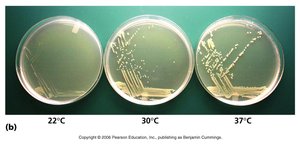
Temperature affects microbial growth by influencing enzymatic activity and membrane fluidity. Each microbe has a minimum, optimum, and maximum temperature for growth.
Low temperatures: Membranes become rigid and fragile.
High temperatures: Membranes become too fluid, leading to cell lysis.
Optimum temperature: Enzymatic reactions occur at maximal rates.
Categories of Microbes Based on Temperature Ranges
Microbes are classified by their preferred temperature ranges:
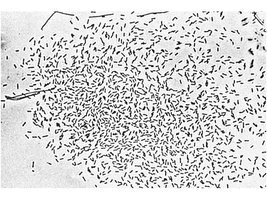
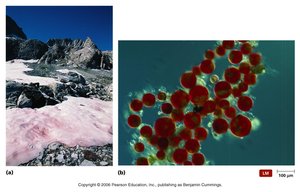
Psychrophiles: Grow best at low temperatures (0-20°C).
Mesophiles: Grow best at moderate temperatures (20-40°C).
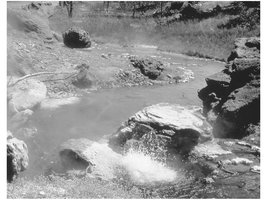
Thermophiles: Grow best at high temperatures (40-70°C).
Hyperthermophiles: Grow at extremely high temperatures (>80°C).
Example: Methanopyrus kandleri grows at 122°C, the highest known record.
Example: The alga Chlamydomonas is a psychrophile.
pH Requirements
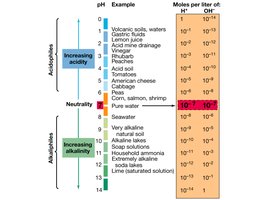
Microbes are sensitive to changes in acidity. Most bacteria and protozoa are neutrophiles, growing best at neutral pH. Acidophiles thrive in acidic environments, while alkalinophiles prefer alkaline conditions.
Neutrophiles: pH 6.5-7.5
Acidophiles: Grow in acidic habitats
Alkalinophiles: Grow in alkaline habitats (up to pH 11.5)
Water, Osmotic Pressure, and Hydrostatic Pressure
Water is essential for dissolving enzymes and nutrients. Osmotic pressure and hydrostatic pressure are critical physical factors affecting microbial growth.
Osmotic pressure: Hypertonic solutions cause plasmolysis; restricts organisms to certain environments.
Obligate halophiles: Require high salt concentrations (up to 30%).
Facultative halophiles: Can tolerate high salt concentrations.
Hydrostatic pressure: Barophiles (piezophiles) live under extreme pressure; their enzymes and membranes depend on this pressure.
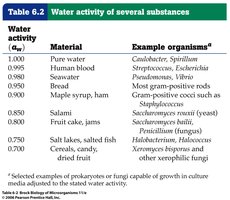
Water Activity (aw) | Material | Example Organisms |
|---|---|---|
1.000 | Pure water | Caulobacter, Spirillum |
0.995 | Human blood | Streptococcus, Escherichia |
0.980 | Seawater | Pseudomonas, Vibrio |
0.950 | Bread | Most gram-positive rods |
0.900 | Maple syrup, ham | Gram-positive cocci (e.g., Staphylococcus) |
0.850 | Salami, jams | Saccharomyces rouxii (yeast) |
0.800 | Fruit cake, pies | Penicillium (fungus) |
0.750 | Salt lakes, salted fish | Halobacterium, Halococcus |
0.700 | Cereals, candy, dried fruit | Other xerophilic fungi |
Halophiles and Water Activity
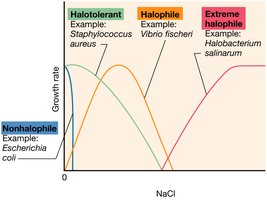
Microbes are classified based on their tolerance to salt concentrations:
Nonhalophile: Cannot tolerate salt (e.g., Escherichia coli).
Halotolerant: Can tolerate some salt (e.g., Staphylococcus aureus).
Halophile: Require moderate salt (e.g., Vibrio fischeri).
Extreme halophile: Require very high salt (e.g., Halobacterium salinarum).
Hydrostatic Pressure
Water exerts pressure in proportion to its depth. Barophiles (piezophiles) are organisms that thrive under extreme pressure, such as those found in deep-sea environments. Their cellular structures depend on this pressure to maintain functionality.
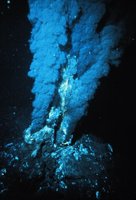
Example: Deep-sea hydrothermal vent communities.