 뒤로
Microbial Nutrition and Growth: Study Notes
스터디 가이드 - 스마트 노트
 자료에 맞춘 맞춤형 노트, 핵심 정의, 예시, 맥락을 확장해 제공합니다.
Microbial Nutrition and Growth
Introduction
Microbial growth refers to the increase in the population of microbes, primarily through the reproduction of individual cells. This process results in the formation of discrete colonies or complex communities known as biofilms. Understanding the nutritional and physical requirements for microbial growth is essential for culturing, controlling, and studying microorganisms in laboratory and clinical settings.
Growth Requirements
Chemical and Energy Requirements
Nutrients are substances required for energy production and the synthesis of cellular structures. The most common elements include carbon, oxygen, nitrogen, and hydrogen.
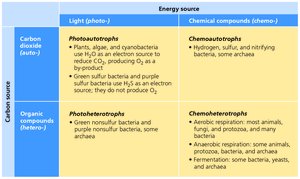
Sources of Carbon, Energy, and Electrons:
Autotrophs: Use inorganic carbon (CO2) to synthesize organic compounds.
Heterotrophs: Obtain carbon by catabolizing organic molecules from other organisms.
Chemotrophs: Acquire energy from redox reactions involving chemicals.
Phototrophs: Acquire energy from sunlight.
Organotrophs: Obtain electrons from organic molecules.
Lithotrophs: Obtain electrons from inorganic molecules.
Oxygen Requirements
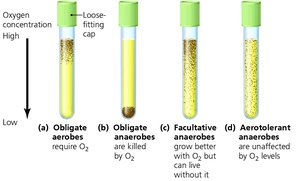
Obligate aerobes require oxygen for survival.
Obligate anaerobes are killed by oxygen due to the presence of toxic forms of oxygen (e.g., singlet oxygen, superoxide radicals, peroxide anion, hydroxyl radical).
Microorganisms vary in their oxygen requirements:
Facultative anaerobes: Can grow with or without oxygen (e.g., Escherichia coli).
Aerotolerant anaerobes: Tolerate oxygen but do not use it (e.g., lactobacilli).
Microaerophiles: Require low levels of oxygen (2–10%, e.g., Helicobacter pylori).
Nitrogen, Phosphorus, Sulfur, and Other Requirements
Nitrogen is essential for amino acids and nucleotides. Some bacteria can fix atmospheric nitrogen (N2 → NH3).
Phosphorus is required for nucleic acids, ATP, and membranes.
Sulfur is needed for certain amino acids and vitamins.
Trace elements are required in small amounts (e.g., iron, copper, zinc).
Growth factors are organic chemicals that some organisms cannot synthesize and must obtain from the environment (e.g., vitamins, amino acids).
Physical Requirements for Growth
Temperature
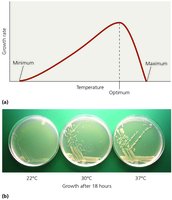
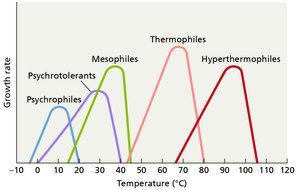
Temperature affects the three-dimensional structure of proteins and the fluidity of cellular membranes. Microbes are classified based on their preferred temperature ranges:
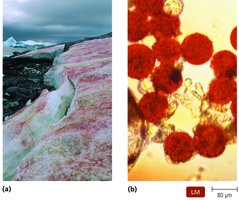
Psychrophiles: Grow best below 15°C.
Psychrotolerants: Tolerate cold but grow best at higher temperatures.
Mesophiles: Grow best between 20°C and 40°C (most human pathogens).
Thermophiles: Grow above 45°C.
Hyperthermophiles: Grow above 80°C.
pH
Neutrophiles: Grow best at neutral pH (around 7).
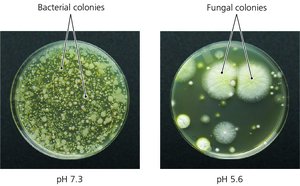
Acidophiles: Thrive in acidic environments.
Alkalinophiles: Live in alkaline soils and water.
Water, Osmotic Pressure, and Hydrostatic Pressure
Water is essential for dissolving nutrients and enzymes and is a reactant in many metabolic reactions.
Osmotic pressure: The pressure exerted by solutes across a semipermeable membrane. Hypotonic solutions cause cells to swell; hypertonic solutions cause cells to shrivel. Halophiles require high salt concentrations.
Hydrostatic pressure: Barophiles live under extreme pressure, which is necessary for their membrane and enzyme function.
Associations and Biofilms
Microbial Relationships
Antagonistic: One organism harms another.
Synergistic: Both benefit, but the relationship is not essential.
Symbiotic: Organisms are interdependent and rarely live outside the relationship.
Biofilms
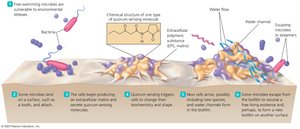
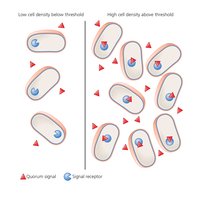
Biofilms are complex communities of microorganisms attached to surfaces and encased in an extracellular matrix. They form through quorum sensing, where bacteria communicate via signaling molecules. Biofilms are common on medical devices and mucous membranes and are often more resistant to antibiotics.
Culturing Microorganisms
Culture and Inoculation
Culture: The act of cultivating microorganisms or the microorganisms themselves.
Inoculum: Introduction of microbes into a medium containing nutrients.
Sources include environmental, clinical, and stored specimens.
Obtaining Pure Cultures
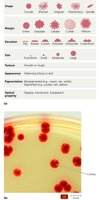
Pure (axenic) cultures arise from a single progenitor cell (colony-forming unit, CFU).
Aseptic technique prevents contamination.
Common isolation techniques:
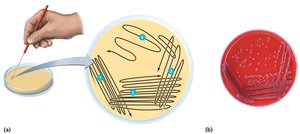
Streak plate method
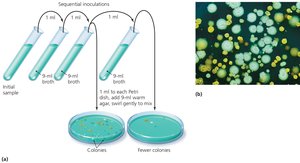
Pour plate method
Culture Media
Defined media: Exact chemical composition is known.
Complex media: Contains nutrients from yeast, meat, or plants; composition is not precisely known.
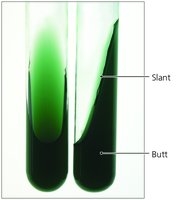
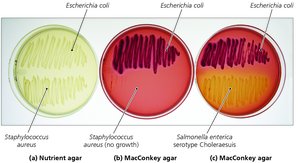
Selective media: Favors or inhibits the growth of certain microbes.
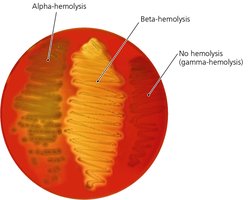
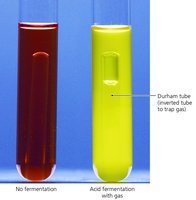
Differential media: Distinguishes microbes based on their metabolic reactions.
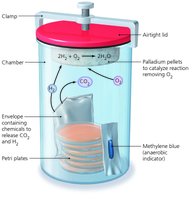
Anaerobic media: Supports growth of anaerobes.
Transport media: Used to maintain and transport clinical specimens.
Special Culture Techniques
Animal and cell culture: Used for organisms that cannot grow on artificial media (e.g., viruses).
Low-oxygen culture: Mimics body tissues with low oxygen (e.g., CO2 incubators, candle jars).
Preserving Cultures
Refrigeration: Short-term storage.
Deep-freezing: Long-term storage (years).
Lyophilization: Freeze-drying for decades of preservation.
Growth of Microbial Populations
Binary Fission
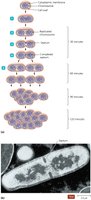
Most bacteria reproduce by binary fission, a process in which one cell divides to form two identical daughter cells. The steps include chromosome replication, cell elongation, septum formation, and cell separation.
Generation Time and Growth Curves
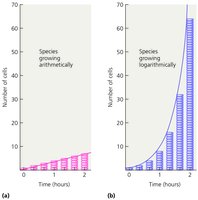
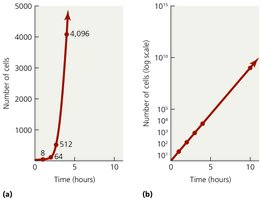
Generation time: The time required for a cell to divide and its population to double. It depends on environmental conditions.
Microbial growth can be represented arithmetically or logarithmically.
Population growth curve phases:
Lag phase: Cells adjust to environment; little division.
Log (exponential) phase: Rapid cell division; most susceptible to antibiotics.
Stationary phase: Rate of cell death equals rate of cell division.
Death phase: Cell death exceeds cell division due to nutrient depletion and waste accumulation.
Continuous Culture
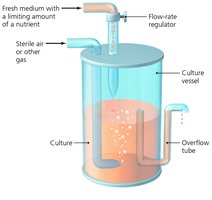
A chemostat is used to maintain microbial populations in a particular phase of growth by continuously adding fresh medium and removing old medium. This is important in industrial microbiology.
Measuring Microbial Reproduction
Direct Methods (No Incubation Required)
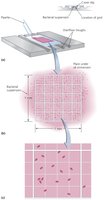
Microscopic counts: Counting cells using a cell counter or hemocytometer.
Electronic counters: Coulter counter (electrical current interruption) and flow cytometry (light detection).

Direct Methods (Requiring Incubation)
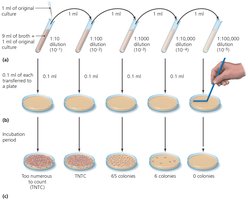
Serial dilution and viable plate counts: Diluting a sample and counting colonies to estimate population size.
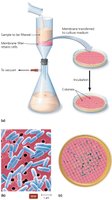
Membrane filtration: Filtering a sample and counting colonies on a filter.
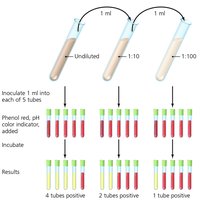
Most probable number (MPN): Statistical estimation based on dilution and growth in broth tubes.
Indirect Methods
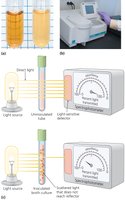
Turbidity: Measuring cloudiness of a culture with a spectrophotometer; more turbid means more cells.
Metabolic activity: Measuring the consumption of nutrients or production of waste products.
Dry weight: Weighing dried cells to estimate biomass.
Molecular methods: Detecting DNA sequences of unculturable microbes.
Case Study: Listeria monocytogenes
Listeria monocytogenes is a psychrotolerant bacterium that can survive in various environmental conditions and cause listeriosis, especially in immunocompromised individuals.
It can be identified using selective and differential media.
Treatment often involves antibiotics that inhibit bacterial enzymes.
