 뒤로
Microbial Regulatory Systems: Mechanisms of Gene Expression Control in Prokaryotes
스터디 가이드 - 스마트 노트
 자료에 맞춘 맞춤형 노트, 핵심 정의, 예시, 맥락을 확장해 제공합니다.
Microbial Regulatory Systems
DNA-Binding Proteins
Microbial gene regulation relies on DNA-binding proteins that interact with specific DNA sequences to control transcription. Bacterial and archaeal genes are often organized in operons, lacking introns, and regulated by promoter regions recognized by DNA-binding proteins.
Operons: Clusters of genes transcribed under a single promoter, allowing coordinated regulation.
Promoters: DNA regions with distinct nucleotide sequences recognized by regulatory proteins and RNA polymerase.
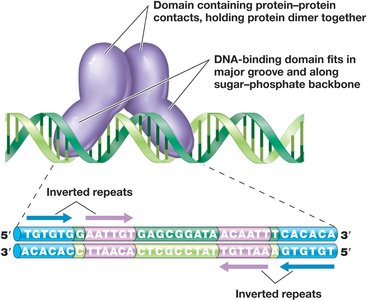
Sequence-Specific Binding: Most DNA-binding proteins interact with DNA in a sequence-specific manner, primarily at the major groove.
Inverted Repeats: Common binding sites for regulatory proteins, often recognized by homodimeric proteins.
Homodimeric Proteins: Two identical polypeptides, each binding to an inverted repeat.
Transcription Factors and Effectors
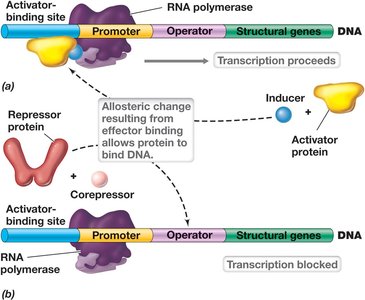
Transcription factors are proteins that regulate gene expression by binding to DNA. Their activity is modulated by small molecules called effectors, which induce allosteric changes in the protein structure.
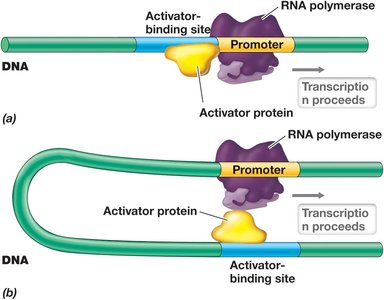
Activator Proteins: Bind to DNA and recruit RNA polymerase, turning on transcription.
Repressor Proteins: Bind to operator regions, blocking transcription.
Effectors: Small molecules (inducers or corepressors) that alter transcription factor conformation and DNA-binding ability.
Allosteric Proteins: Undergo conformational changes upon effector binding, determining their regulatory function.
Repression and Activation
Gene expression in prokaryotes is controlled by mechanisms of repression and activation, ensuring enzymes are produced only when needed.
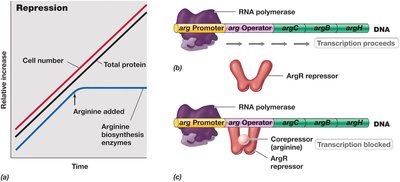
Enzyme Repression: Synthesis of enzymes is prevented when the end product is abundant. The final product acts as a corepressor, binding to the repressor protein and blocking transcription.
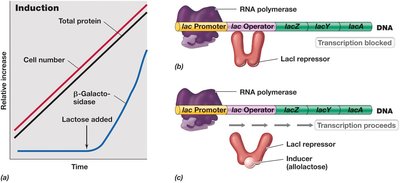
Enzyme Induction: Enzyme production is triggered by the presence of a substrate, typically affecting catabolic enzymes.
Negative Control: Repressors inhibit transcription, but basal levels may persist.
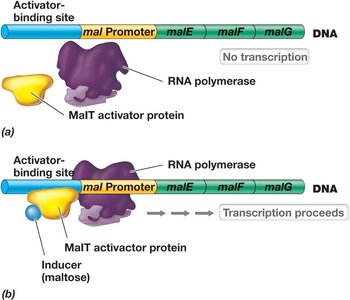
Positive Control: Activator proteins facilitate transcription, often by helping RNA polymerase recognize weak promoters.
Operons versus Regulons
Operons are groups of genes regulated by a single promoter, while regulons consist of multiple operons or genes controlled by the same regulatory protein. This allows coordinated regulation of dispersed genes.
Regulons: Multiple operons controlled by a single regulatory protein (e.g., maltose regulon, arginine regulon).
Multiple Control Features: Many operons and regulons have complex regulatory mechanisms.
Two-Component Regulatory Systems
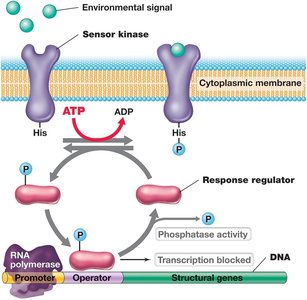
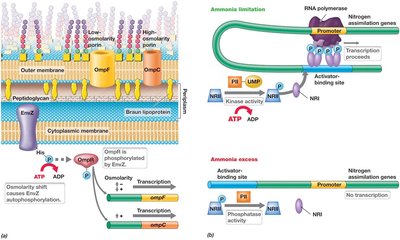
Prokaryotes use two-component systems to sense and respond to environmental changes. These systems consist of a sensor kinase and a response regulator.
Sensor Kinase: Located in the cytoplasmic membrane, detects environmental signals and autophosphorylates at a histidine residue.
Response Regulator: DNA-binding protein in the cytoplasm, receives phosphate from sensor kinase and regulates transcription.
Feedback Loop: Phosphatase removes phosphate from response regulator, terminating the response.
System | Environmental Signal | Sensor Kinase | Response Regulator | Primary Activity |
|---|---|---|---|---|
Arc system | Oxygen | ArcB | ArcA | Repressor/activator |
Nitrate/nitrite respiration (Nar) | Nitrate/nitrite | NarX/NarQ | NarL/NarP | Activator/repressor |
Nitrogen utilization (Ntr) | Organic nitrogen shortage | NRII (GlnL) | NRI (GlnG) | Activator |
Pho regulon | Inorganic phosphate | PhoR | PhoB | Activator/repressor |
Porin regulation | Osmotic pressure | EnvZ | OmpR | Activator/repressor |
Regulation of Chemotaxis
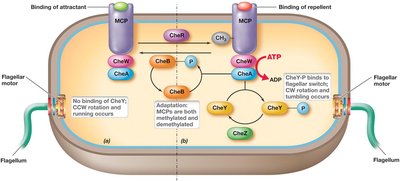
Chemotaxis is the movement of bacteria toward attractants or away from repellents, regulated by a modified two-component system that controls flagellar rotation.
Methyl-accepting Chemotaxis Proteins (MCPs): Sensory proteins that detect attractants/repellents and interact with sensor kinases.
CheA: Sensor kinase that autophosphorylates in response to repellent binding.
CheY: Response regulator that controls flagellar rotation; phosphorylated CheY induces tumbling, unphosphorylated CheY allows running.
Adaptation: Feedback loop involving CheB and methylation of MCPs resets the sensory system.
Cell-to-Cell Signaling and Quorum Sensing
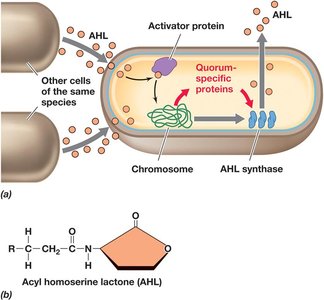
Prokaryotes communicate via small extracellular molecules, coordinating group behaviors such as biofilm formation through quorum sensing.
Quorum Sensing: Regulatory mechanism assessing population density via autoinducer molecules.
Autoinducers: Species-specific signaling molecules (e.g., acyl homoserine lactone, AI-2, short peptides).
Mechanism: Autoinducers diffuse across cell envelopes, accumulate, and bind to activator proteins or sensor kinases, triggering gene transcription.
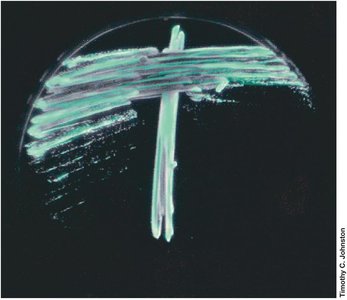
Applications: Regulates bioluminescence, virulence factor production, and biofilm formation.
Global Control Systems
Global control systems regulate transcription of many genes across multiple regulons, integrating signals from activators, repressors, two-component systems, regulatory RNAs, and alternative sigma factors.
System | Signal | Regulatory Protein | Number of Genes Regulated |
|---|---|---|---|
Aerobic respiration | O2 presence | ArcA (repressor) | >50 |
Anaerobic respiration | Lack of O2 | FNR (activator) | >70 |
Catabolite repression | Cyclic AMP | CRP (activator) | >300 |
Heat shock | Temperature | RpoH/RpoE (sigma factors) | >36 |
Nitrogen utilization | NH3 limitation | NRI/RpoN | >12 |
Oxidative stress | Oxidizing agents | OxyR (activator) | >30 |
SOS response | DNA damage | LexA (repressor) | >20 |
General stress response | Stress conditions | RpoS (sigma factor) | >400 |
The lac Operon and Catabolite Repression
The lac operon is a model for gene regulation, responding to both specific and global controls. Catabolite repression ensures the preferred carbon source (glucose) is used first.
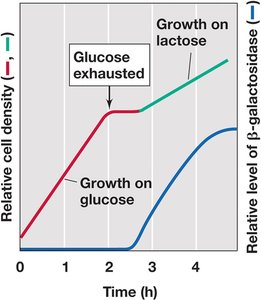
Diauxic Growth: Sequential use of glucose and lactose, with a lag phase between growth periods.
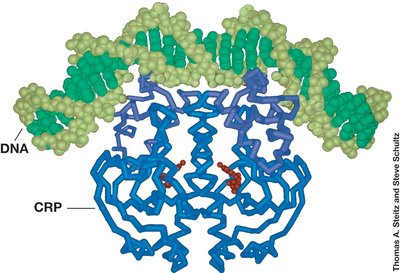
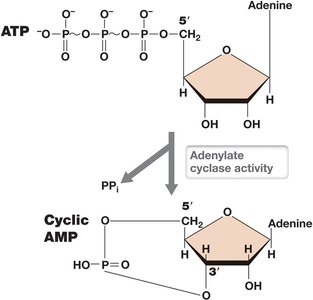
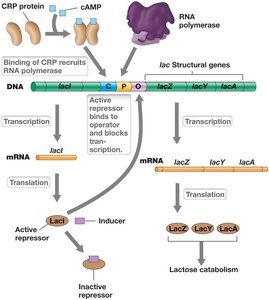
CRP (Cyclic AMP Receptor Protein): Activator protein that binds DNA only when complexed with cAMP, recruiting RNA polymerase.
Regulation: For lac gene transcription, cAMP must be high (for CRP binding) and lactose must be present (to inactivate LacI repressor).
Stringent and General Stress Responses
Microbes activate survival pathways under stress, such as nutrient deprivation or environmental challenges.
Stringent Response: Shuts down macromolecule synthesis and activates survival pathways, triggered by alarmones (ppGpp, pppGpp).
General Stress Response: Controlled by alternative sigma factor RpoS, regulating over 400 genes for stress adaptation.
The Heat Shock Response
Heat shock response protects cells from protein denaturation due to heat, solvents, osmotic stress, or UV light.
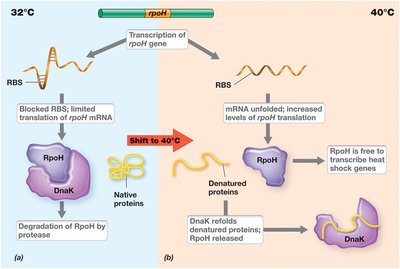
Heat Shock Proteins: Refold or degrade denatured proteins; major classes include Hsp100, Hsp90, Hsp70 (DnaK), Hsp60 (GroEL), Hsp10 (GroES).
Alternative Sigma Factor RpoH: Controls heat shock protein expression; its degradation is inhibited during stress, increasing transcription of heat shock genes.
RNA-Based Regulation
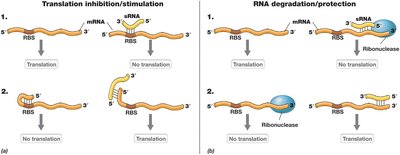
Regulatory RNAs modulate gene expression post-transcriptionally, including small RNAs (sRNAs), riboswitches, and attenuation mechanisms.
Noncoding RNAs (ncRNAs): RNAs not translated to protein, including rRNAs, tRNAs, and sRNAs.
sRNAs: Base pair with mRNAs, affecting translation or stability.
Riboswitches: mRNA regions that bind metabolites, altering secondary structure to control transcription or translation.
Attenuation: Premature termination of transcription, regulated by leader sequences and secondary structure formation.
Feedback Inhibition (Allostery)
Feedback inhibition is a mechanism for temporarily shutting down biosynthetic pathways when the end product is abundant.
Allosteric Enzymes: Have both active and allosteric binding sites; end product binding at the allosteric site changes enzyme conformation, preventing substrate binding.
Reversible Reaction: Pathway resumes when end product levels decrease.
*Additional info: The notes expand on brief points with academic context, definitions, and examples to ensure completeness and clarity for exam preparation.*
