 뒤로
Microbiology of Food: Spoilage, Preservation, and Fermentation
스터디 가이드 - 스마트 노트
 자료에 맞춘 맞춤형 노트, 핵심 정의, 예시, 맥락을 확장해 제공합니다.
Food Microbiology
Microbial Roles in Food
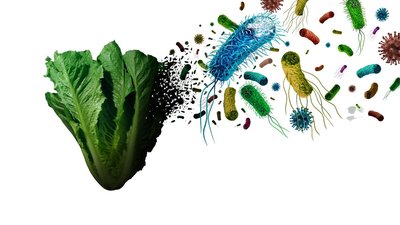
Microorganisms play essential roles in food, both beneficial and detrimental. Their activities are key to the production of fermented foods, but they can also diminish food quality and safety. Foods are rarely sterile, and microbial presence is inevitable.
Beneficial microbes: Used in fermentation to produce foods like yogurt, cheese, and bread.
Detrimental microbes: Cause spoilage and foodborne diseases.
Food as a medium: Foods are rich in nutrients, making them ideal for microbial growth.
Requirements for Microbial Life
Microbial growth in food depends on several essential factors:
Liquid water: Necessary for biochemical reactions.
Energy source: Required to drive cellular processes.
Electron source: Needed for metabolic reactions.
Nutrients: Used to build macromolecules.
Microbial Metabolism and Food Environments
Microbial Metabolism and Niche
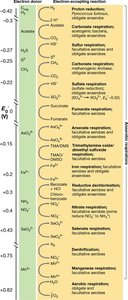
Microbial metabolism determines how microbes interact with their environment and food. Microenvironments and niches are shaped by the availability of nutrients, moisture, and other factors.
Microbial metabolism: The sum of all biochemical reactions in a microbe.
Microenvironments: Small, localized environments within food where microbes thrive.
Niche: The specific role and habitat of a microbe in food.
Food Spoilage and Preservation
Food Spoilage
Food spoilage refers to any change in appearance, smell, or taste that makes food unacceptable, often due to microbial growth. The physical and chemical characteristics of food determine its susceptibility to spoilage.
Food spoilage vs. foodborne disease: Spoilage organisms are usually not the same as those causing disease.
Organic matter: Foods are rich in organic compounds, supporting microbial growth.
Water activity: Moisture content is a key factor in spoilage.
Classification of Foods by Susceptibility to Spoilage
Foods are categorized based on their moisture content and susceptibility to spoilage:
Perishable foods: High moisture, spoil quickly (e.g., meats, fruits, vegetables).
Semi-perishable foods: Moderate moisture (e.g., potatoes, apples, nuts).
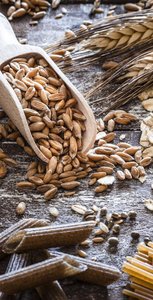
Nonperishable foods: Low moisture, spoil slowly (e.g., sugar, flour).
Microbial Spoilage of Fresh Food
The time required for a microbial population to reach significant levels depends on the initial inoculum size and the rate of growth during the exponential phase.
Initial inoculum: The number of microbes present at the start.
Growth rate: Influenced by temperature, moisture, and nutrients.
Types of Food Spoilage and Microbial Communities
The type of spoilage and the composition of the spoilage community depend on the food product and storage temperature. Psychrotolerant microorganisms can grow at refrigeration temperatures (3–5°C), but grow best above 20°C.
Psychrotolerant microbes: Can grow at low temperatures, affecting refrigerated foods.
Community composition: Varies with food type and storage conditions.
Food Preservation Methods
Principles of Food Preservation
Food storage and preservation methods are designed to slow or stop the growth of microorganisms that spoil food or cause disease. Major methods include altering temperature, acidity, moisture, and treating with radiation or chemicals.
Temperature: Refrigeration and freezing slow microbial growth.
Acidity: Lowering pH inhibits many microbes.
Moisture: Drying or adding solutes reduces water activity.
Radiation: Ionizing radiation deactivates microbial cells.
Chemicals: Additives prevent microbial growth.
Temperature Control
Lowering storage temperature reduces microbial growth and spoilage. Freezing is more effective than refrigeration, but some growth can occur in pockets of liquid water within frozen food.
Refrigeration: Slows growth, but many bacteria can still grow.
Freezing: Reduces growth considerably; temperatures below −20°C are rarely used due to cost and impact on food quality.
Heating Methods
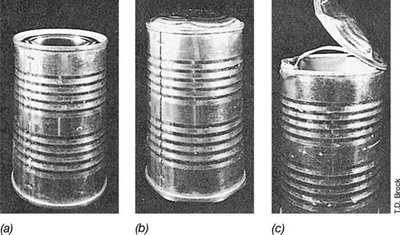
Heating reduces bacterial load and can sterilize food. Pasteurization is a limited heat treatment that reduces microbial numbers and eliminates pathogens, while canning sterilizes food in sealed containers.
Pasteurization: Reduces pathogens, does not sterilize.
Canning: Sterilizes food, requires careful processing to prevent anaerobic bacteria like Clostridium (causes botulism).
Moisture Control
Foods can be preserved by drying or adding solutes (salt, sugar) to reduce water activity. Extremely dry or solute-loaded foods prevent bacterial growth, but spoilage by fungi can still occur.
Drying: Physical removal of water.
Solute addition: Salt or sugar binds water, lowering activity.
Chemical Preservation
Many foods are preserved by adding antimicrobial chemicals such as nitrites, sulfites, propionate, and benzoate. The benefits of additives must be weighed against potential risks, such as promoting growth of unwanted microbes.
Antimicrobials: Prevent microbial growth.
Additives: Enhance texture, color, freshness, or flavor; some may stimulate growth of pathogens (e.g., trehalose and Clostridioides difficile).
Radiation Preservation
Irradiation with ionizing radiation (eBeam technology) is an effective method for reducing microbial contamination without altering the food's form or flavor. It oxidizes and deactivates key macromolecules in microbial cells.
Ionizing radiation: Destroys microbial DNA and proteins.
eBeam technology: Fast-growing method for food preservation.
Fermentation and Food Preservation
Fermentation Processes
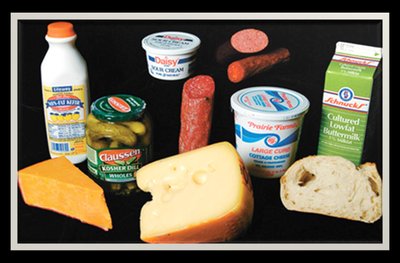
Fermentation is a natural method of food preservation, relying on the metabolic activities of microorganisms. It produces organic acids, alcohol, and other chemicals that inhibit spoilage organisms and pathogens.
Organic acids: Produced by lactic acid bacteria, acetic acid bacteria, and propionic acid bacteria.
Alcohol: Produced by yeasts like Saccharomyces cerevisiae.
Major Microbes in Fermented Foods
Different microbes are important in the production of various fermented foods:
Lactic acid bacteria: Lactococcus, Lactobacillus, Streptococcus (dairy, vegetables).
Acetic acid bacteria: Acetobacter (vinegar).
Propionic acid bacteria: Propionibacterium (certain cheeses).
Yeasts: Saccharomyces cerevisiae (bread, alcoholic beverages).
Preservative Effects of Fermentation
The high levels of organic acids or alcohol generated during fermentation prevent the growth of spoilage organisms and pathogens. Fermentation also enhances nutritional value, taste, and aroma.
Preservatives: Organic acids, alcohol.
Additional benefits: Improved nutrition, flavor, and aroma.
Summary Table: Food Spoilage and Fermentation
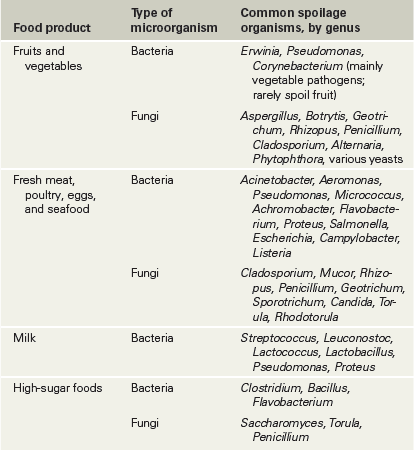
Common Spoilage Organisms by Food Product
Food product | Type of microorganism | Common spoilage organisms, by genus |
|---|---|---|
Fruits and vegetables | Bacteria | Erwinia, Pseudomonas, Corynebacterium |
Fungi | Aspergillus, Botrytis, Geotrichum, Rhizopus, Penicillium, Cladosporium, Alternaria, Phytophthora, various yeasts | |
Fresh meat, poultry, eggs, seafood | Bacteria | Acinetobacter, Aeromonas, Pseudomonas, Micrococcus, Achromobacter, Flavobacterium, Proteus, Salmonella, Escherichia, Campylobacter, Listeria |
Fungi | Cladosporium, Mucor, Rhizopus, Penicillium, Geotrichum, Sporotrichum, Candida, Torula, Rhodotorula | |
Milk | Bacteria | Streptococcus, Leuconostoc, Lactococcus, Lactobacillus, Pseudomonas, Proteus |
High-sugar foods | Bacteria | Clostridium, Bacillus, Flavobacterium |
Fungi | Saccharomyces, Torula, Penicillium |
Primary Fermenting Microorganisms by Food Category
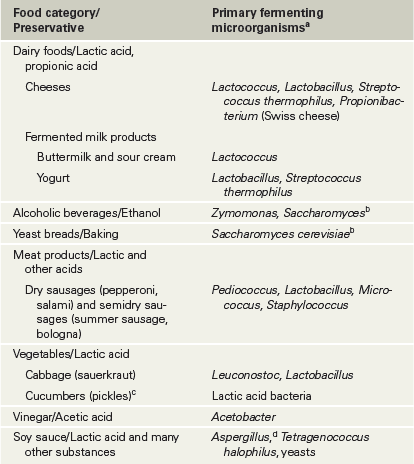
Food category/Preservative | Primary fermenting microorganisms |
|---|---|
Dairy foods/Lactic acid, propionic acid | Lactococcus, Lactobacillus, Streptococcus thermophilus, Propionibacterium |
Fermented milk products | Lactococcus |
Yogurt | Lactobacillus, Streptococcus thermophilus |
Alcoholic beverages/Ethanol | Zymomonas, Saccharomyces |
Yeast breads/Baking | Saccharomyces cerevisiae |
Meat products/Lactic acid and others | Pediococcus, Lactobacillus, Micrococcus, Staphylococcus |
Vegetables/Lactic acid | Leuconostoc, Lactobacillus |
Cucumbers (pickles) | Lactic acid bacteria |
Vinegar/Acetic acid | Acetobacter |
Soy sauce/Lactic acid and many other substances | Aspergillus, Tetragenococcus halophilus, yeasts |
Check Your Understanding
List the major food groups as categorized by their susceptibility to spoilage.
Identify physical and chemical methods used for food preservation. How does each method limit growth of microorganisms?
List some dairy, meat, beverage, and vegetable foods produced by microbial fermentation. What is the preservative in each case?
