뒤로
뒤로Molecules of Microbiology: Structure, Function, and Classification of Biomolecules
스터디 가이드 - 스마트 노트
 자료에 맞춘 맞춤형 노트, 핵심 정의, 예시, 맥락을 확장해 제공합니다.
Molecules of Microbiology
Concept: Carbon in Biological Molecules
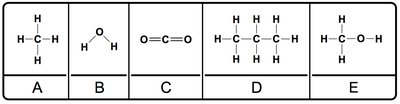
Carbon is the most abundant element in living systems (excluding water) and forms the backbone of organic molecules such as carbohydrates, proteins, nucleic acids, and lipids. Organic molecules are defined by the presence of covalently linked carbon and hydrogen atoms, while hydrocarbons are composed solely of carbon and hydrogen.
Organic Molecules: Contain covalently bonded carbon and hydrogen atoms.
Hydrocarbons: Organic molecules made only of carbon and hydrogen.
Carbon's Versatility: Carbon can form four covalent bonds, allowing for diverse molecular structures.
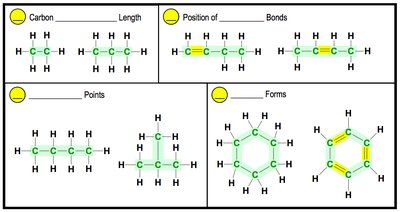
Variations in Carbon Backbones: Length, position of double bonds, branch points, and linear vs. ring forms.
Example: Identifying organic molecules and hydrocarbons in structural diagrams.
Concept: Functional Groups
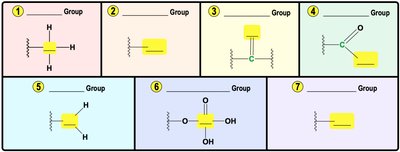
Functional groups are specific groups of atoms that confer distinct chemical properties and reactivity to organic molecules. They typically extend from the carbon backbone and are common in biological molecules.
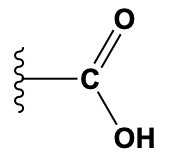
Common Functional Groups: Include hydroxyl (-OH), carbonyl (C=O), carboxyl (-COOH), amino (-NH2), sulfhydryl (-SH), methyl (-CH3), and phosphate (-PO4).
Role: Functional groups determine the chemical behavior and interactions of biomolecules.
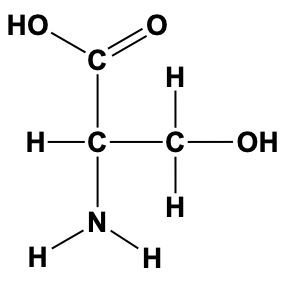
Example: Identifying functional groups in molecular structures.
Introduction to Biomolecules
Classes of Biomolecules
Biomolecules are organic molecules essential to life, classified into four primary groups: carbohydrates, proteins, nucleic acids, and lipids. Each class has unique structure and function in living organisms.
Carbohydrates: Energy storage and structural support.
Proteins: Enzymatic activity, structural support, transport, and signaling.
Nucleic Acids: Storage and transmission of genetic information.
Lipids: Energy storage, membrane structure, and signaling.
Example: Visual map of biomolecule classes and their monomers/polymers.
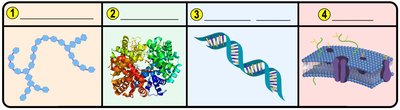
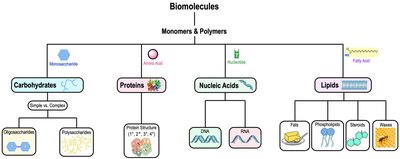
Monomers & Polymers
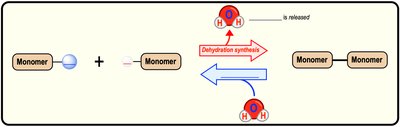
Monomers are small, individual building blocks that can be linked together to form polymers. Polymers are long chains of monomers, and their formation and breakdown are essential for biological processes.
Monomers: Basic units (e.g., monosaccharides, amino acids, nucleotides).
Polymers: Chains of monomers (e.g., polysaccharides, polypeptides, nucleic acid chains).
Formation: Dehydration synthesis forms covalent bonds between monomers, releasing water.
Breakdown: Hydrolysis cleaves covalent bonds, consuming water.
Example: Visual representation of monomer-to-polymer assembly and breakdown.
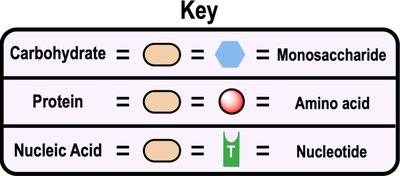
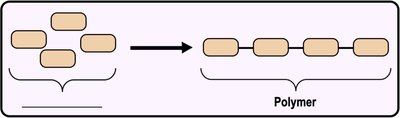
Carbohydrates
Structure and Classification
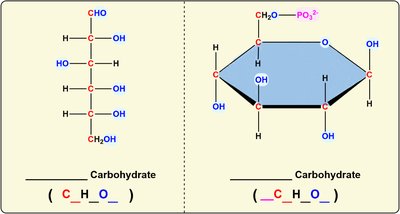
Carbohydrates are carbon-based molecules hydrated with hydroxyl groups. They are also known as saccharides (sugars) and classified by size and complexity.
Simple Carbohydrates: Fit the formula (e.g., glucose).
Complex Carbohydrates: May differ from the formula and include additional atoms (N, S, etc.).
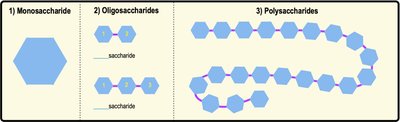
Size Classes:
Monosaccharide: Single sugar unit (e.g., glucose).
Oligosaccharide: 2 to ~20 covalently linked monosaccharides.
Polysaccharide: More than 20 monosaccharides (e.g., starch, cellulose).
Example: Simple vs. complex carbohydrate structures.
Formation & Breakdown of Polysaccharides
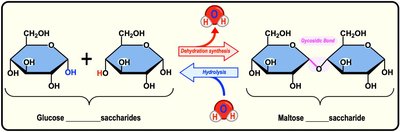
Polysaccharides are formed by dehydration synthesis, linking monosaccharides via glycosidic bonds. Hydrolysis breaks these bonds, releasing energy and individual monosaccharides.
Dehydration Synthesis: Links monosaccharides to form polysaccharides.
Glycosidic Bonds: Covalent bonds between monosaccharides.
Hydrolysis: Breaks down polysaccharides into monosaccharides.
Example: Formation of maltose from two glucose molecules.
Carbohydrate Functions
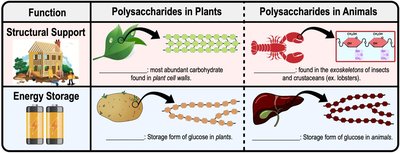
Carbohydrates serve two main functions: structural support and energy storage. Structural carbohydrates include cellulose and chitin, while energy-storage carbohydrates include starch and glycogen.
Structural Support: Cell walls (cellulose in plants, chitin in animals).
Energy Storage: Starch (plants), glycogen (animals).
Example: Polysaccharides in plants and animals.
Proteins
Structure and Formation
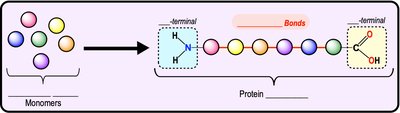
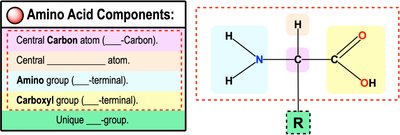
Proteins are polymers made of amino acid monomers linked by peptide bonds. They have directionality, with N-terminal and C-terminal ends.
Amino Acids: Building blocks of proteins, each with a unique R-group.
Peptide Bonds: Covalent bonds linking amino acids.
Directionality: N-terminal (amino group) to C-terminal (carboxyl group).
Example: Formation of proteins from amino acids.
Protein-Related Terms
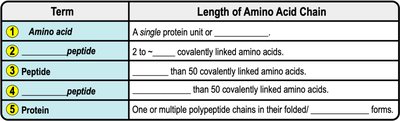
Proteins and their related terms are classified by the length of amino acid chains.
Term | Length of Amino Acid Chain |
|---|---|
Amino acid | A single protein unit or monomer |
Oligopeptide | 2 to ~50 covalently linked amino acids |
Peptide | Less than 50 covalently linked amino acids |
Polypeptide | More than 50 covalently linked amino acids |
Protein | One or multiple polypeptide chains in their folded, functional forms |
Protein Structure
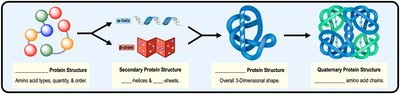
Proteins have a hierarchical structure organized into four levels:
Primary Structure: Amino acid sequence; determines all other levels.
Secondary Structure: Formation of α-helices or β-sheets via hydrogen bonding.
Tertiary Structure: Overall 3D shape of a polypeptide chain.
Quaternary Structure: Association of multiple polypeptide chains.
Example: Four levels of protein structure.
Denatured Proteins & Chaperones
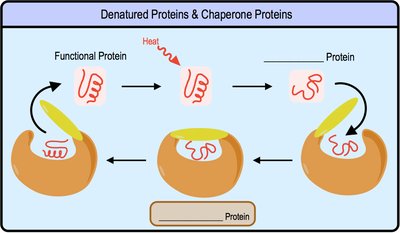
A protein's structure is critical for its function. Denatured proteins lose their functional shape due to environmental changes (pH, temperature, salt concentration). Chaperone proteins assist in refolding or renaturing proteins.
Denatured Protein: Non-functional protein with altered shape.
Chaperone Proteins: Help proteins refold into their functional shape.
Example: Protein denaturation and renaturing.
Nucleic Acids
Structure and Formation
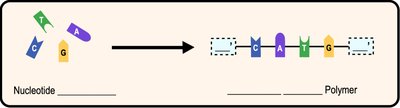
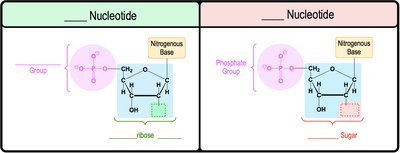
Nucleic acids are polymers that store and encode genetic information. Their monomers are nucleotides, which consist of a phosphate group, a pentose sugar, and a nitrogenous base. DNA and RNA differ in their sugar and base composition.
Nucleotides: Building blocks of nucleic acids.
Directionality: 5' phosphate end to 3' hydroxyl end.
Example: Formation of nucleic acids from nucleotide monomers.
Nitrogenous Bases
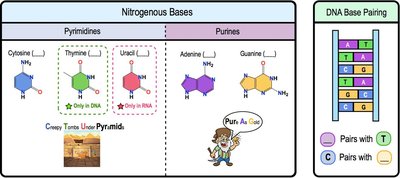
There are five nitrogenous bases grouped as pyrimidines (single-ring) and purines (double-ring). In DNA, bases pair via hydrogen bonding: A with T, C with G.
Pyrimidines: Cytosine, Thymine (DNA only), Uracil (RNA only).
Purines: Adenine, Guanine.
Base Pairing: A-T, C-G in DNA; A-U, C-G in RNA.
Example: Nitrogenous base classification and DNA base pairing.
Formation & Breakdown of Nucleic Acids
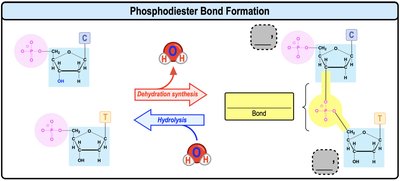
Nucleic acids are formed by dehydration synthesis, linking nucleotides via phosphodiester bonds. The sugar-phosphate backbone gives directionality to the polymer.
Phosphodiester Bonds: Covalent bonds between nucleotides.
Directionality: 5' phosphate to 3' hydroxyl end.
Example: Phosphodiester bond formation.
DNA vs. RNA
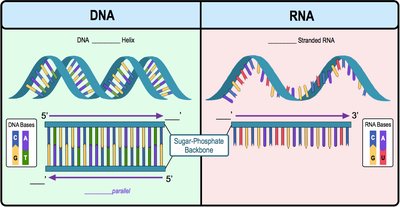
DNA stores genetic information and forms a double helix with antiparallel strands. RNA is usually single-stranded and functions in protein synthesis and other cellular roles.
DNA: Double helix, antiparallel strands, base pairing (A-T, C-G).
RNA: Single-stranded, base pairing (A-U, C-G).
Example: Structure of DNA and RNA.
Lipids
Structure and Types
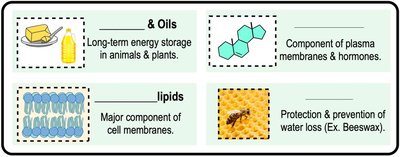
Lipids are hydrophobic biomolecules insoluble in water, highly diverse in structure and function. They do not form polymers and include fats, oils, phospholipids, steroids, and waxes.
Amphipathic Lipids: Contain both hydrophobic and hydrophilic groups.
Types: Fats & oils, phospholipids, steroids, waxes.
Example: Types of lipids and their functions.
Fatty Acids
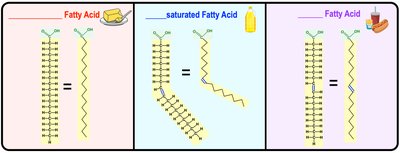
Fatty acids are hydrocarbon chains with a carboxylic acid group. They are classified as saturated (only single C-C bonds, solid at room temp), unsaturated (one or more C=C bonds, liquid at room temp), and trans fats (artificial, linear unsaturated fatty acids).
Saturated Fatty Acids: Fully saturated with hydrogens, only single bonds.
Unsaturated Fatty Acids: One or more double bonds, kinked structure.
Trans Fats: Artificial, unsaturated but linear.
Example: Comparison of fatty acid types.
Triglycerides
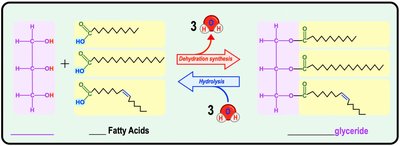
Triglycerides are lipids with three fatty acid chains covalently linked to a single glycerol molecule via dehydration synthesis.
Structure: Three fatty acids + one glycerol.
Formation: Dehydration synthesis links fatty acids to glycerol.
Example: Triglyceride formation.
Phospholipids
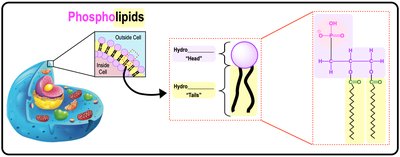
Phospholipids are a major component of cell membranes, containing a phosphate group, amphipathic structure with a polar head and nonpolar tails.
Structure: Polar head (phosphate group), nonpolar tails (fatty acids).
Function: Form cell membranes, interact with water via polar heads.
Example: Phospholipid structure and membrane formation.
Steroids & Waxes
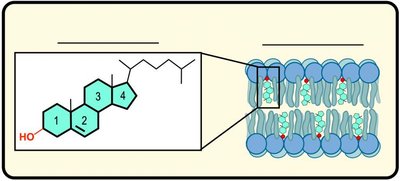
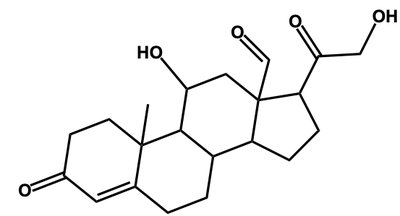
Steroids are lipids made of four fused carbon ring structures, such as cholesterol, which is important for animal cell membranes. Waxes are lipids used for protection and prevention of water loss.
Steroids: Four fused carbon rings, structural and hormonal roles.
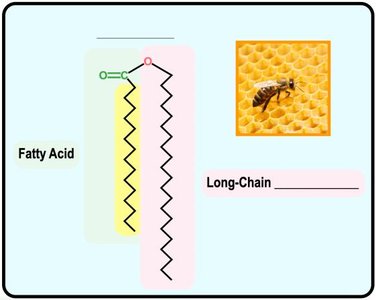
Waxes: Fatty acids bound to long-chain alcohols, protective function.
Example: Steroid and wax structures.