 뒤로
lab 11 - Oxygen Requirements for Bacterial Growth: Categories, Metabolic Basis, and Culturing Techniques
스터디 가이드 - 스마트 노트
 자료에 맞춘 맞춤형 노트, 핵심 정의, 예시, 맥락을 확장해 제공합니다.
lab 11 - Oxygen Requirements for Growth
Introduction
Microorganisms exhibit diverse adaptations to environmental oxygen levels, which directly influence their growth and metabolic processes. Understanding these adaptations is essential for culturing bacteria in laboratory settings and predicting their behavior in various environments. Bacteria are classified into distinct categories based on their response to oxygen, each with unique metabolic characteristics and requirements.
Categories of Bacteria Based on Oxygen Response
Bacteria are grouped according to their ability to grow in the presence or absence of oxygen. The five primary categories are:
Obligate Aerobes: Require oxygen for growth; perform aerobic respiration.
Obligate Anaerobes: Cannot tolerate oxygen; perform anaerobic respiration or fermentation.
Facultative Anaerobes: Can grow with or without oxygen; prefer aerobic respiration when oxygen is available, but switch to anaerobic pathways when it is absent.
Aerotolerant Anaerobes: Do not use oxygen but can survive in its presence; rely on fermentation and possess mechanisms to detoxify oxygen byproducts.
Microaerophiles: Require oxygen at concentrations lower than atmospheric levels; higher oxygen concentrations are inhibitory or toxic.
Metabolic Basis for Oxygen Response
The metabolic basis for each category is determined by two factors: the method of ATP production and the ability to detoxify reactive oxygen species (ROS).
Aerobic Respiration: Uses oxygen as the final electron acceptor, yielding the most ATP.
Anaerobic Respiration: Uses alternative electron acceptors (e.g., nitrate, sulfate), yielding less ATP than aerobic respiration.
Fermentation: Uses organic molecules as electron acceptors, yielding the least ATP.
ROS detoxification is achieved by enzymes such as superoxide dismutase (SOD) and catalase or peroxidase. The presence or absence of these enzymes determines a bacterium's tolerance to oxygen.
Key Enzymes for Oxygen Tolerance
Superoxide Dismutase (SOD): Converts superoxide radicals to hydrogen peroxide.
Catalase: Breaks down hydrogen peroxide into water and oxygen.
Peroxidase: Also breaks down hydrogen peroxide, but without producing oxygen.
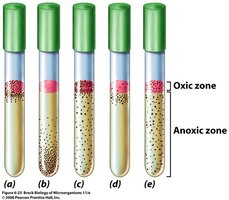
Growth Patterns in Fluid Thioglycolate Medium
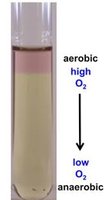
Fluid thioglycolate medium creates an oxygen gradient, with high oxygen at the top and low oxygen at the bottom. This allows for the differentiation of bacterial oxygen requirements based on growth location within the tube.
Obligate Aerobe: Growth only at the top.
Facultative Anaerobe: Growth throughout, heaviest at the top.
Microaerophile: Growth as a thin band just below the top.
Aerotolerant Anaerobe: Even growth throughout the tube.
Obligate Anaerobe: Growth only at the bottom.
Laboratory Techniques for Culturing Bacteria by Oxygen Requirement
Different methods are used to create environments suitable for each oxygen category:
Obligate Aerobes: Incubate in normal atmospheric conditions; shaking increases oxygenation.
Facultative Anaerobes: Can be cultured in air or anaerobic conditions.
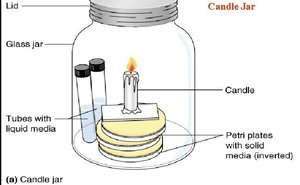
Microaerophiles: Use a candle jar or specialized microaerophilic incubator to create reduced oxygen and increased CO2 levels.
Aerotolerant Anaerobes: Can be cultured in air; will use fermentation regardless of oxygen presence.
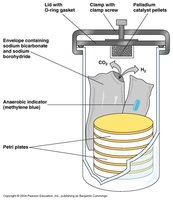
Obligate Anaerobes: Use anaerobic jars or chambers with gas packs to remove oxygen, or reducing media such as thioglycolate broth.
Examples of Bacterial Oxygen Categories
Organism | Oxygen Category | Growth Pattern in Thioglycolate | Growth in Incubator | Growth in Candle Jar | Growth in Anaerobic Jar |
|---|---|---|---|---|---|
Clostridium sporogenes | Strict Anaerobe | Bottom | 0 | 0 | +++ |
Pseudomonas aeruginosa | Obligate Aerobe | Top | +++ | + | 0 |
Escherichia coli | Facultative Anaerobe | Throughout (heaviest at top) | +++ | ++ | ++ |
Neisseria subflava | Microaerophile | Band just below top | + | +++ | 0 |
Discussion: Predicting Growth Behavior
Obligate Aerobe: Will only grow in environments with sufficient oxygen; dies in anaerobic conditions.
Facultative Anaerobe: Grows in both aerobic and anaerobic conditions, but prefers oxygen for higher ATP yield.
Microaerophile: Grows best in reduced oxygen; inhibited by atmospheric levels.
Aerotolerant Anaerobe: Grows in presence or absence of oxygen, but only uses fermentation.
Obligate Anaerobe: Grows only in absence of oxygen; exposure to oxygen is lethal.
Metabolic and Enzymatic Comparison Table
Category | Metabolizes Oxygen | Growth in Atmospheric O2 | Growth in Absence of O2 | Detoxifies Oxygen Byproducts |
|---|---|---|---|---|
Aerobe | Yes | Yes | No | Yes (SOD + Catalase) |
Facultative Anaerobe | Yes | Yes | Yes | Yes (SOD + Catalase) |
Strict Anaerobe | No | No | Yes | No |
Aerotolerant Anaerobe | No | Yes | Yes | Yes (SOD + Peroxidase) |
Microaerophile | Yes | No (only at reduced O2) | No | Limited (SOD, little catalase) |
Common Laboratory Media and Methods
Fluid Thioglycolate Medium: Contains sodium thioglycolate to reduce oxygen, resazurin or methylene blue as oxygen indicators, and agar to limit oxygen diffusion. Used to distinguish oxygen requirements based on growth location.
Anaerobic Jar: Uses gas generator envelopes to remove oxygen and produce CO2; indicator strip confirms anaerobic conditions.
Candle Jar: Creates microaerophilic conditions by burning a candle, reducing oxygen and increasing CO2.
Equations and Formulas
ATP Yield Comparison:
Aerobic Respiration:
Anaerobic Respiration:
Fermentation:
Application Example
If a thioglycolate tube shows growth throughout but is densest at the surface, this suggests a facultative anaerobe. The organism uses aerobic respiration when oxygen is available (top of tube) and switches to fermentation or anaerobic respiration in lower oxygen regions (bottom of tube).
Additional info: The candle jar is used to create microaerophilic conditions, suitable for organisms like Neisseria subflava that require reduced oxygen and increased CO2. Shaking the thioglycolate tube before inoculation disrupts the oxygen gradient, making it unreliable for distinguishing oxygen requirements.
