 뒤로
Chapter 14
스터디 가이드 - 스마트 노트
 자료에 맞춘 맞춤형 노트, 핵심 정의, 예시, 맥락을 확장해 제공합니다.
Principles of Disease and Epidemiology
Pathology, Etiology, and Pathogenesis
Pathology is the study of disease, focusing on its causes (etiology) and the manner in which it develops (pathogenesis). Infection refers to the invasion or colonization of the body by pathogens, which may exist without causing detectable disease. An infectious disease occurs when an infection results in any change in the state of health, often due to microorganisms locating in parts of the body where they are not normally found.
Human Microbiome and Normal Microbiota
The human microbiome begins to establish in utero and continues to develop throughout life, influenced by birth method, diet, environment, and other factors. Normal microbiota (normal flora) are microorganisms that permanently colonize the host and typically do not cause disease under normal conditions, while transient microbiota are present temporarily.
Normal microbiota play a role in immune system development.
Distribution and composition are determined by nutrients, physical and chemical factors, mechanical factors, body defenses, age, diet, geography, hygiene, and lifestyle.
Microbial antagonism (competitive exclusion) protects the host by competing for nutrients, producing bacteriocins, and affecting pH and oxygen levels.
Opportunistic pathogens are normal microbiota that cause disease when in the wrong environment.
Symbiosis: Relationships Between Microbiota and Host
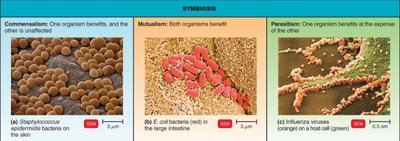
Symbiosis describes relationships between organisms, including commensalism, mutualism, and parasitism. These relationships are illustrated by the interaction between normal microbiota and the host.
Commensalism: One organism benefits, the other is unaffected.
Mutualism: Both organisms benefit.
Parasitism: One organism benefits at the expense of the other.
Koch’s Postulates
Koch’s postulates are a sequence of procedures used to prove that a particular microorganism causes a specific disease:
The same pathogen must be present in every case of the disease.
The pathogen must be isolated from the diseased host and grown in pure culture.
The pathogen from the pure culture must cause the disease when inoculated into a healthy, susceptible laboratory animal.
The pathogen must be isolated from the inoculated animal and shown to be the original organism.
Exceptions include pathogens that cause multiple diseases, those only affecting humans, microbes that cannot be cultured, and diseases with similar signs and symptoms caused by different pathogens.
Classifying Infectious Diseases
Symptoms: Subjective changes felt by the patient (e.g., pain).
Signs: Objective changes measurable or observable (e.g., fever).
Syndrome: Specific group of signs and symptoms accompanying a disease.
Communicable disease: Spread from one host to another (e.g., COVID-19, influenza).
Contagious disease: Easily and rapidly spread (e.g., measles).
Noncommunicable disease: Not spread between hosts (e.g., tetanus).
Occurrence of Disease
Incidence: Number of new cases during a specific time period.
Prevalence: Total number of cases (old and new) at a specified time.
Sporadic disease: Occurs occasionally (e.g., typhoid fever).
Endemic disease: Constantly present (e.g., common cold).
Epidemic disease: Acquired by many people in a short time (e.g., influenza).
Pandemic disease: Worldwide epidemic (e.g., COVID-19).
Severity and Duration of Disease
Acute disease: Rapid onset, short duration (e.g., influenza).
Chronic disease: Slow development, long duration (e.g., hepatitis).
Latent disease: Inactive for a time, then activates (e.g., herpes).
Herd immunity: Immunity in most of a population.
Stages in the Development of Disease
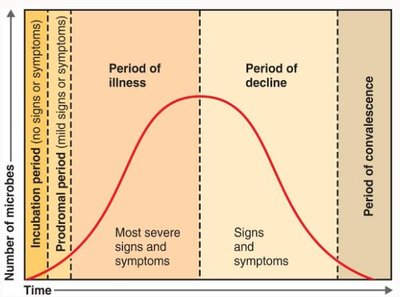
The progression of disease includes several distinct periods:
Incubation period: Interval between initial infection and first signs/symptoms.
Prodromal period: Early, mild, nonspecific symptoms.
Period of illness: Disease is most severe.
Period of decline: Signs and symptoms subside.
Period of convalescence: Recovery and return to prediseased state.
Extent of Host Involvement
Local infection: Limited to a small area (e.g., boils).
Systemic infection: Spread throughout the body (e.g., measles).
Focal infection: Systemic infection that began as a local infection.
Sepsis: Toxic inflammatory condition from spread of microbes or toxins.
Bacteremia: Bacteria in the blood.
Septicemia: Growth of bacteria in the blood.
Toxemia: Toxins in the blood.
Viremia: Viruses in the blood.
Primary infection: Initial acute infection.
Secondary infection: Opportunistic infection after primary infection.
Subclinical infection: No noticeable signs or symptoms (e.g., Hepatitis A).
Predisposing Factors
Variables that increase susceptibility or alter disease course include nutrition, sex, genetic inheritance, climate, environment, vaccination, age, lifestyle, and behaviors.
Reservoirs of Infection
Human reservoirs: People with symptoms or carriers (asymptomatic, incubating, convalescent, chronic, passive).
Animal reservoirs: Zoonoses (diseases transmitted from animals to humans, e.g., rabies).
Nonliving reservoirs: Soil, water, and foods (e.g., Clostridium tetani).
Transmission of Disease
Direct contact transmission: Close association between infected and susceptible host.
Congenital transmission: From mother to fetus or newborn.
Indirect contact transmission: Via nonliving object (fomite).
Droplet transmission: Airborne droplets less than 1 meter.
Vehicle transmission: Transmission by inanimate reservoir (air, water, food).
Vector transmission: Arthropods transmit disease mechanically (on feet) or biologically (pathogen reproduces in vector).
Healthcare-Associated Infections (HAIs)
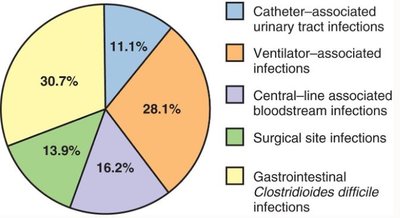
HAIs are acquired during treatment in healthcare facilities, affecting 1 in 31 hospital patients in the U.S. annually. They result from microorganisms in the hospital environment, weakened host status, and chains of transmission. Compromised hosts are at higher risk due to impaired resistance.
Common HAIs: Catheter-associated urinary tract infections, ventilator-associated infections, central-line associated bloodstream infections, surgical site infections, and gastrointestinal Clostridioides difficile infections.
Antimicrobial resistance: High among HAIs.
Chain of transmission: Direct contact (staff to patient), indirect contact (fomites, ventilation systems).
Emerging Infectious Diseases
Emerging infectious diseases are new, changing, or increasing in incidence, often zoonotic and vector-borne. Contributing factors include genetic recombination, evolution, antibiotic/pesticide use, genetic instability, climate changes, transportation, ecological disasters, animal control, public health failures, and bioterrorism.
Epidemiology
Epidemiology is the study of where and when diseases occur and how they are transmitted in populations. It determines etiology, identifies patterns, assembles data, predicts spread, and explores control methods.
Reproductive number (R0): Average number of people infected by one individual.
Types of epidemiology: Descriptive (data collection), analytical (cause/risk analysis), experimental (hypothesis and controlled experiments).
Case reporting: Establishes chain of transmission, requires reporting to health officials, provides early warning of outbreaks.
CDC: Collects and analyzes epidemiological information, publishes Morbidity and Mortality Weekly Report (MMWR).
Morbidity: Incidence of specific notifiable disease.
Mortality: Deaths from notifiable diseases.
Morbidity rate: Number affected relative to population.
Mortality rate: Number of deaths relative to population.
Additional info:
Fecal microbial transfer (FMT) is used to treat Clostridium difficile infections by restoring normal microbiota.
Antigenic shift and drift are mechanisms by which RNA viruses change, contributing to emerging diseases.
Historical figures in epidemiology include John Snow (cholera mapping), Ignaz Semmelweis (handwashing), and Florence Nightingale (sanitation).
