 뒤로
뒤로Prokaryotic and Eukaryotic Cell Structures and Functions
스터디 가이드 - 스마트 노트
 자료에 맞춘 맞춤형 노트, 핵심 정의, 예시, 맥락을 확장해 제공합니다.
Prokaryotic Cell Structures
Cytoplasm
The cytoplasm is the thick, aqueous, elastic, and semitransparent substance inside the plasma membrane of prokaryotic cells. It is composed of approximately 80% water, along with proteins, carbohydrates, lipids, and ions. The cytoplasm contains the cell's genetic material (nucleoid), ribosomes, and various inclusions. The cytoskeleton is a series of fibers within the cytoplasm that play roles in cell division, maintaining cell shape, growth, and DNA movement.

The Nucleoid
The nucleoid is the region in a prokaryotic cell where the bacterial chromosome—a circular thread of double-stranded DNA—resides. This DNA contains the cell's genetic information and is not enclosed by a nuclear envelope or associated with histones. Plasmids are small, extrachromosomal circles of DNA (typically 5–100 genes) that carry nonessential genes, such as those for antibiotic resistance or toxin production. Plasmids replicate independently and can be transferred between bacteria.
Ribosomes
Ribosomes are the sites of protein synthesis in prokaryotic cells. They are composed of protein and ribosomal RNA (rRNA) and are classified as 70S ribosomes, consisting of a 50S large subunit and a 30S small subunit. Several antibiotics, such as streptomycin, gentamicin, erythromycin, and chloramphenicol, specifically target prokaryotic ribosomal function, inhibiting protein synthesis.

Inclusions
Inclusions are reserve deposits of nutrients found in prokaryotic cells. Types include:
Metachromatic granules (volutin): phosphate reserves
Polysaccharide granules: energy reserves
Lipid inclusions: energy reserves
Sulfur granules: energy reserves
Carboxysomes: contain RuBisCO enzyme for carbon fixation during photosynthesis
Gas vacuoles: protein-covered cylinders that maintain buoyancy
Magnetosomes: iron oxide inclusions that help bacteria orient along magnetic fields

Endospores
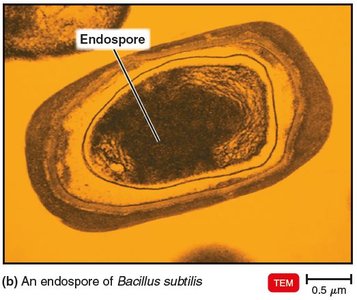
Endospores are highly resistant, dormant structures produced by certain bacteria (notably Bacillus and Clostridium) when nutrients are depleted. They are resistant to desiccation, heat, chemicals, and radiation, allowing survival for thousands of years. Endospore formation (sporulation) is a survival mechanism, not a reproductive process. When conditions improve, endospores germinate and return to the vegetative state. Endospores are significant in the food industry due to their resistance to standard sterilization methods.

Eukaryotic Cell Structures
Overview of Eukaryotic Cell Structures
Eukaryotic cells are characterized by membrane-bound organelles and a true nucleus. They are structurally more complex than prokaryotic cells and include plant, animal, fungal, and protist cells.


Flagella and Cilia
Flagella and cilia are projections used for locomotion or moving substances along the cell surface. Flagella are long and few in number, while cilia are short and numerous. Both structures are composed of microtubules made of the protein tubulin, arranged in a 9+2 array (nine pairs in a ring with two central microtubules). Eukaryotic flagella move in a wavelike manner.


Cell Wall and Glycocalyx
The cell wall is found in plants, algae, and fungi, and is composed of carbohydrates such as cellulose (plants), chitin (fungi), and glucan/mannan (yeasts). The glycocalyx is a carbohydrate-rich layer bonded to proteins and lipids in the plasma membrane, found in animal cells. It strengthens the cell surface, aids in cell attachment, and is involved in cell–cell recognition.
Plasma (Cytoplasmic) Membrane
The plasma membrane of eukaryotic cells is similar in structure to that of prokaryotes, consisting of a phospholipid bilayer with integral and peripheral proteins. Unique features include the presence of sterols (complex lipids) and carbohydrates for attachment and recognition. Eukaryotic membranes also perform endocytosis (phagocytosis, pinocytosis, and receptor-mediated endocytosis), in addition to selective permeability, diffusion, osmosis, and active transport.
Cytoplasm
The cytoplasm in eukaryotic cells is the substance inside the plasma membrane and outside the nucleus. The cytosol is the fluid portion, while the cytoskeleton (composed of microfilaments, intermediate filaments, and microtubules) provides shape and support. Cytoplasmic streaming refers to the movement of cytoplasm throughout the cell.
Ribosomes
Eukaryotic ribosomes are the sites of protein synthesis and are classified as 80S ribosomes (composed of 60S and 40S subunits). Some are membrane-bound (attached to the endoplasmic reticulum), while others are free in the cytoplasm. Eukaryotic organelles such as mitochondria and chloroplasts contain 70S ribosomes, similar to those in prokaryotes.
Organelles
Nucleus: Double-membrane structure (nuclear envelope) containing DNA complexed with histones to form chromatin. During cell division, chromatin condenses into chromosomes.
Endoplasmic Reticulum (ER): Folded transport network. Rough ER is studded with ribosomes and synthesizes proteins; smooth ER synthesizes membranes, fats, and hormones.
Golgi Complex: Modifies proteins from the ER and transports them via secretory vesicles to the plasma membrane.
Lysosomes: Vesicles formed in the Golgi complex containing digestive enzymes.
Vacuoles: Cavities formed from the Golgi complex or by endocytosis, used for storage and maintaining cell shape.
Mitochondria: Double-membrane organelles with inner folds (cristae) and matrix, responsible for ATP production via cellular respiration. Contain 70S ribosomes and circular DNA, and can reproduce independently.
Chloroplasts: Sites of photosynthesis in plant cells, containing thylakoids with chlorophyll, 70S ribosomes, and circular DNA.
Peroxisomes: Organelles that oxidize fatty acids and detoxify harmful substances.
Centrosomes: Composed of a pericentriolar matrix and centrioles, serving as the organizing center for the mitotic spindle during cell division.





The Evolution of Eukaryotes
Endosymbiotic Theory
The endosymbiotic theory explains the origin of eukaryotic cells. It proposes that larger prokaryotic cells engulfed smaller ones, which then became endosymbionts. The nucleus formed from infoldings of the plasma membrane, while ingested photosynthetic bacteria became chloroplasts and aerobic bacteria became mitochondria. Evidence supporting this theory includes the similarities between mitochondria/chloroplasts and bacteria: both have circular DNA, 70S ribosomes, double membranes, and can reproduce independently of the host cell.
