 뒤로
Prokaryotic Cell Cycle and Microbial Growth: Structured Study Notes
스터디 가이드 - 스마트 노트
 자료에 맞춘 맞춤형 노트, 핵심 정의, 예시, 맥락을 확장해 제공합니다.
Cell Cycle vs Population Growth
Definitions and Distinctions
The prokaryotic cell cycle refers to the sequence of events occurring in a single bacterial cell, while population growth describes the increase in cell number within a microbial population. Understanding these concepts is fundamental for microbiology, with implications in ecology, clinical microbiology, industrial applications, and public health.
Cell Cycle: Includes cell elongation, chromosome replication, septum formation, and cytokinesis.
Population Growth: Refers to the collective increase in cell numbers, often measured in batch or continuous cultures.
Binary Fission: The most common method of prokaryotic cell division, producing two identical daughter cells.
Other Division Methods: Budding, aerial spore formation, fragmentation.
Applications: Growth rate affects survival, infection spread, fermentation, biocontrol, and sanitation.
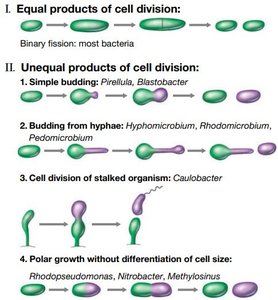
Prokaryotic Cell Cycle
Binary Fission Process
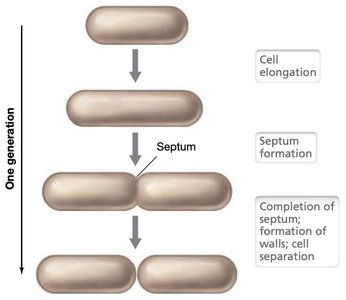
Binary fission is the primary mechanism of cell division in bacteria. The process involves cell elongation, septum formation, and separation into two daughter cells. The timing and regulation of these steps are influenced by metabolic and environmental factors.
Elongation: Cell grows in size.
Chromosome Replication: DNA is duplicated.
Septum Formation: Partition forms between dividing cells.
Cytokinesis: Physical separation into two cells.
Generation Time: Varies by species (e.g., E. coli ~21 min, M. tuberculosis ~12-20 h).
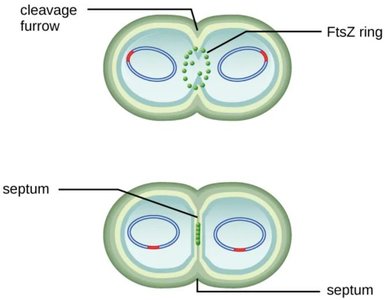
FtsZ Rings
The FtsZ protein polymerizes to form a Z-ring at the cell's midpoint, defining the division plane. This ring recruits the divisome complex, which orchestrates septum formation and cell division.
FtsZ: Tubulin-like protein essential for cytokinesis.
Z-ring: Localizes at mid-cell, marks division site.
Divisome: Protein complex that initiates septum formation.
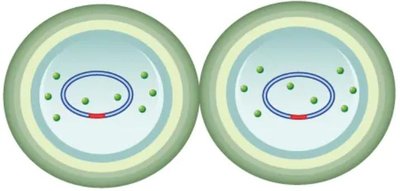
Peptidoglycan Synthesis During Division
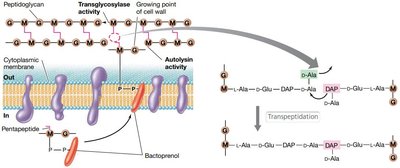
Peptidoglycan biosynthesis is tightly coordinated with cell division. The process involves severing old peptidoglycan, synthesizing precursors, exporting them, inserting new material, and cross-linking peptides.
Autolysins: Hydrolyze glycosidic bonds for remodeling.
Bactoprenol: Lipid carrier for peptidoglycan precursors.
Transglycosylases: Catalyze glycosidic bond formation.
Transpeptidases: Cross-link peptide chains.
Microbial Growth
Exponential Growth
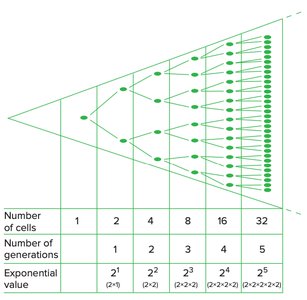
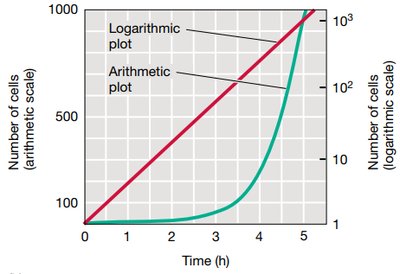
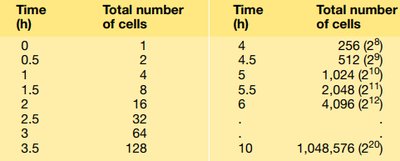
Microbial populations grow exponentially under optimal conditions, doubling at regular intervals. The mathematical model for exponential growth is essential for predicting population dynamics.
Formula:
Generation Time (g):
Growth Rate: Influenced by nutrients, genetics, and environment.
Example: Beneckea natriegens (9.6 min), E. coli (21 min), M. tuberculosis (12 h).
Microbial Growth Dynamics – Batch Culture
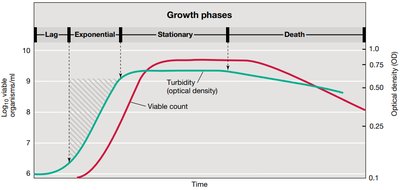
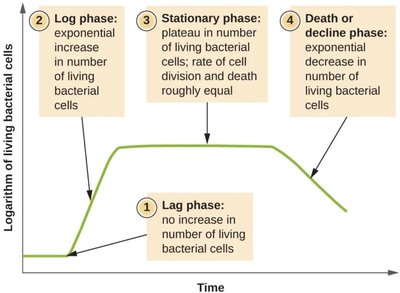
Batch cultures are closed systems where microbial growth follows a characteristic curve: lag, exponential, stationary, and death phases. Each phase reflects changes in physiology and metabolism.
Lag Phase: Adaptation, no increase in cell number.
Exponential Phase: Balanced growth, maximum rate.
Stationary Phase: Growth ceases, nutrient depletion, waste accumulation.
Death Phase: Cell death exceeds growth, population declines.
Microbial Growth Dynamics – Continuous Culture
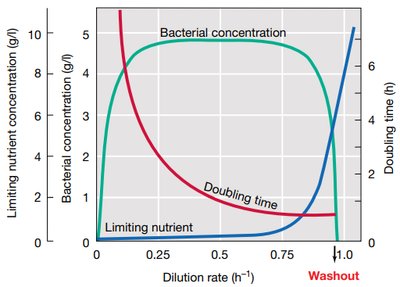
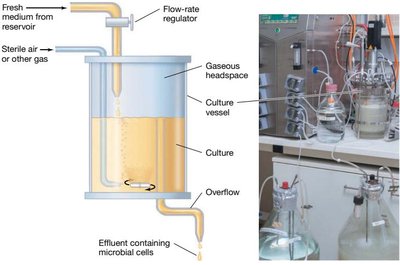
Continuous culture systems, such as chemostats and turbidostats, maintain microbial populations in a steady state by supplying nutrients and removing waste. These systems are crucial for studying physiology and industrial microbiology.
Chemostat: Controls growth rate via limiting nutrient and dilution rate.
Turbidostat: Maintains cell density by adjusting nutrient influx based on optical density.
Steady State: Cell density and substrate concentration remain constant.
Washout: Occurs when dilution rate exceeds growth rate.
Controlling Microbial Growth
General Principles
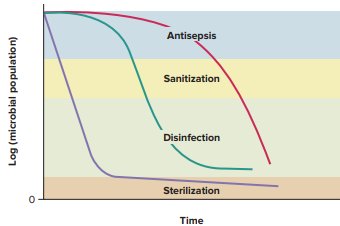
Microbial control methods are essential for public health, clinical, and industrial settings. The level of cleanliness required depends on the item and the infectious agent.
Disinfection: Reduces microbial load, including pathogens.
Sanitization: Reduces microbial load to safe levels.
Sterilization: Destroys all cells, endospores, and viruses.
Antiseptic: Reduces microbial load on living tissue.
Degerming: Physical removal of microbes.

Environmental Effects on Growth
Temperature
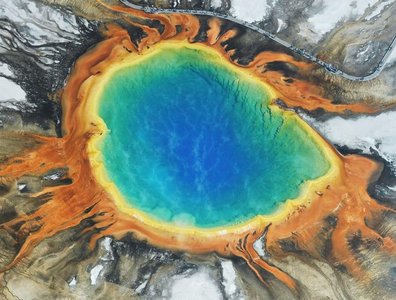
Microbes are adapted to a wide range of temperatures. Cardinal temperatures define the minimum, optimum, and maximum for growth. Adaptations allow survival in extreme environments.
Minimum: Lowest temperature for growth.
Optimum: Best temperature for growth.
Maximum: Highest temperature for growth.
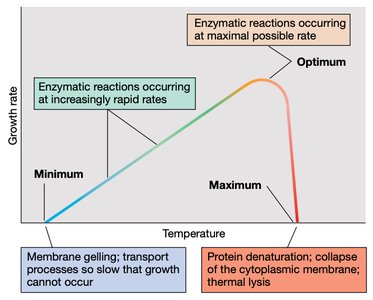
Temperature Classes of Organisms
Microbes are classified by their temperature preferences, with specific molecular adaptations for survival.
Psychrophiles: Optimum <15°C.
Mesophiles: Optimum 30–39°C.
Thermophiles: Optimum 50–70°C.
Hyperthermophiles: Optimum >80°C.
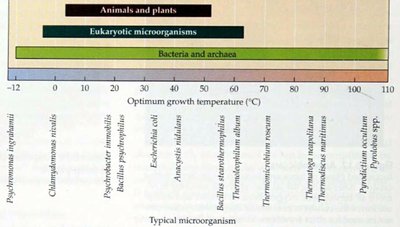
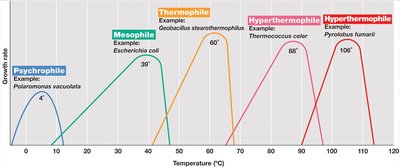
Temperature Adaptations
Microbes adapt to low and high temperatures through changes in protein structure, membrane composition, and protective molecules.
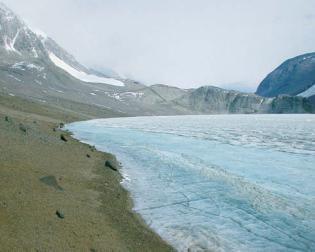
Low Temperature: Cold-stable proteins, unsaturated fatty acids, cryoprotectants.
High Temperature: Heat-stable proteins, saturated fatty acids, ether linkages, DNA stabilization.
pH
Microbes are classified by their optimal extracellular pH. Intracellular pH is maintained for macromolecular stability.
Acidophiles: Optimal pH <5.5.
Neutrophiles: Optimal pH 5.5–7.9.
Alkaliphiles: Optimal pH >8.
Oxygen
Oxygen requirements and tolerances vary among microbes. Reactive oxygen species (ROS) are detoxified by specific enzymes.
Obligate Aerobes: Require oxygen.
Facultative Anaerobes: Grow with or without oxygen.
Aerotolerant Anaerobes: Indifferent to oxygen.
Obligate Anaerobes: Oxygen is toxic.
ROS Detoxification: Superoxide dismutase, catalase, peroxidase.
Osmolarity
Water availability and solute concentration affect microbial growth. Adaptations include accumulation of compatible solutes and tolerance to high salt or sugar environments.
Water Activity (aw): Ranges from 0 (no water) to 1 (pure water).
Halophiles: Require high NaCl.
Osmophiles: Grow in high sugar environments.
Xerophiles: Grow in dry environments.
Other Environmental Factors
Microbes may also adapt to hydrostatic pressure and radiation. Barophiles thrive under high pressure, while radiophiles tolerate high levels of radiation.
Hydrostatic Pressure: Barotolerant and barophilic microbes.
Radiation: Radiococcus radiodurans is highly resistant.
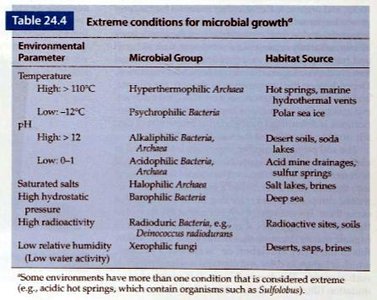
Environmental Parameter | Microbial Group | Habitat Source |
|---|---|---|
High Temperature (>110°C) | Hyperthermophilic Archaea | Hot springs, hydrothermal vents |
Low Temperature (<-12°C) | Psychrophilic Bacteria | Polar sea ice |
High pH (>12) | Alkaliphilic Bacteria, Archaea | Desert soils, soda lakes |
Low pH (0-1) | Acidophilic Bacteria, Archaea | Acid mine drainages, sulfur springs |
Saturated salts | Halophilic Archaea | Salt lakes, brines |
High hydrostatic pressure | Barophilic Bacteria | Deep sea |
High radioactivity | Radiophilic Bacteria (e.g., Deinococcus radiodurans) | Radioactive sites, soils |
Low relative humidity | Xerophilic fungi | Deserts, brines |
